
Why Does Earth Sound Like a “Mechanical Hum” in Space?
Space

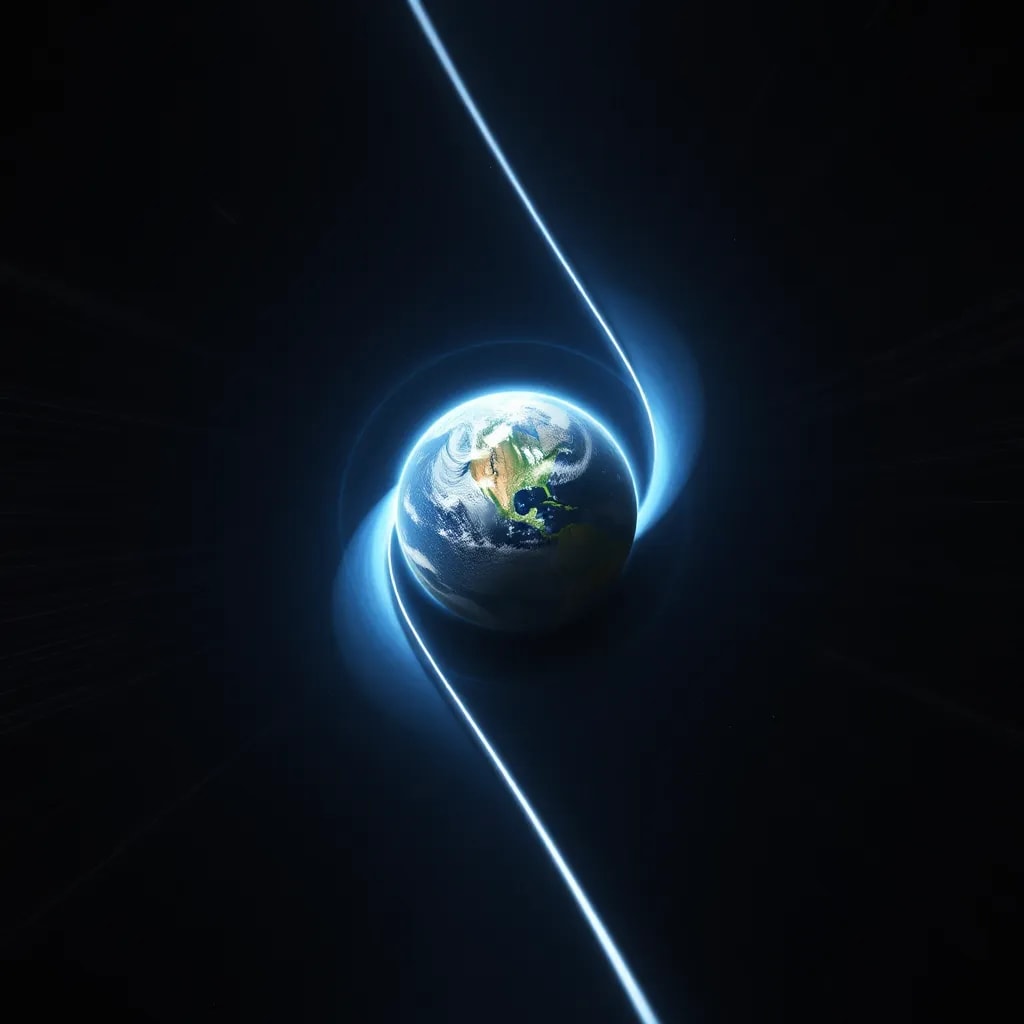
No air, no wind, no sound—just a cold, vast vacuum. And it’s true that traditional sound, as we know it, can’t travel through space since it relies on air molecules to vibrate. Yet, scientists have discovered something both eerie and fascinating: Earth actually makes a sound and it’s not a gentle whisper. It’s a deep, mechanical hum, something you’d expect to hear from a massive machine or a sci-fi spacecraft. But how is this possible? What is Earth really "saying" out there in the cosmic silence?
Space Isn’t Completely Silent
Let’s start with a little physics. Sound, in our everyday experience, travels through air as pressure waves caused by vibrating molecules. But in space, where there's no air, this kind of sound can’t exist. Instead, space is full of electromagnetic and plasma waves types of vibrations that, while not audible to our ears, can be converted into sound using special instruments.
That’s exactly what scientists have done. NASA’s Van Allen Probes and other space missions have been equipped with sensitive instruments designed to pick up these invisible waves. When converted into audio signals, these waves reveal a rich and mysterious soundscape and Earth’s voice is among the most captivating. It hums. Not melodically, but in a steady, low-frequency, mechanical kind of way. It sounds almost like the thrum of a distant engine or the background hum of a spaceship engine from a science fiction movie.
What’s Causing the Hum?
The key player behind Earth’s mechanical hum is its magnetosphere the massive magnetic field surrounding the planet that shields us from solar radiation and cosmic particles. When charged particles from the Sun (the solar wind) crash into Earth’s magnetic field, they create disturbances. These disturbances send out plasma waves, and those waves are what we can “hear” once the data is translated into sound.
But there’s more to it. Another contributor is the ionosphere, a layer of Earth’s atmosphere that’s rich in charged particles. These particles interact with magnetic fields and produce complex, dynamic patterns. One particularly interesting phenomenon is the Schumann resonance a set of natural electromagnetic waves that exist between Earth’s surface and the ionosphere. These resonate at very low frequencies, around 7.8 Hz, technically in the infrasound range. When captured and converted, they add to Earth’s low, pulsing voice.
What Does Earth Sound Like?
Imagine you’re floating next to a satellite equipped to capture these waves. What would you hear?
The recording wouldn’t be loud or melodic. Instead, you’d get a deep, droning hum, steady and a little ominous like the engine room of an alien spaceship. Sometimes, layered into the hum, you might detect crackles, subtle sighs, or pulsing beats. These aren’t added effects they’re part of the real data, capturing the complex interaction between the Earth, the Sun, and space itself.
NASA has made some of these recordings publicly available. You can listen to them online, and it’s both mesmerizing and haunting. It feels like the Earth is whispering or perhaps warning into the darkness of space.
Why Does This Matter?
Listening to Earth might seem like a poetic or artistic pursuit, but it’s rooted in hard science. These “sounds” help scientists understand how the magnetosphere functions, especially during solar storms. When the Sun releases large amounts of energy, it can send waves of charged particles toward Earth. These events, if strong enough, can interfere with satellites, damage electrical grids, and disrupt communication systems.
By monitoring the sounds Earth makes, researchers can predict solar storms, better understand space weather, and protect crucial technology.
On a larger scale, every planet and even some moons has its own electromagnetic “voice.” By listening carefully, scientists can learn about the magnetic fields of other worlds, the presence of atmospheres, or even the likelihood of liquid oceans beneath icy crusts. In some futuristic missions, planetary “sounds” might even help us detect alien life or habitability.
Is Earth a Living Machine?
Hearing Earth hum in space gives rise to a strange idea: maybe Earth is like a giant machine, always humming, always working. And in many ways, that’s not far off. The magnetic field, internal core processes, atmospheric movements, and cosmic interactions all function like intricate gears in a larger system. We live inside this machine so deeply embedded that we rarely notice its pulse.
But from a distance, the hum is undeniable. Earth sings a low song, and space listens.
Conclusion: The Voice of a Planet
Earth doesn’t produce sound in space the way a guitar or a bell does. Instead, its voice is made of electromagnetic energy mysterious and invisible until we choose to listen. That deep, mechanical hum is more than a curiosity. It’s a window into our planet’s dynamics, a tool for protecting technology, and a reminder that even in the silence of space, nothing is truly still.
One day, as we venture farther into the galaxy, we may discover new planets not by sight, but by sound planets that sing, hum, or whisper through the cosmos. And maybe, just maybe, they’ll hum back.
About the Creator
Keep reading
More stories from Holianyk Ihor and writers in Futurism and other communities.
Can We Measure the “Real” Motion of the Universe?
When we gaze into the night sky, the stars and galaxies seem still like glittering gems pinned to a cosmic dome. But in reality, the Universe is in constant motion. Our planet spins on its axis, orbits the Sun, the Sun orbits the center of the Milky Way, and the entire galaxy moves through space. Even space itself is stretching. So, a fascinating question arises: Can we actually measure the “real” motion of the Universe? And if we can relative to what?
By Holianyk Ihor6 months ago in Futurism
About Binding Prometheus
I want to start actively advocating on behalf of my own work, and the most valuable part of my canon is, without a doubt, Binding Prometheus, the play I have been working on since 2019 and only finished in 2023 as part of my MA. The play itself is an amalgamation of a million different inspirations. On one end, it evokes the Ancient Greek myth-play, deriving its own title from the earliest extant work of Western drama we have, Aeschylus’s Prometheus Bound. On the other end, it borrows significantly from the sci-fi bulwarks from over the years, namely Mary Shelley’s Frankenstein and Karel Capek’s Rossum’s Universal Robots. The play could be an episode of Black Mirror, I fear. I don’t know. I’ve only ever seen one episode of Black Mirror.
By Steven Christopher McKnight15 days ago in Futurism
United States Truffle Market Size and Forecast 2025–2033
United States Truffle Market at a Glance The United States Truffle Market is expected to reach US$ 324.59 million by 2033, rising from US$ 177.75 million in 2024, at a CAGR of 6.92% from 2025 to 2033. Growth is driven by increasing consumer demand for gourmet food, the expansion of fine-dining and luxury restaurants, rising interest in premium and exotic ingredients, innovation in truffle-based products, and the growing influence of culinary tourism.
By jaiklin Fanandish7 days ago in Futurism


Comments
There are no comments for this story
Be the first to respond and start the conversation.