
United States Truffle Market Size and Forecast 2025–2033
Luxury on the Plate: How Gourmet Demand, Culinary Tourism, and Product Innovation Are Reshaping America’s Truffle Industry

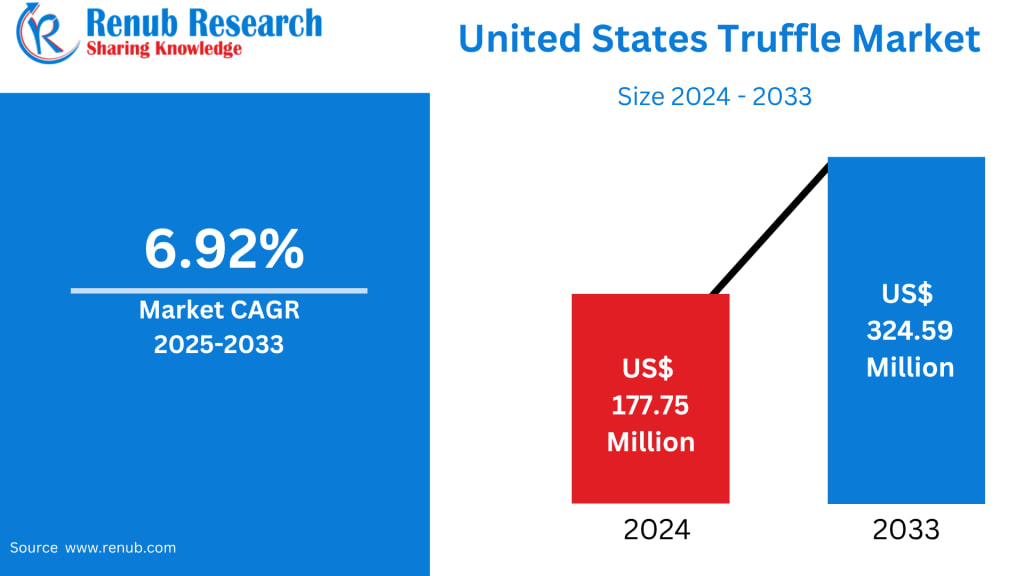
United States Truffle Market at a Glance
The United States Truffle Market is expected to reach US$ 324.59 million by 2033, rising from US$ 177.75 million in 2024, at a CAGR of 6.92% from 2025 to 2033. Growth is driven by increasing consumer demand for gourmet food, the expansion of fine-dining and luxury restaurants, rising interest in premium and exotic ingredients, innovation in truffle-based products, and the growing influence of culinary tourism.
Once considered a rare delicacy reserved for elite European kitchens, truffles are steadily entering mainstream American culinary culture. From Michelin-starred restaurants to high-end grocery aisles and e-commerce platforms, truffles and truffle-infused products are redefining luxury dining and premium home cooking across the United States.
United States Truffle Industry Overview
Truffles are rare underground fungi prized for their intense aroma, complex flavor, and culinary prestige. In the United States, the market includes black and white truffles, as well as a wide range of value-added products such as truffle oils, salts, sauces, spreads, butters, and gourmet snacks. While Europe remains a major source of fresh truffles, domestic cultivation is expanding, supported by advancements in agroforestry, orchard management, and fungal inoculation techniques.
The U.S. truffle industry operates across two major fronts: fresh truffle supply for high-end restaurants and processed truffle products for retail and home use. Fine-dining establishments, luxury hotels, gourmet retailers, and specialty food stores remain the primary demand drivers. At the same time, rising awareness of food provenance, clean labels, and premium ingredients has encouraged consumers to explore truffle-based condiments and ready-to-use gourmet products.
Limited natural availability and labor-intensive harvesting continue to position truffles as high-value ingredients. However, innovation in preservation, logistics, and product development has broadened accessibility while maintaining exclusivity. As American consumers increasingly associate truffles with indulgence, culinary sophistication, and experiential dining, the industry is evolving from a niche luxury segment into a structured premium food market.
Market Dynamics: What Is Driving Growth?
Rising Demand for Gourmet and Exotic Foods
The American food landscape is undergoing a premium transformation. Consumers are no longer satisfied with mass-produced flavors; instead, they seek distinctive, artisanal, and exotic ingredients that elevate everyday meals into memorable experiences. Truffles, with their unmistakable aroma and deep umami profile, perfectly align with this trend.
Chefs use truffles to enhance everything from pasta and risotto to eggs, steaks, and even desserts. Meanwhile, gourmet grocery stores and online marketplaces offer truffle oils, salts, spreads, and sauces that allow home cooks to experiment with luxury flavors. Culinary media, celebrity chefs, and social platforms have further glamorized truffles, reinforcing their association with exclusivity and refined taste. This cultural shift toward experiential eating continues to drive consistent demand across both restaurant and retail channels.
Expansion of Fine-Dining and Luxury Restaurant Segments
The growth of upscale dining establishments is a direct catalyst for the U.S. truffle market. High-end restaurants, boutique hotels, and premium catering services frequently use truffles as a signature ingredient to differentiate menus and justify premium pricing. Truffles are commonly paired with meat, seafood, cheese, and handmade pasta, offering diners a sensory experience that aligns with luxury dining expectations.
Seasonal truffle menus, chef-curated tasting events, and gourmet festivals further stimulate consumer interest. Cities with strong culinary reputations—such as New York, San Francisco, Los Angeles, Chicago, and Miami—act as trendsetters, popularizing truffle-infused dishes that eventually filter into mainstream food culture. As fine-dining continues to expand in metropolitan and tourist regions, it creates sustained demand for both fresh truffles and processed gourmet products.
Innovation in Truffle-Based Products and Domestic Cultivation
Product innovation has been a defining force in market expansion. Brands are introducing truffle oils, flavored salts, sauces, cheeses, butters, snack foods, and ready-to-use condiments, making truffle flavors accessible to consumers who may never purchase fresh truffles. These products also offer longer shelf life, easier distribution, and more affordable entry points into the luxury food category.
Simultaneously, domestic truffle cultivation is gaining momentum. Controlled orchard-based production reduces reliance on European imports, stabilizes supply, and improves freshness. Research in cultivation methods, inoculation techniques, and post-harvest handling has improved yield consistency and quality. Combined with e-commerce distribution and gourmet retail partnerships, innovation is broadening the market’s reach while preserving its premium positioning.
Challenges Facing the United States Truffle Market
Limited Natural Availability and High Cost
Truffles are notoriously difficult to grow. They require specific soil chemistry, climate conditions, and symbiotic relationships with host trees. Wild truffle harvesting is seasonal, labor-intensive, and dependent on trained animals, making production inherently expensive. Imported truffles add logistics, storage, and quality-control costs.
This scarcity drives premium pricing, limiting accessibility for average consumers and smaller foodservice operators. Price volatility and inconsistent supply can disrupt restaurant menus and retail inventory. For emerging domestic producers, high setup costs and long cultivation cycles present barriers to entry. As a result, while demand remains strong, affordability and availability continue to constrain mass adoption.
Perishability and Supply Chain Complexity
Fresh truffles are highly perishable, often retaining peak quality for only a short period even under optimal storage. Maintaining aroma and flavor during transportation requires temperature-controlled logistics, specialized packaging, and rapid distribution. Any delay or mishandling can result in quality degradation, spoilage, and financial loss.
Retailers and restaurants must carefully manage inventory to minimize waste, while importers face challenges related to customs clearance and transit time. These logistical hurdles increase operational costs and limit the geographic reach of fresh truffles. Although processed truffle products offer better stability, maintaining authenticity and flavor integrity remains critical for brand credibility.
State-Level Market Insights
California Truffle Market
California stands at the forefront of the U.S. truffle industry. Its strong culinary culture, affluent consumer base, and favorable climate for cultivation have positioned the state as both a major consumption and production hub. Cities such as San Francisco and Los Angeles feature high-end restaurants, gourmet retailers, and farmers’ markets that regularly showcase fresh truffles and truffle-infused products.
Northern California, in particular, has seen growth in domestic truffle farms producing black and burgundy varieties. Culinary schools, food festivals, and a strong farm-to-table ethos further enhance consumer awareness. High disposable income, health-conscious lifestyles, and appreciation for artisanal foods make California a cornerstone of the U.S. truffle market.
Texas Truffle Market
Texas represents a fast-growing market driven by urban expansion and culinary innovation in cities such as Austin, Dallas, and Houston. The rise of fine-dining restaurants, luxury hotels, and experiential food culture has increased demand for premium ingredients, including truffles.
Domestic cultivation is emerging, supported by experimentation with suitable growing regions, while European imports continue to meet high-end demand. Texas consumers are increasingly open to gourmet cooking at home, boosting sales of truffle oils, salts, and specialty sauces. With a large population, rising disposable income, and a dynamic food scene, Texas is becoming a significant contributor to national growth.
New York Truffle Market
New York is synonymous with luxury dining and gourmet food culture. Manhattan and Brooklyn host some of the nation’s most influential restaurants, specialty food stores, and culinary events. Seasonal truffle menus, chef collaborations, and gourmet festivals drive both awareness and demand.
Consumers in New York are highly receptive to premium ingredients and international food trends. Retailers and e-commerce platforms offer a wide variety of truffle-based products, while food media coverage reinforces the ingredient’s prestige. The state’s sophisticated palate, strong hospitality sector, and global culinary influence make New York one of the most important markets for truffles in the United States.
Florida Truffle Market
Florida’s truffle market benefits from tourism, luxury hospitality, and multicultural cuisine. Cities such as Miami, Orlando, and Tampa feature high-end resorts, fine-dining restaurants, and gourmet food retailers that cater to affluent travelers and residents.
Seasonal tourism boosts demand for premium dining experiences, while retirees and luxury-focused consumers drive retail sales of truffle-infused products. Emerging domestic cultivation and increasing imports ensure product availability during peak seasons. Culinary festivals and resort-driven dining trends make Florida a key market for both fresh truffles and value-added gourmet products.
Recent Developments in the U.S. Truffle Market
2024: The Truffle & Wine Co., a leading truffle producer, acquired a U.S.-based truffle farming operation to strengthen its North American presence and expand domestic production capabilities. This move reflects increasing confidence in U.S. cultivation as a long-term supply strategy.
August 2022: TRUFF partnered with Hidden Valley Ranch to launch a limited-edition Spicy Truffle Ranch dressing. By combining mainstream appeal with gourmet flavor, the collaboration introduced truffles to a broader consumer base and highlighted the commercial potential of truffle-infused packaged foods.
These developments underscore a shift toward scaling production, expanding distribution, and integrating truffles into everyday gourmet products, without diluting the ingredient’s premium identity.
Market Segmentation
By Product
Black Truffles
White Truffles
Others
By Nature
Conventional
Organic
By Form
Fresh
Processed
By Distribution Channel
B2B
B2C
By End Use
Food & Beverages
Cosmetics & Personal Care Products
Pharmaceuticals
By State (29 Viewpoints)
California, Texas, New York, Florida, Illinois, Pennsylvania, Ohio, Georgia, New Jersey, Washington, North Carolina, Massachusetts, Virginia, Michigan, Maryland, Colorado, Tennessee, Indiana, Arizona, Minnesota, Wisconsin, Missouri, Connecticut, South Carolina, Oregon, Louisiana, Alabama, Kentucky, Rest of the United States.
Competitive Landscape
All companies are analyzed across five perspectives: Company Overview, Key Persons, Recent Developments & Strategies, SWOT Analysis, and Sales Analysis.
Key Players Include:
Arotz, SA
Gazzarrini Tartufi
TruffleHunter, Inc.
Urbani Truffles
SABATINO NA LLC
LES FRÈRES JAUMARD
The Welsh Truffle Co.
PLANTIN Truffles
Truffle Hill
Competition is centered on sourcing quality, expanding domestic production, brand differentiation, and innovation in value-added products.
Outlook: Where the Market Is Headed
The U.S. truffle market is transitioning from a niche luxury segment into a structured premium food category. With a projected value of US$ 324.59 million by 2033, growth will be fueled by gourmet dining trends, domestic cultivation, product diversification, and digital retail channels.
While challenges such as high cost, perishability, and supply constraints remain, innovation in cultivation, logistics, and packaging is steadily addressing these barriers. As American consumers continue to seek experiential dining, artisanal quality, and premium flavors, truffles will remain a symbol of culinary sophistication—both in restaurants and at home.
Final Thoughts
The United States truffle market is no longer defined solely by rarity—it is now shaped by innovation, accessibility, and evolving consumer taste. As gourmet culture deepens and domestic production expands, truffles are becoming an enduring feature of America’s premium food ecosystem.
From fine-dining kitchens to gourmet grocery shelves, truffles represent more than an ingredient—they embody luxury, craftsmanship, and the future of experiential food. With strong fundamentals and a growing appetite for indulgent culinary experiences, the U.S. truffle industry is poised for a flavorful decade ahead.
About the Creator
jaiklin Fanandish
Jaiklin Fanandish, a passionate storyteller with 10 years of experience, crafts engaging narratives that blend creativity, emotion, and imagination to inspire and connect with readers worldwide.
Keep reading
More stories from jaiklin Fanandish and writers in Futurism and other communities.
United States Edible Offal Market Size and Forecast 2025–2033
United States Edible Offal Market The United States Edible Offal Market is expected to reach US$ 17 billion by 2033, rising from US$ 11.9 billion in 2024, registering a CAGR of 4.04% from 2025 to 2033. Supported by the development of value-added products and expanding retail availability, the market is being driven by rising demand for protein-rich foods, increasing consumer awareness of the nutritional benefits of organ meats, the sustainability and zero-waste movement, and the growing popularity of ethnic and traditional cuisines across the country.
By jaiklin Fanandish2 days ago in Futurism
About Binding Prometheus
I want to start actively advocating on behalf of my own work, and the most valuable part of my canon is, without a doubt, Binding Prometheus, the play I have been working on since 2019 and only finished in 2023 as part of my MA. The play itself is an amalgamation of a million different inspirations. On one end, it evokes the Ancient Greek myth-play, deriving its own title from the earliest extant work of Western drama we have, Aeschylus’s Prometheus Bound. On the other end, it borrows significantly from the sci-fi bulwarks from over the years, namely Mary Shelley’s Frankenstein and Karel Capek’s Rossum’s Universal Robots. The play could be an episode of Black Mirror, I fear. I don’t know. I’ve only ever seen one episode of Black Mirror.
By Steven Christopher McKnight11 days ago in Futurism
United States Personal Computer Market Analysis & Forecast 2025–2033
United States Personal Computer Market Overview The United States Personal Computer Market is entering a decisive growth phase as digital work habits, educational transformation, and high-performance computing needs reshape demand across the country. According to Renub Research, the market is estimated to grow substantially from US$ 47.32 billion in 2024 to US$ 88.63 billion by 2033, registering a strong Compound Annual Growth Rate (CAGR) of 7.22% during the forecast period 2025–2033.
By Aaina Oberoi4 days ago in Futurism



Comments
There are no comments for this story
Be the first to respond and start the conversation.