
Can We Measure the “Real” Motion of the Universe?
Space

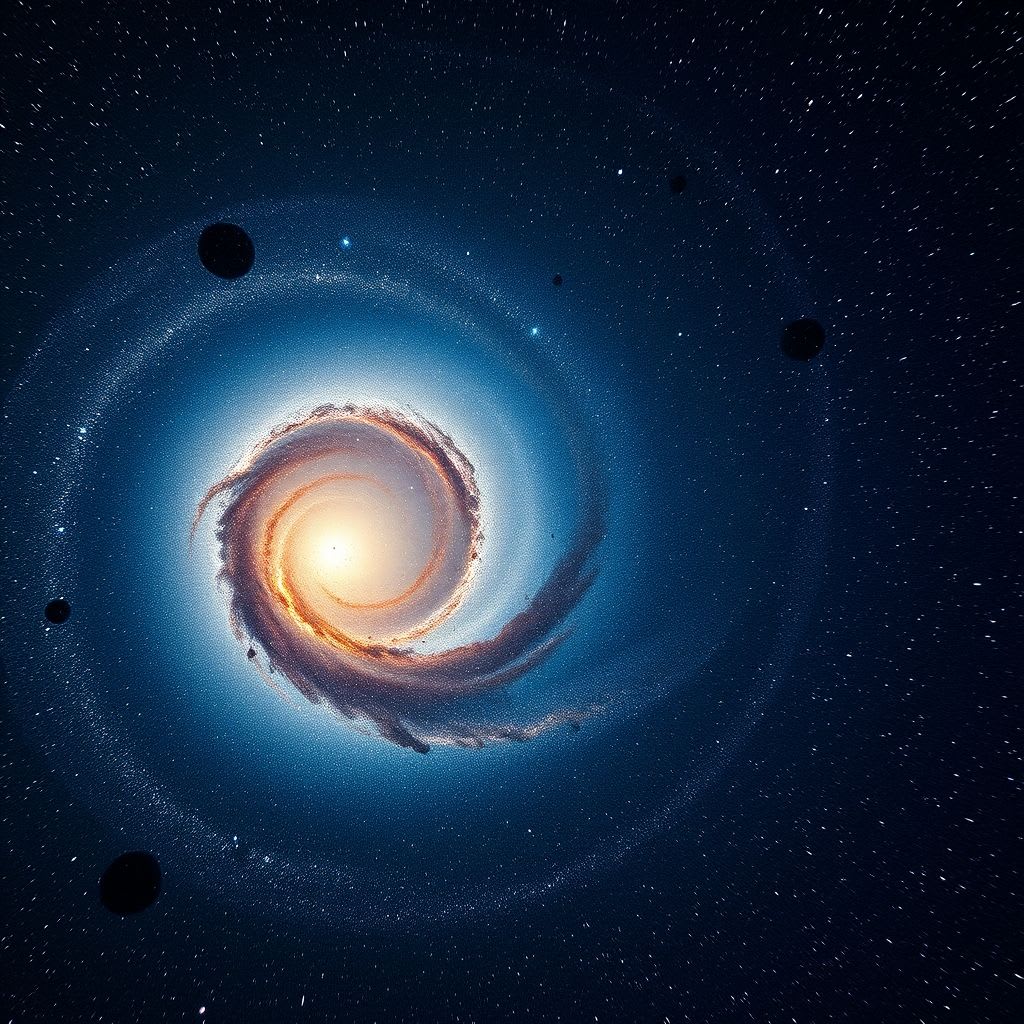
When we gaze into the night sky, the stars and galaxies seem still like glittering gems pinned to a cosmic dome. But in reality, the Universe is in constant motion. Our planet spins on its axis, orbits the Sun, the Sun orbits the center of the Milky Way, and the entire galaxy moves through space. Even space itself is stretching. So, a fascinating question arises: Can we actually measure the “real” motion of the Universe? And if we can relative to what?
What Do We Mean by “Real” Motion?
To measure motion, we need a point of reference. In physics, motion is always relative it’s the change in position of one object in relation to another. For example, Earth orbits the Sun, which in turn orbits the center of the Milky Way. Our galaxy itself barrels through the cosmos at an astonishing speed of about 600 km/s.
But if everything is moving, what is truly at rest? Is there a universal yardstick, a cosmic background against which we can measure the absolute motion of the Universe?
The Cosmic Microwave Background: Our Best Cosmic Benchmark
Surprisingly, such a reference point does exist at least a very good approximation of one. It's called the Cosmic Microwave Background (CMB): faint, ancient radiation left over from the Big Bang. This “afterglow of creation” fills the Universe and reaches us from every direction, more or less uniformly.
If Earth and our galaxy were perfectly at rest relative to the CMB, we’d see it with the same temperature from all directions. But we don’t. There’s a slight difference: a dipole anisotropy. In one direction, the CMB appears slightly warmer; in the opposite, cooler. This isn’t a flaw in the data it’s a clue. It tells us that we’re moving relative to this ancient radiation field.
This temperature difference is like a cosmic Doppler effect the same principle that makes an ambulance sound higher-pitched as it approaches and lower-pitched as it moves away. Only here, it’s not sound but light, and the shift tells us how fast and in what direction we’re moving.
How Fast Are We Going?
Based on this dipole shift in the CMB, scientists estimate that our Solar System is traveling at around 370 km/s toward the constellation Leo. Combine this with the Milky Way’s own motion through the cosmos along with local galactic clusters and flows and we find ourselves hurtling through space at roughly 600 km/s relative to the CMB.
This is one of the best ways we currently have to measure what could be called the Universe’s “real” motion or at least our motion through it, using the CMB as a reference frame.
Is the Entire Universe Moving?
Now here’s where things get even more intriguing. According to Einstein’s general theory of relativity, it’s not just galaxies moving through space it’s space itself that’s expanding. This expansion means that distant galaxies appear to recede from us, not because they’re flying away, but because the space between us is stretching.
This phenomenon is measured via redshift: the further away a galaxy is, the more its light is stretched toward the red end of the spectrum. This redshift is one of the key pieces of evidence for the expansion of the Universe.
But this isn’t “motion” in the classical sense. Galaxies aren’t cruising through a static backdrop the backdrop itself is changing. So in this sense, asking whether the entire Universe is moving becomes a far more philosophical or relativistic question.
Is There Such a Thing as Absolute Motion?
Einstein's theories revolutionized our understanding of motion. They tell us that there is no such thing as absolute rest. All motion is relative. We can only talk about speed or velocity in terms of what we’re moving relative to.
Even the CMB, while a useful and nearly universal reference point, isn’t a true absolute. It’s just the best benchmark we currently have. Beyond the observable Universe, there may be other regions, other laws, or even other movements we simply cannot detect at least for now.
But What If…?
Some physicists and philosophers have speculated about the existence of an invisible “ether” or hidden field a kind of absolute framework through which all things move. In the 19th century, the idea of the “luminiferous aether” was popular until Einstein’s work rendered it unnecessary.
Still, modern theories like quantum fields, string theory, and the idea of a multiverse keep such thoughts alive, even if purely speculative. Could there be a deeper layer to the cosmos, something we’ve yet to uncover, that allows for an absolute motion? Maybe. But for now, such ideas remain in the realm of theoretical imagination.
Final Thoughts
So, can we measure the “real” motion of the Universe? To an extent yes. We can track our galaxy’s movement relative to the cosmic microwave background and observe how space itself expands. These observations offer a kind of cosmic GPS, letting us understand our place in the grand celestial flow.
But absolute motion in the deepest sense might not even exist. In a Universe without a fixed center or an edge, movement is always in relation to something else.
We are all travelers in a cosmic sea, sailing through space on a planet that orbits a star, in a galaxy that rides the currents of an ever-expanding Universe. Whether we’ll ever find the “shore” a place of true rest remains one of the greatest mysteries of existence.
About the Creator
Keep reading
More stories from Holianyk Ihor and writers in Futurism and other communities.
Can We Grow Earth Trees on Another Planet?
The idea of growing trees beyond Earth might sound like pure science fiction something straight out of a futuristic movie. Yet, more and more scientists are seriously exploring this possibility. In a world where climate change, resource depletion, and the search for new homes beyond our planet are urgent realities, planting trees on other planets is shifting from fantasy to a realistic goal. But is it actually possible? Let’s dive in and find out.
By Holianyk Ihor6 months ago in Futurism
About Binding Prometheus
I want to start actively advocating on behalf of my own work, and the most valuable part of my canon is, without a doubt, Binding Prometheus, the play I have been working on since 2019 and only finished in 2023 as part of my MA. The play itself is an amalgamation of a million different inspirations. On one end, it evokes the Ancient Greek myth-play, deriving its own title from the earliest extant work of Western drama we have, Aeschylus’s Prometheus Bound. On the other end, it borrows significantly from the sci-fi bulwarks from over the years, namely Mary Shelley’s Frankenstein and Karel Capek’s Rossum’s Universal Robots. The play could be an episode of Black Mirror, I fear. I don’t know. I’ve only ever seen one episode of Black Mirror.
By Steven Christopher McKnight17 days ago in Futurism
Gaming Peripherals Market Size and Forecast 2025–2033
Gaming Peripherals Market: An Industry in Rapid Transformation The global gaming peripherals market is entering a decisive growth phase as gaming continues to evolve from a leisure activity into a mainstream form of digital entertainment and professional competition. According to Renub Research, the Gaming Peripherals Market is expected to grow from US$ 4.94 billion in 2024 to US$ 9.10 billion by 2033, registering a compound annual growth rate (CAGR) of 7.02% from 2025 to 2033. This expansion reflects not only the surging popularity of gaming worldwide but also the rising demand for high-performance devices such as gaming mice, mechanical keyboards, headsets, controllers, and other immersive accessories.
By Aaina Oberoi5 days ago in Futurism




Comments (1)
"This is a beautifully explained reflection on the nature of motion in our Universe. It highlights how everything is in constant movement, yet true absolute motion remains elusive. The use of the Cosmic Microwave Background as a cosmic reference point is fascinating, and the philosophical questions about absolute rest make us wonder about the deeper mysteries of existence. Thank you for sharing such an insightful perspective!"