
When the Universe Was One Second Old: The Birth of the First Hydrogen Atoms
Space

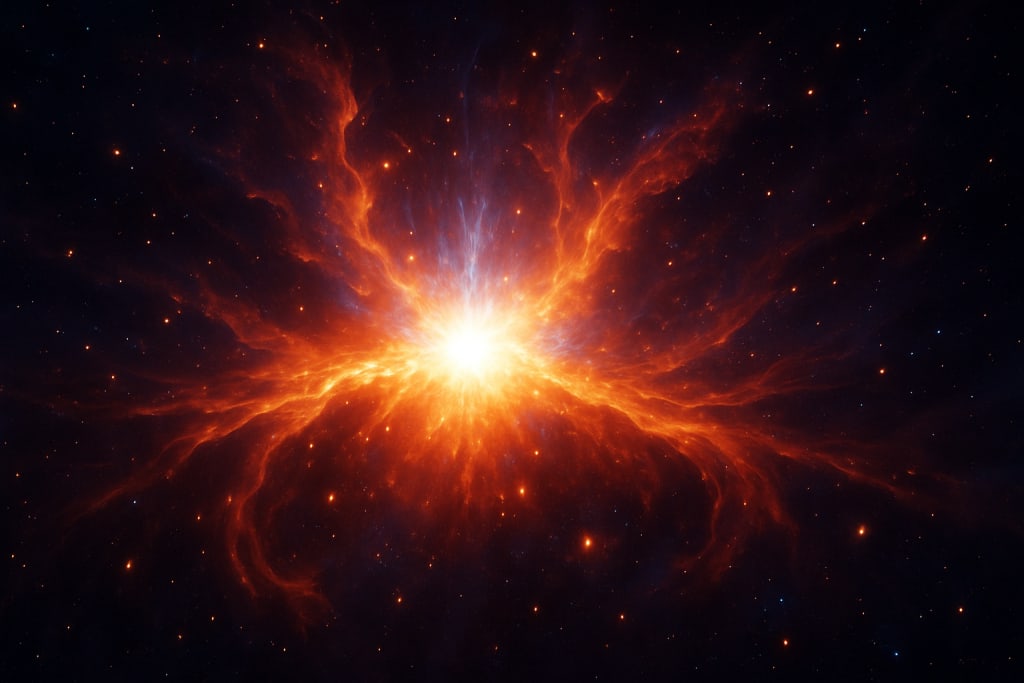
Imagine a cosmic stopwatch starting at the very instant the Universe burst into existence. It clicks once—one second has passed. Just a single heartbeat. That moment is so short that most of us wouldn’t even notice it. But on the scale of the cosmos, one second after the Big Bang marks a profound turning point. It’s the moment when the foundations of all future matter—including stars, planets, and eventually us—began to solidify.
A Universe Younger Than a Blink
The Big Bang wasn’t an explosion that hurled debris into empty space. Instead, it was the rapid expansion of space itself—an unfolding of reality from an incomprehensibly hot, dense state. At the exact moment of “time zero,” the entire Universe was smaller than an atom and hotter than anything we can imagine.
In the first fractions of a second, the laws of physics as we know them were still taking shape. Energy transformed into particles, particles collided and transformed back into energy, and everything existed in a chaotic, seething soup.
To put it into perspective:
- At 10⁻⁶ seconds (one millionth of a second), the Universe was already cooling enough for quarks to bind together into protons and neutrons. This is like having a cake completely baked after the first fraction of a millisecond.
- By 0.1 seconds, the cosmos was filled with neutrinos—tiny, elusive particles that are still flying through you every second.
And then came the moment that changed everything: the one-second mark.
One Second: Cooling, Structuring, Surviving
At one second old, the Universe had cooled from unimaginable temperatures down to 10 billion degrees Kelvin. Still hot enough to vaporize any known material—but “cool” enough for something remarkable to happen.
Until this moment, protons had been battered relentlessly by high-energy photons. Any attempt they made to hold together was instantly crushed. But as the Universe expanded and cooled, these destructive collisions became less frequent.
Now, for the first time, protons could survive.
A proton is the nucleus of what will eventually become an atom of hydrogen. So the birth of the proton is, essentially, the birth of the simplest element in the Universe. In a single second, the cosmic chaos began to transform into structure.
Why Hydrogen Came First
Hydrogen’s dominance is no coincidence. It is the simplest element—just one proton and, later, one electron. Creating heavier elements requires neutrons, but neutrons are unstable outside of atomic nuclei. They begin decaying within seconds.
That’s why forming complex atomic nuclei had to wait.
Hydrogen, however, didn’t have this problem. Its building block—the proton—is stable for almost indefinitely. Once the Universe became cool enough for protons to exist, hydrogen was inevitable.
But Not Quite Atoms Yet
It’s important to note that while the Universe had hydrogen nuclei after one second, it didn’t yet have actual atoms. The early Universe was still so hot that electrons couldn’t attach to protons. Any attempt to pair up was quickly blasted apart by the sea of energetic photons.
True hydrogen atoms—neutral, complete, and ready to become the building blocks of stars—didn’t appear until about 380,000 years later, during a period known as recombination. That’s when the Universe finally cooled enough for electrons to settle into orbit around protons.
A Universe That Breathes Hydrogen
If you look up at the night sky, nearly everything you see—the stars, the glowing nebulae, the galaxies swirling like cosmic hurricanes—exists because hydrogen formed in those first seconds.
Hydrogen fuels stars.
Hydrogen fuses into helium, releasing light.
Hydrogen creates the elements that make planets and life possible.
Think about a simple example:
The Sun, which sustains every living organism on Earth, is a giant ball of hydrogen gas undergoing nuclear fusion. Every sunrise you see, every warm day, every growing plant, every breath you take is connected to those first protons born one second after the Big Bang.
Why That First Second Still Matters
Understanding the first second after the Big Bang helps us understand why the Universe looks the way it does:
- Why the Universe is mostly hydrogen and helium
Because heavier elements required stars, and stars needed those first protons to exist.
- Why galaxies formed the way they did
Hydrogen clouds clumped under gravity, creating the first stars and stellar nurseries.
- Why chemistry is possible at all
Without stable hydrogen nuclei, there would be no atoms, no molecules, no chemistry—and no life.
A Second That Shaped Eternity
It’s astonishing to think that one second—a unit of time we barely notice—was enough for the Universe to set the stage for everything that followed. In that one second, the cosmos shifted from a wild inferno of free-floating particles to a place where matter could finally begin to take shape.
The next time you look at the stars, remember: their story began in the very first second of time, with the birth of hydrogen—the simplest, most plentiful, and most important element in the Universe.
About the Creator
Keep reading
More stories from Holianyk Ihor and writers in Futurism and other communities.
Why Astronauts Lose Up to One Liter of Fluid Per Day in Orbit
When astronauts leave Earth, their bodies begin to change almost immediately. Bones weaken, muscles shrink, and even the sense of taste can shift. But one of the most surprising effects of spaceflight happens within the first few days in orbit: astronauts start losing up to one liter of bodily fluid per day.
By Holianyk Ihor2 months ago in Futurism
About Binding Prometheus
I want to start actively advocating on behalf of my own work, and the most valuable part of my canon is, without a doubt, Binding Prometheus, the play I have been working on since 2019 and only finished in 2023 as part of my MA. The play itself is an amalgamation of a million different inspirations. On one end, it evokes the Ancient Greek myth-play, deriving its own title from the earliest extant work of Western drama we have, Aeschylus’s Prometheus Bound. On the other end, it borrows significantly from the sci-fi bulwarks from over the years, namely Mary Shelley’s Frankenstein and Karel Capek’s Rossum’s Universal Robots. The play could be an episode of Black Mirror, I fear. I don’t know. I’ve only ever seen one episode of Black Mirror.
By Steven Christopher McKnight17 days ago in Futurism
Saudi Arabia Used Car Market: Rising Demand, Digital Platforms & Pricing Trends
According to IMARC Group's latest research publication, The Saudi Arabia used car market size was valued at USD 10.2 Billion in 2025. Looking forward, IMARC Group estimates the market to reach USD 17.4 Billion by 2034, exhibiting a CAGR of 6.11% from 2026-2034.
By Abhay Rajput2 days ago in Futurism
My New Book is Finally Here
My poetry collection Beautiful and Brutal Things is done. It's actually done and finally published over 270 pages. Over a year of my life went into this book. More than a year, really. Long days at my computer, sometimes seven days a week because I couldn't stop even when I probably should have. Then two months of editing that felt harder than the writing itself. But it's finished, and I'm still standing, and the book is real.
By Tim Carmichaela day ago in BookClub



Comments
There are no comments for this story
Be the first to respond and start the conversation.