
When Galaxies Collide: The Future Cosmic Dance of the Milky Way and Andromeda
Space

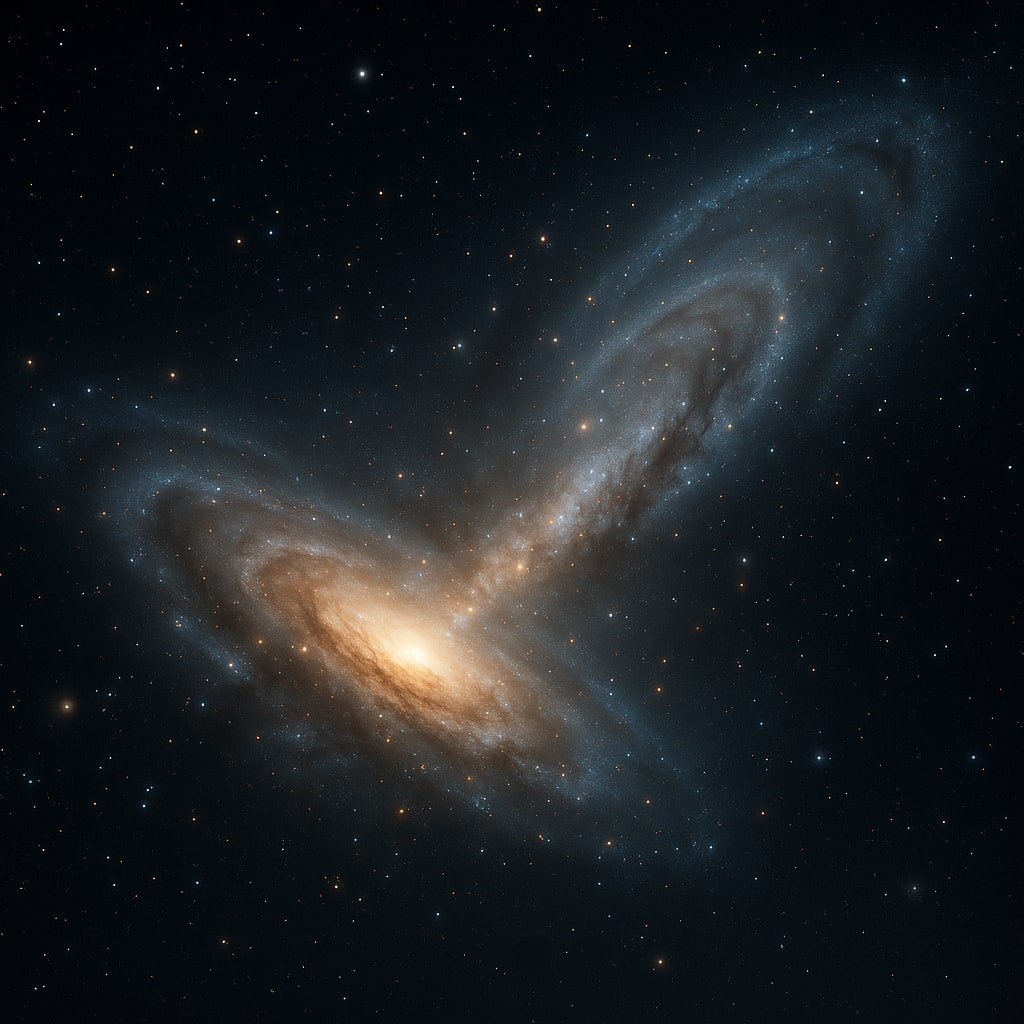
A Slow-Motion Collision in the Night
Far beyond the reach of our telescopes’ finest details, an extraordinary cosmic event is already underway. The Milky Way—our home galaxy—and its massive neighbor, the Andromeda Galaxy, are locked in a slow, gravitational embrace. Although they are separated by about 2.5 million light-years, the two galaxies are inching toward each other at a staggering 110 kilometers per second.
That might sound fast, but on a galactic timescale, it’s more like a slow dance. Astronomers estimate that in roughly four billion years, these two colossal star cities will collide and merge, creating an entirely new galaxy.
This isn’t science fiction. It’s destiny—written in gravity.
A Cosmic Collision That’s Not Really a Crash
When people hear “galaxy collision,” they often imagine a violent crash of stars and worlds exploding in chaos. But in truth, the space between stars is vast—so vast that direct collisions between stars are incredibly rare.
Instead of smashing into each other, the Milky Way and Andromeda will gracefully merge, their gravitational forces tugging and stretching each other’s spiral arms into long, flowing streams of stars and gas. Picture two whirlpools in an ocean swirling together—beautiful, chaotic, but not destructive on a human scale.
Over hundreds of millions of years, their structures will twist and distort, until eventually, they form a single, giant, elliptical galaxy. Astronomers have already given it a name: Milkomeda—a poetic blend of “Milky Way” and “Andromeda.”
What Will Happen to the Sun (and Us)
By the time this happens, the Sun will still be shining, though it will be nearing the end of its stable life. The collision itself won’t tear our solar system apart, but gravity will shuffle it around. Some models suggest the Sun might be flung to the outskirts of the new galaxy; others predict it could drift closer to the dense galactic core.
If there are any distant descendants of humanity—or whatever intelligent life follows us—they might look up at the night sky and witness the greatest light show in cosmic history. Imagine the Andromeda Galaxy growing larger and larger over millions of years until it dominates the heavens, filling the sky with billions of shimmering stars.
It would be a view unlike anything we can comprehend today—a living demonstration of the universe’s power and beauty.
How We Know What’s Coming
This isn’t guesswork or wild speculation. The prediction of the Milky Way–Andromeda collision comes from precise data gathered by the Hubble Space Telescope and the European Space Agency’s Gaia mission. These observatories measure the exact movements of stars and galaxies with stunning accuracy.
By tracking how fast Andromeda’s stars are moving and in what direction, astronomers have determined that the galaxy is on a direct collision course with us. Computer simulations show the first close pass occurring in about 3.8 to 4.5 billion years, followed by a long, spiraling merger that will finish after six to seven billion years.
Andromeda isn’t just coming toward us—it’s also slightly tilted, meaning the galaxies won’t collide head-on but will instead swirl around each other before fully combining. It’s the universe’s slowest waltz.
Black Holes, Fireworks, and a New Beginning
Both the Milky Way and Andromeda harbor supermassive black holes at their centers—each containing millions of times the mass of the Sun. When the galaxies merge, these two monsters will spiral inward, eventually colliding in a spectacular burst of gravitational waves that will ripple through space-time itself.
Meanwhile, vast clouds of gas and dust will compress under the turbulence of the merger, sparking new waves of star formation. The night sky of the future Milkomeda will blaze with young, blue stars and glowing nebulae—a galactic rebirth on a grand scale.
It may be the end of the Milky Way as we know it, but it will also mark the beginning of something magnificent.
The Bigger Picture
The idea of galaxies colliding might sound unique, but it’s actually a natural part of cosmic evolution. Nearly every large galaxy has grown through mergers and collisions. The universe is a vast, dynamic ecosystem where destruction and creation are inseparably linked.
In fact, when we look through telescopes at distant galaxies, we often see younger universes filled with ongoing mergers—streams of stars, twisted shapes, and glowing arcs that tell the story of endless transformation.
Our own future merger is simply the next chapter in that cosmic narrative.
The Universe Remains Beautiful
When the Milky Way and Andromeda finally become one, the Earth may no longer exist—the Sun will have grown hotter, likely stripping our planet of its oceans and atmosphere. But somewhere in the vastness of Milkomeda, new solar systems will form, new planets will spin into orbit, and perhaps new beings will look to the sky and wonder about their place in the cosmos.
In the grand design of the universe, collisions create opportunity. Stars are born, elements mix, and new worlds take shape. What seems like an ending is, in truth, the start of another cosmic story—written across the heavens in light and time.
About the Creator
Keep reading
More stories from Holianyk Ihor and writers in Futurism and other communities.
The Coolest Star in the Universe: WISE 1828+2650, the “Room-Temperature” Star
When we think of a star, we imagine something blazing hot — a roaring sphere of plasma like our Sun, burning at thousands of degrees and flooding space with light. But the cosmos loves to challenge our assumptions. Somewhere out there, about 40 light-years away, floats a celestial oddball that defies everything we expect from a “star.”
By Holianyk Ihor3 months ago in Futurism
About Binding Prometheus
I want to start actively advocating on behalf of my own work, and the most valuable part of my canon is, without a doubt, Binding Prometheus, the play I have been working on since 2019 and only finished in 2023 as part of my MA. The play itself is an amalgamation of a million different inspirations. On one end, it evokes the Ancient Greek myth-play, deriving its own title from the earliest extant work of Western drama we have, Aeschylus’s Prometheus Bound. On the other end, it borrows significantly from the sci-fi bulwarks from over the years, namely Mary Shelley’s Frankenstein and Karel Capek’s Rossum’s Universal Robots. The play could be an episode of Black Mirror, I fear. I don’t know. I’ve only ever seen one episode of Black Mirror.
By Steven Christopher McKnight18 days ago in Futurism
Surgical Stapler Market: Procedure Efficiency & Growth Outlook
According to IMARC Group's latest research publication, The global surgical stapler market size reached USD 4.8 Billion in 2024. Looking forward, IMARC Group expects the market to reach USD 8.5 Billion by 2033, exhibiting a growth rate (CAGR) of 6.27% during 2025-2033.
By James Whitmanabout 10 hours ago in Futurism


Comments
There are no comments for this story
Be the first to respond and start the conversation.