
When Earth Was a Giant Snowball: The Chilling Story of a Frozen Apocalypse
Space

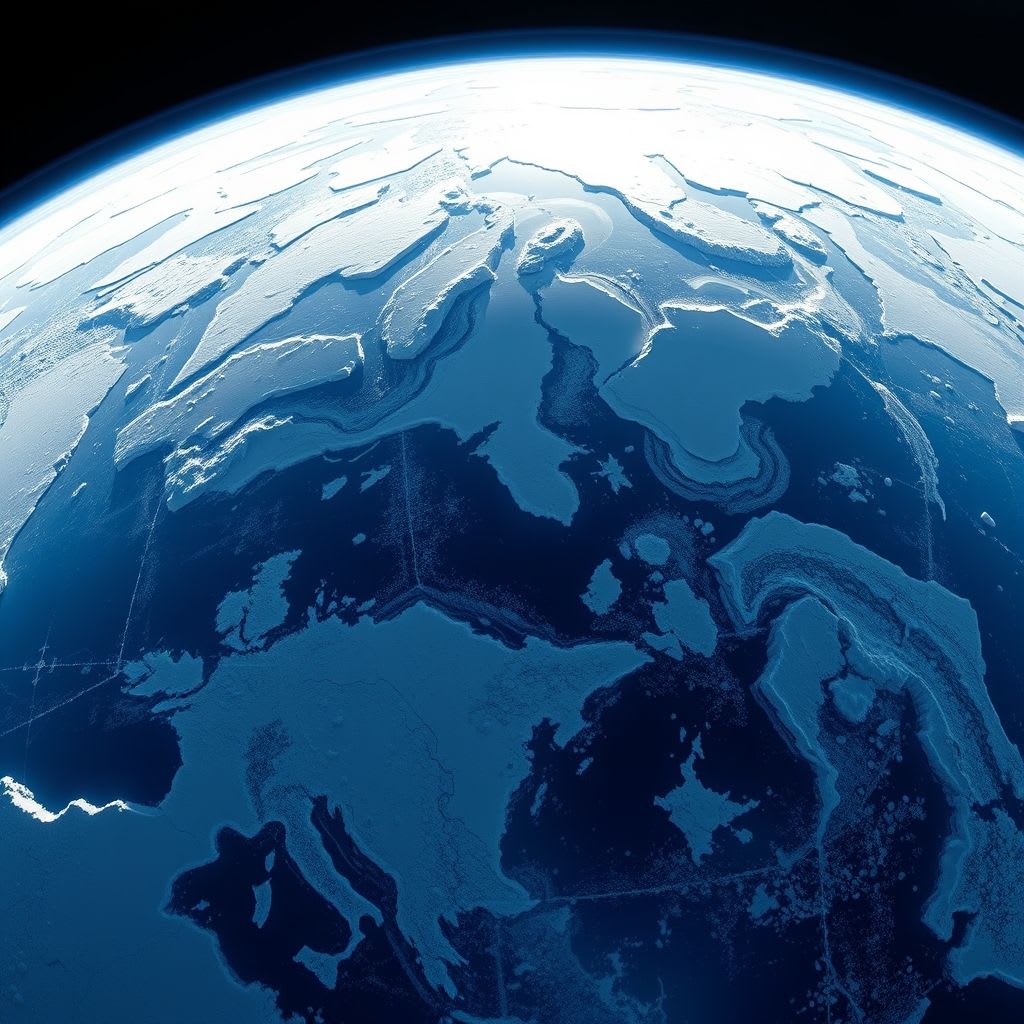
Imagine Earth completely encased in ice from the poles all the way to the equator. No green forests, no blue oceans, just a vast, frozen wasteland reflecting sunlight into the empty silence of space. It may sound like science fiction, but this scenario was a chilling reality hundreds of millions of years ago. Welcome to one of the most mysterious and extreme chapters in Earth’s history: the Snowball Earth era.
What Was Snowball Earth?
"Snowball Earth" is the name given to a series of ancient glaciation events when scientists believe nearly the entire planet was covered in ice. These global freezes are thought to have occurred at least twice during the Neoproterozoic Era, around 720 million and 635 million years ago. This frozen age came right before the Cambrian Explosion, when complex life suddenly flourished in Earth's oceans.
How Did the Planet Freeze Over?
To turn Earth into a giant snowball, something had to trigger a dramatic drop in global temperatures. Scientists have proposed several possible causes:
- A decrease in greenhouse gases: A significant reduction in atmospheric carbon dioxide could have led to rapid cooling.
- A weaker Sun: During this time, the Sun emitted less energy than it does today.
- Continental drift: The supercontinents of that era were clustered around the equator. This positioning may have accelerated weathering of rocks, pulling CO₂ from the atmosphere.
- Positive feedback loop: As ice spread, it reflected more sunlight (a phenomenon known as albedo), cooling the Earth even further and encouraging even more ice growth.
The result? A full planetary deep freeze a true snowball Earth.
What Was Life Like on a Frozen World?
Now picture oceans covered in ice up to several kilometers thick. Beneath that ice, water remained liquid thanks to Earth’s internal heat. But on the surface, a dark and frigid silence reigned. Most photosynthetic organisms the base of the food chain were wiped out or barely clung to survival.
Yet life didn't disappear entirely. Microorganisms likely survived in underwater volcanic vents, geothermal hot springs, or in small patches of open water similar to polynyas in today’s Arctic. These tiny sanctuaries became natural laboratories where life endured the deep freeze and prepared for the evolutionary leap to come.
How Did Earth Thaw Out?
The planet didn’t stay frozen forever. Deep beneath the icy shell, volcanoes continued to erupt. These eruptions spewed carbon dioxide into the atmosphere, but the ice prevented it from being absorbed by rocks and oceans so CO₂ slowly built up.
Eventually, the greenhouse effect kicked in with incredible force. When atmospheric carbon levels reached a critical point, global temperatures skyrocketed. Ice began to melt first at the equator, then everywhere and Earth’s surface transformed from a frozen desert into a warm, wet world again. Some researchers believe temperatures may have risen by tens of degrees Celsius in a relatively short geological time.
From Ice to Life: A Surprising Turn
Ironically, the Snowball Earth era an age of cold, death, and near-extinction may have set the stage for an explosion of life. As glaciers retreated, they left behind oceans rich in nutrients. The extreme conditions might have forced surviving organisms to evolve new survival strategies, paving the way for more complex forms of life.
Just 50 to 100 million years later, Earth experienced the Cambrian Explosion, a time when most major groups of animals first appeared. The ancestors of today’s fish, insects, and even humans may owe their existence to the apocalyptic cold snap that came before.
What Can We Learn From a Frozen Past?
The Snowball Earth theory isn’t just a fascinating piece of scientific history it’s a cautionary tale. It shows how dramatic climate shifts can reshape the entire planet, extinguish species, and change the course of evolution.
Today, we're facing a very different kind of climate crisis a rapid warming caused by human activity. Studying ancient climate events like Snowball Earth helps scientists understand how Earth's systems respond to extreme changes, and what might happen if we push them too far.
Final Thoughts: A Planet of Extremes
Snowball Earth was not a myth, nor a minor ice age it was a full planetary apocalypse, where ice smothered the world and only the hardiest life survived. But from that silence and stillness came the seeds of incredible biodiversity.
Now, as we look out at melting ice caps and rising seas, it’s worth remembering that our planet has always been a world of extremes frozen or fiery, barren or blooming. And in the quiet, icy past of Snowball Earth, the future of life was already beginning to take shape.
About the Creator
Keep reading
More stories from Holianyk Ihor and writers in Futurism and other communities.
Why Does Night Exist? And What If It Didn’t?
Every day ends the same way the next one begins with the arrival of night. The sun sets, the sky darkens, and we barely question it. Night just happens, right? But have you ever stopped to wonder: why does night even exist? And more intriguingly what would happen if there were no night at all?
By Holianyk Ihor6 months ago in Futurism
About Binding Prometheus
I want to start actively advocating on behalf of my own work, and the most valuable part of my canon is, without a doubt, Binding Prometheus, the play I have been working on since 2019 and only finished in 2023 as part of my MA. The play itself is an amalgamation of a million different inspirations. On one end, it evokes the Ancient Greek myth-play, deriving its own title from the earliest extant work of Western drama we have, Aeschylus’s Prometheus Bound. On the other end, it borrows significantly from the sci-fi bulwarks from over the years, namely Mary Shelley’s Frankenstein and Karel Capek’s Rossum’s Universal Robots. The play could be an episode of Black Mirror, I fear. I don’t know. I’ve only ever seen one episode of Black Mirror.
By Steven Christopher McKnight18 days ago in Futurism
Egypt Textiles and Apparel Market: Fashion Demand, Production Expansion & Industry Trends
According to IMARC Group's latest research publication, Egypt textiles and apparel market size reached USD 23,538.3 Million in 2024. The market is projected to reach USD 36,924.5 Million by 2033, exhibiting a growth rate of 5.13% during 2025-2033.
By Abhay Rajput4 days ago in Futurism


Comments
There are no comments for this story
Be the first to respond and start the conversation.