
When And Where To See A Six-Planet Parade This Weekend, Last Until 2028
A rare celestial spectacle will light up August mornings with a dazzling lineup of planets, the moon, and more—here’s how to catch it before it disappears for years.

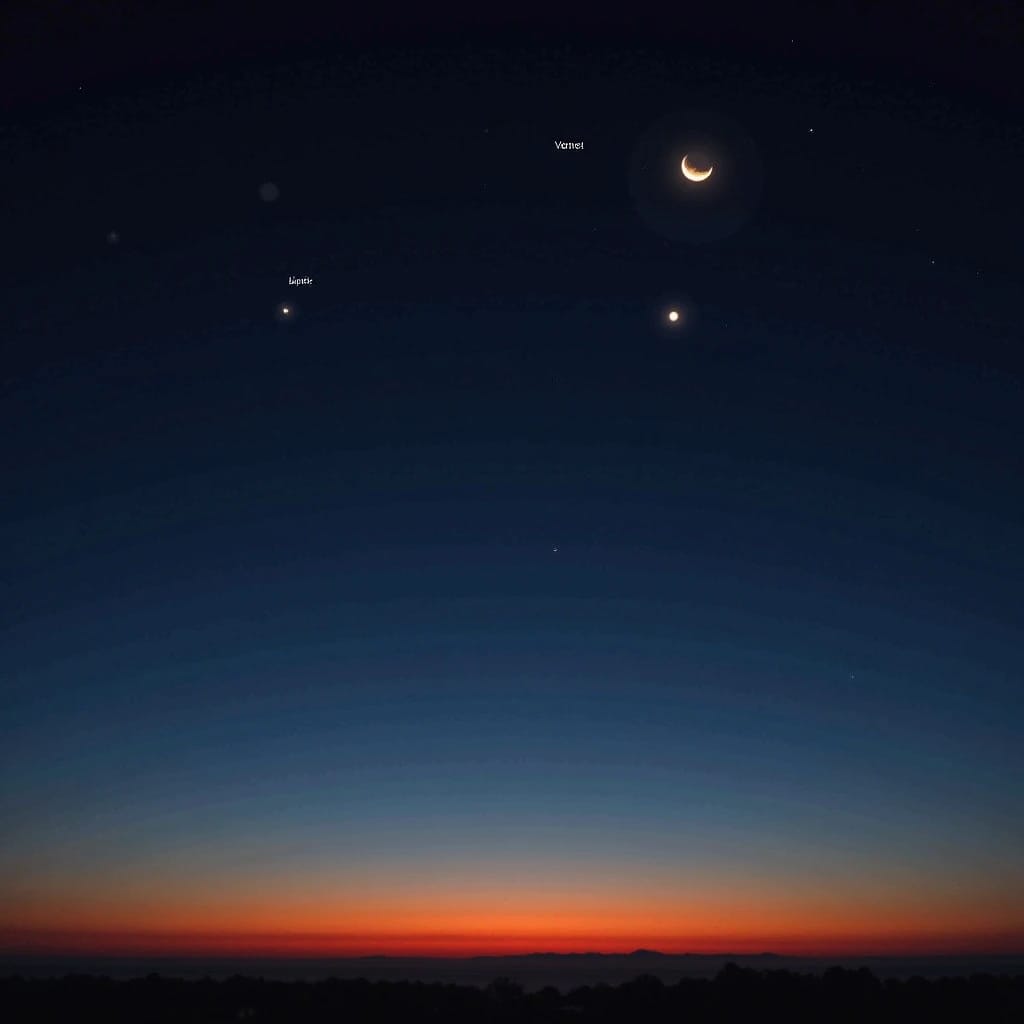
Key About This Parade
Venus and Jupiter will shine close to each other above due east, with Mercury becoming visible beneath them closer to sunrise.
Saturn is high in the south, with Neptune just above. Uranus is high in the southeast, but like Neptune, requires a telescope to see. You don’t need anything but your naked eyes to see this “planet parade.”
Joining the “planet parade” all week is a waning crescent moon, which will get slimmer on each successive morning and pass close to the Venus, Jupiter and Mercury later in the week.
Mars is the solitary planet left in the evening sky, so isn’t part of this “planet parade.”
This weekend, the early morning sky will host a rare and beautiful astronomical event: a six-planet parade that won’t return until 2028.
For five consecutive mornings starting Saturday, August 17, anyone willing to rise before the sun will be rewarded with a breathtaking view in the eastern sky—a lineup featuring Jupiter, Venus, Mercury, and the waning crescent moon, with Uranus and Neptune also in position, though too faint to be seen without a telescope.
The parade’s peak will arrive on Wednesday, August 20, when the moon, reduced to a slender crescent, will appear to cozy up to the brilliant Venus in a striking close encounter.
What Is a Planet Parade?
While some media outlets might call it a “planetary alignment,” astronomers prefer the term planet parade—and for good reason. In reality, the planets aren’t perfectly lined up in space. Instead, they appear in a line from our perspective here on Earth, spread out along the ecliptic—the plane of our solar system.
Think of it this way: if the solar system were a fried egg, the sun would be the yolk at the center, and the planets would orbit around it along the egg white. A true alignment, or syzygy, is rare and usually occurs during events like eclipses. In a planet parade, the visual alignment is an illusion created by perspective, but that doesn’t make it any less spectacular to witness.
The Week’s Viewing Highlights
The best time to see this event is about an hour before sunrise each morning. Here’s what you can expect on each day of the parade:
Saturday, Aug. 17: The moon will be a 36%-lit crescent, shining high above Jupiter and Venus. Mercury will be visible low on the horizon, while Saturn glows high in the south.
Sunday, Aug. 18: The crescent moon slims to 26% illumination and moves closer to the planets, glowing faintly with Earthshine—sunlight reflecting from Earth’s surface back onto the moon.
Monday, Aug. 19: Mercury reaches its highest point in the morning sky. The moon, now 16%-lit, will form a gentle arc with Venus and Jupiter.
Tuesday, Aug. 20: The star of the week—literally. A 9%-lit crescent moon will appear right next to Venus, with Mercury shining faintly below and Jupiter perched above.
Wednesday, Aug. 21: A mere 4%-lit crescent moon will hover just above the horizon, close to Jupiter, Venus, and Mercury—and in the same frame as the Beehive Cluster, a glittering group of stars in the constellation Cancer.
Who’s Invited to the Parade?
Four planets—Jupiter, Venus, Mercury, and Saturn—will be visible to the naked eye.
Venus will be the brightest, easily spotted even as the sky begins to lighten.
Jupiter, sitting above Venus, will also be unmistakable.
Mercury will be trickier—low in the east and best viewed with an unobstructed horizon.
Saturn will shine high in the southern sky.
The other two participants, Uranus and Neptune, are far too faint for unaided eyes. Uranus is high in the southeast, Neptune above Saturn—both requiring at least binoculars or a telescope.
Mars, meanwhile, will be absent from the festivities, lingering alone in the evening sky.
Vast Distances, Tiny Apparent Sizes
Although the planets look close together, they are separated by hundreds of millions of miles. This week:
Mercury is 80 million miles from Earth.
Venus is 118 million miles away.
Jupiter is 548 million miles from us—almost five times farther than Venus.
Saturn is even more distant at 888 million miles.
These staggering distances remind us that a planet parade is a line-of-sight illusion, not a cosmic gathering.
Why This One Matters
This will be the last six-planet parade until 2028, and its timing makes it particularly photogenic. The moon’s changing position and slim crescent shape add beauty to the display, especially during its close pass by Venus. For photographers, these mornings offer opportunities to capture multiple planets alongside the moon and, in some cases, deep-sky objects like the Beehive Cluster.
What’s Next in the Sky
The parade wraps up on Thursday, Aug. 21, when Mercury disappears into the sun’s glare. After that, Saturn, Venus, and Jupiter will remain visible in the pre-dawn sky.
Mark your calendars for August 31, when Venus will appear alongside the Beehive Cluster—a treat for binocular users. And looking further ahead, September 21, 2025, will bring Saturn at opposition. With Earth directly between Saturn and the sun, the planet will shine brighter and larger than at any other time that year, visible all night long.
This weekend’s six-planet parade is a fleeting gift for stargazers—one that rewards an early alarm clock with a sky full of worlds. Whether you’re an experienced astronomer or simply someone who loves a beautiful sunrise, this is an event you won’t want to miss.
About the Creator
Muhammad Sabeel
I write not for silence, but for the echo—where mystery lingers, hearts awaken, and every story dares to leave a mark
Keep reading
More stories from Muhammad Sabeel and writers in Futurism and other communities.
The ‘9-9-6 Work Schedule’ Could Be Coming To Your Workplace Soon
AI startups are glorifying exhaustion for the sake of productivity, implementing the “9-9-6 work schedule” in an attempt to “win the AI race," according to recent reports. Tekendra Parmar, writing in last month’s Inc., says, “In a bid to outpace Chinese rivals, some AI startups are adopting that country’s grueling “9-9-6 work schedule.” But the future of work might actually lie in working less, not more.” Parmar adds that the “9-9-6 work schedule” could actually hurt instead of help productivity.
By Muhammad Sabeel7 months ago in Futurism
AI Direct Selling Market to hit USD 625.1 billion by 2034
AI Direct Selling Market Overview The global AI Direct Selling Market is projected to reach approximately USD 625.1 Billion by 2034, increasing from nearly USD 14.5 Billion in 2024. This represents a significant CAGR of 45.7% during the forecast period from 2025 to 2034. Market growth is being driven by the increasing integration of artificial intelligence into direct selling operations, enabling companies to automate customer engagement, personalize product recommendations, and improve distributor productivity.
By Roberto Crum5 days ago in Futurism
AI Inference Server Market to Hit Nearly USD 133.2 Billion By 2034
AI Inference Server Market Overview The global AI Inference Server Market is projected to reach approximately USD 133.2 Billion by 2034, rising from about USD 24.6 Billion in 2024. This expansion represents a strong CAGR of 18.40% during the forecast period from 2025 to 2034. Market growth is being driven by the rapid adoption of artificial intelligence workloads across enterprises, cloud platforms, and edge computing environments.
By Roberto Crum5 days ago in Futurism




Comments
There are no comments for this story
Be the first to respond and start the conversation.