
What If Earth Is the Only Habitable Planet?
Space

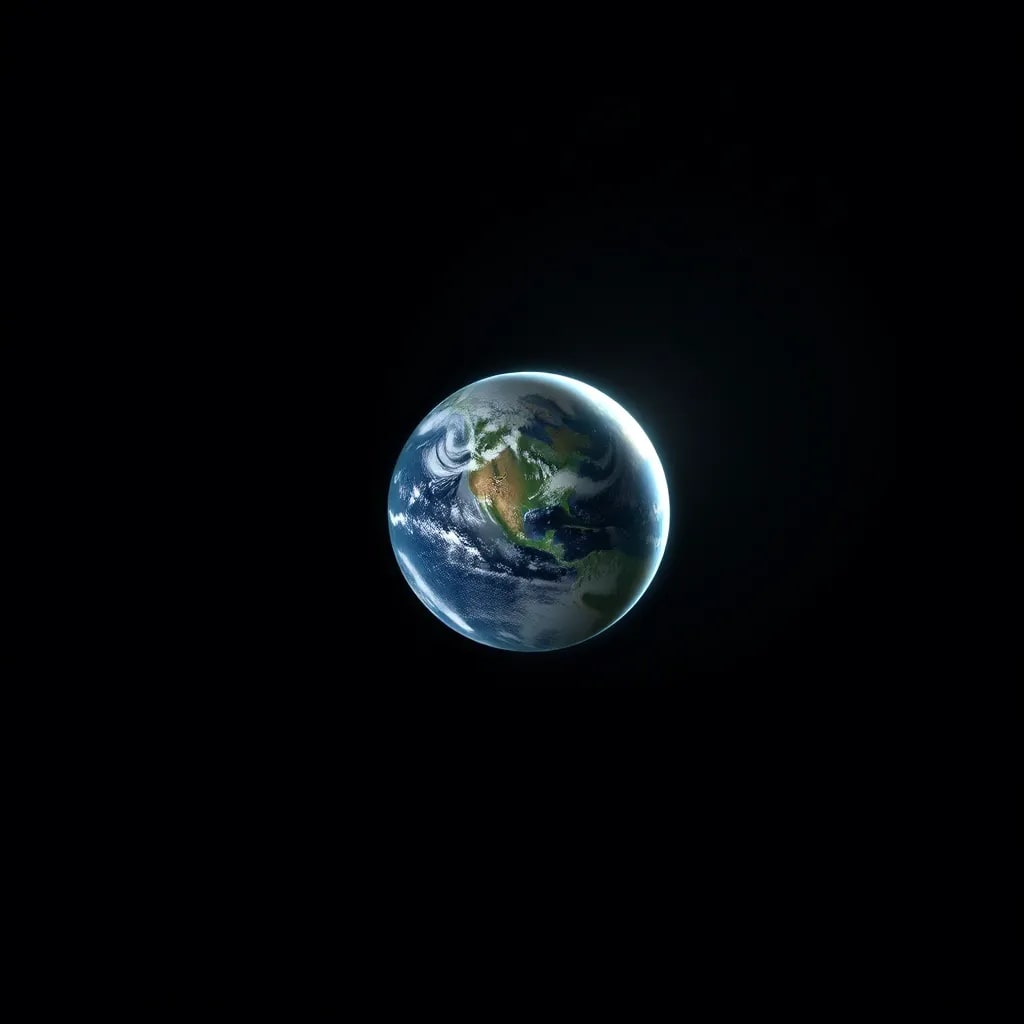
Loneliness Among the Stars and the Uniqueness of Our Blue World
When we gaze into the night sky, the stars seem endless millions of tiny lights twinkling like cosmic invitations. Each one is a distant sun, many with planets orbiting them. In recent decades, astronomers have discovered thousands of exoplanets, and quite a few lie in the so-called "habitable zone" the not-too-hot, not-too-cold region where liquid water could exist.
And yet, one haunting question remains:
What if Earth is the only habitable planet in the entire universe?
A Unique Accident or a Cosmic Rule?
At first glance, the idea that we're alone feels almost impossible. The universe is unimaginably vast with over 2 trillion galaxies and more stars than grains of sand on every beach on Earth. Surely, somewhere out there, life must have taken hold?
And yet… silence.
No messages, no signals, no signs. Just the cold, quiet hum of space. One possibility is deeply unsettling: perhaps life especially intelligent life simply doesn’t exist elsewhere.
Maybe the precise conditions that led to life on Earth are so incredibly rare, so wildly specific, that they have never been repeated not even once across the entire cosmos.
The Fragile Balance of Life
Life on Earth is possible because of a perfect balance of conditions. Change even one variable, and life might never have emerged:
- We're just the right distance from the Sun.
- Our axis is tilted just enough to give us seasons but not chaos.
- Earth's magnetic field shields us from deadly cosmic radiation.
- Liquid water flows on our surface.
- Plate tectonics help regulate the atmosphere.
- Our atmosphere contains oxygen and ozone, yet isn't too thick or too thin.
This tightrope walk of conditions is astonishing. On millions of other planets, temperatures might swing from deadly heat to bone-chilling cold. Some worlds might be scorched, others frozen, or entirely lacking in atmosphere. And even if some form of microbial life exists out there, intelligent, complex life may be unimaginably rare or even unique to Earth.
The Fermi Paradox: Where Is Everyone?
In the 1950s, physicist Enrico Fermi asked a simple, brilliant question: “If extraterrestrial civilizations exist, then where is everybody?”
This question now known as the Fermi Paradox still puzzles scientists and thinkers today. One of the possible answers is blunt and bleak: there’s no one else.
Perhaps intelligence is not the inevitable outcome of evolution. Maybe it’s a fluke, an evolutionary accident. Or perhaps intelligent species self-destruct before mastering interstellar travel a grim possibility mirrored in our own fragile relationship with nuclear weapons and climate change.
The Emotional and Philosophical Weight
If Earth truly is the only world with life, then our planet becomes a sacred anomaly a shimmering jewel in an otherwise lifeless expanse. Every forest, every bird, every child is part of a cosmic miracle that has never occurred elsewhere.
This realization should inspire us to treat life as sacred. If no other world hosts anything like us, then our responsibility to protect life grows exponentially. We're not just another species we're possibly the only species capable of pondering existence, writing poetry, building telescopes, or dreaming about the stars.
What This Means for Humanity
- Environmental Responsibility
We have no backup planet. Earth isn’t just our home it may be the only home for life in the universe. Every act of pollution or destruction takes on greater significance.
- Motivation for Space Exploration
If we're alone, the burden of spreading life beyond Earth may rest solely on us. Space exploration becomes not just a scientific goal but a biological mission to plant the seeds of life across the stars.
- An Ethical Challenge
We may be the only conscious observers in the universe. That gives us a moral obligation to preserve our planet, our cultures, and the web of life that evolved with us.
Still, Hope Remains
Despite the silence of the stars, we keep searching. We build powerful telescopes, send robotic explorers to distant moons, and broadcast signals into deep space. Maybe we're just too early maybe civilizations take billions of years to arise, and we’re among the first.
Or maybe, on a distant world orbiting another sun, someone is looking at their sky and wondering the same thing.
And even if we are truly alone if Earth is the only cradle of life that doesn't diminish our meaning. It amplifies it. We are the universe looking at itself, understanding itself, and perhaps, someday, reaching beyond itself.
In the end, being alone in the cosmos might not be a tragedy. It might be the greatest call to action in history:
To protect life, to explore, and to carry the light of consciousness into the dark, waiting void.
About the Creator
Keep reading
More stories from Holianyk Ihor and writers in Futurism and other communities.
The Simulation Hypothesis: Are We Living in the Matrix?
What if everything around you every sound, sensation, and memory is part of a sophisticated computer program? Once considered the domain of science fiction, the idea that our universe might be a virtual simulation is now seriously discussed by philosophers, physicists, and computer scientists. What was once the premise of a blockbuster film like The Matrix has grown into one of the most provocative theories of our time. But what exactly is the simulation hypothesis, and why are so many brilliant minds taking it seriously?
By Holianyk Ihor6 months ago in Futurism
About Binding Prometheus
I want to start actively advocating on behalf of my own work, and the most valuable part of my canon is, without a doubt, Binding Prometheus, the play I have been working on since 2019 and only finished in 2023 as part of my MA. The play itself is an amalgamation of a million different inspirations. On one end, it evokes the Ancient Greek myth-play, deriving its own title from the earliest extant work of Western drama we have, Aeschylus’s Prometheus Bound. On the other end, it borrows significantly from the sci-fi bulwarks from over the years, namely Mary Shelley’s Frankenstein and Karel Capek’s Rossum’s Universal Robots. The play could be an episode of Black Mirror, I fear. I don’t know. I’ve only ever seen one episode of Black Mirror.
By Steven Christopher McKnight14 days ago in Futurism
United States Residential Remodeling Market Size and Forecast 2025–2033
Introduction The United States residential remodeling market has entered a transformative phase, driven by evolving homeowner lifestyles, rising property values, and an increased emphasis on sustainability and modernization. According to Renub Research, the United States Residential Remodeling Market is expected to reach US$ 804.02 billion by 2033, up from US$ 531.34 billion in 2024, growing at a CAGR of 4.71% between 2025 and 2033. This steady expansion reflects the essential role of remodeling in maintaining and enhancing the nation’s aging housing stock while aligning homes with contemporary living standards.
By Renub Researcha day ago in Futurism



Comments
There are no comments for this story
Be the first to respond and start the conversation.