

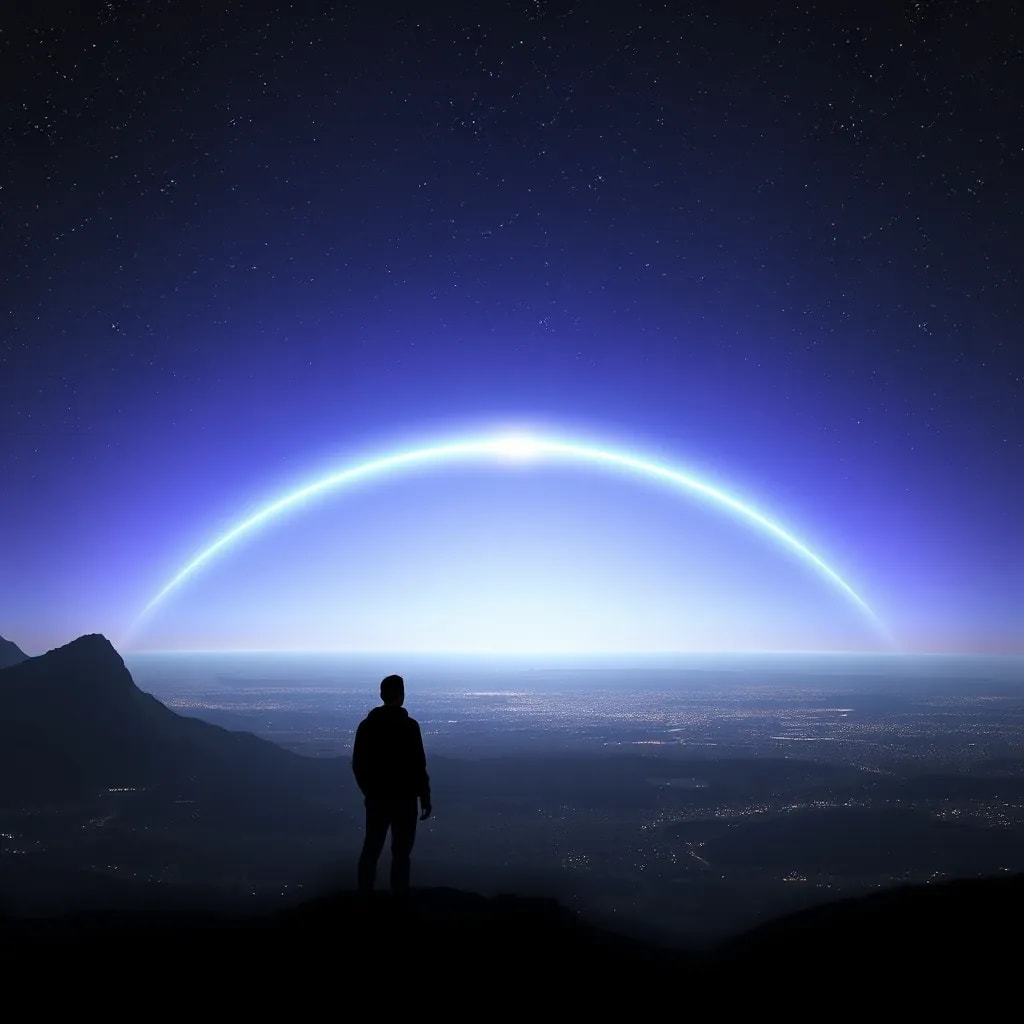
An Imaginative Scenario with Surprisingly Real Consequences
When we picture Saturn, one feature instantly steals the spotlight: its magnificent rings. Wide, glittering, and ethereal, they give the gas giant its signature look and make it one of the most iconic planets in our solar system. But what if Earth had rings too?
It might sound like pure science fiction, but let’s indulge in this cosmic "what if" and imagine a world where our home planet wears a shimmering halo of dust and ice. From shifting ecosystems to altered myths, the presence of a ring could have changed the story of Earth in fascinating ways.
What Would It Look Like?
Imagine stepping outside in the early morning. Instead of a vast, empty sky, you'd see a luminous arch stretching across the horizon a soft, glowing curve bending across the heavens like a permanent rainbow. The closer you'd live to the equator, the higher in the sky the ring would appear. From the poles, it might be barely visible or just a thin line at the horizon.
Earth’s ring, like Saturn’s, would likely be made up of countless particles ice shards, rocky debris, and dust ranging from grains of sand to car-sized fragments. Unlike the fleeting beauty of the Northern Lights, this display would be constant. At night, the ring would shimmer with reflected sunlight and moonlight, casting a silvery glow over the landscape and reshaping the very meaning of “night.”
How Would Nature Be Affected?
An Earth with a ring wouldn’t just look different it would feel different too. The ring would act as a second source of illumination by reflecting sunlight. In certain latitudes, the sky might never be truly dark. That eerie glow would disrupt the planet’s natural light cycles, leading to profound changes in both plant and animal life.
- Brighter nights could throw off circadian rhythms in humans and animals alike, affecting sleep patterns and behavior.
- Migratory birds, which navigate by starlight, might become confused or lose their way entirely, as stars would often be hidden behind the glowing band.
- Plants in equatorial regions might adjust their growth cycles or even evolve new adaptations to cope with the extra light exposure.
Could This Actually Happen?
Surprisingly, yes at least temporarily. Some scientists believe that Earth may have had rings at some point in its ancient past. A massive asteroid impact or the destruction of a former moon could have launched debris into orbit, forming a ring that lasted for thousands or even millions of years before falling back to Earth or coalescing into another moon.
The formation of such a ring system could be triggered by:
- The disintegration of a large satellite due to tidal forces;
- A collision with a massive space object;
- A volcanic super-eruption hurling enough material into orbit.
While these are rare and catastrophic events, they are not entirely outside the realm of possibility.
How Would It Change Human History?
A permanent ring in the sky would have profoundly influenced human culture, mythology, and science.
- In ancient times, the ring would have likely become a sacred symbol seen as a divine halo or the "eye" of the heavens.
- Entire mythologies might have developed around it, and it could have served as an important celestial calendar or religious omen.
- Artists, poets, and architects would be endlessly inspired by its presence. Think of temples aligned with the ring, poems written about its glow, and legends born from its mysterious beauty.
- Astronomy could have advanced much faster, driven by constant curiosity about this celestial feature hanging above us.
- Some cultures might even have believed the ring marked the border between the world of the living and the divine.
Would It Be Dangerous?
As awe-inspiring as it might be, an Earth ring system wouldn't come without risks.
- Meteoroid showers could be more frequent if particles from the ring occasionally fell through the atmosphere.
- Space travel would become far more hazardous. Rockets, satellites, and space stations would have to navigate through or around dense belts of debris.
- Depending on its density, the ring might reflect enough sunlight to influence global temperatures, possibly cooling the planet by a few degrees enough to affect weather and crop patterns over time.
Final Thoughts
The idea of an Earth ring is more than just a visual fantasy. It's a compelling reminder of how fragile and dynamic our planetary system really is. A simple band of ice and rock, orbiting high above, could have rewritten ecosystems, civilizations, and history itself.
For now, Earth remains ringless, and we gaze at Saturn’s celestial crown with envy and imagination. But perhaps, in some alternate version of reality or in the distant future we might one day see our skies adorned with a glowing, eternal arc.
Until then, we can only look up and wonder: what if?
About the Creator
Keep reading
More stories from Holianyk Ihor and writers in Futurism and other communities.
A Leap on the Moon: How Your Walk Would Change with One-Sixth Gravity
Imagine standing on the surface of the Moon. Above you hangs the Earth a distant, glowing blue orb suspended in a pitch-black sky. Beneath your boots stretches a dusty gray landscape, silent and alien. You take a step forward… and suddenly realize something feels very different. Each movement is oddly slow, floaty, almost dreamlike. No, you’re not imagining it, this is the reality of lunar gravity.
By Holianyk Ihor6 months ago in Futurism
About Binding Prometheus
I want to start actively advocating on behalf of my own work, and the most valuable part of my canon is, without a doubt, Binding Prometheus, the play I have been working on since 2019 and only finished in 2023 as part of my MA. The play itself is an amalgamation of a million different inspirations. On one end, it evokes the Ancient Greek myth-play, deriving its own title from the earliest extant work of Western drama we have, Aeschylus’s Prometheus Bound. On the other end, it borrows significantly from the sci-fi bulwarks from over the years, namely Mary Shelley’s Frankenstein and Karel Capek’s Rossum’s Universal Robots. The play could be an episode of Black Mirror, I fear. I don’t know. I’ve only ever seen one episode of Black Mirror.
By Steven Christopher McKnight14 days ago in Futurism
United Kingdom Software Development Market Size and Forecast 2026–2034
United Kingdom Software Development Market: Outlook The United Kingdom software development market is entering a period of strong and sustained growth, supported by widespread digital transformation across industries, rapid adoption of cloud platforms, and accelerating use of artificial intelligence and automation technologies. According to Renub Research, the market is expected to expand from US$ 19.55 billion in 2025 to US$ 45.57 billion by 2034, registering a robust compound annual growth rate (CAGR) of 9.86% from 2026 to 2034.
By Marthan Sir6 days ago in Futurism



Comments
There are no comments for this story
Be the first to respond and start the conversation.