
A Leap on the Moon: How Your Walk Would Change with One-Sixth Gravity
Space


Imagine standing on the surface of the Moon. Above you hangs the Earth a distant, glowing blue orb suspended in a pitch-black sky. Beneath your boots stretches a dusty gray landscape, silent and alien. You take a step forward… and suddenly realize something feels very different. Each movement is oddly slow, floaty, almost dreamlike. No, you’re not imagining it, this is the reality of lunar gravity.
One-Sixth Gravity: Your Body Feels the Difference
The Moon's gravity is about 1/6th that of Earth. In other words, someone who weighs 160 pounds (72 kg) on Earth would weigh just about 27 pounds (12 kg) on the Moon. However, your mass the actual amount of matter in your body doesn’t change. That means your muscles still have to move the same mass, but the force pulling you downward is significantly weaker.
The result? Movement feels lighter, slower, and a bit floaty. Your arms swing differently, your steps stretch longer, and even the simple act of shifting your weight takes on an unfamiliar rhythm.
Why a Normal Walk Just Doesn’t Work
Walking as you do on Earth involves controlled falling gravity pulls your body forward with each step, and your feet catch you in a steady rhythm. But on the Moon, that rhythm breaks down.
Because gravity is so much weaker, your feet don’t fall back to the surface with the same force. Instead of a brisk heel-to-toe motion, your feet sort of hang in the air a bit longer. Your body keeps gliding forward, and it can feel like your steps are disconnected from the ground. Try walking normally and you'll find yourself stumbling in slow motion.
This is why astronauts quickly learned to abandon the Earth-style stroll in favor of something more Moon-appropriate.
Enter the Kangaroo Hop
During the Apollo missions, astronauts discovered that hopping with both feet was far more effective than walking. This bouncing motion, similar to a kangaroo’s hop, gave them better balance and let them move more efficiently across the uneven lunar surface. Despite the bulky space suits they wore each weighing about 180 pounds (80 kg) on Earth they were able to jump surprisingly high thanks to the reduced gravity. On the Moon, that same suit only weighed around 30 pounds (13–14 kg), making the movement feel clumsy but not heavy.
Each bounce could lift them up to two feet (60 cm) off the ground something impossible in Earth’s gravity without a trampoline.
Your Lunar Stride: A Ballet in Slow Motion
If you somehow found yourself on the Moon without a spacesuit (in a magical sci-fi scenario where you could breathe and not freeze), your walk might resemble a graceful, slow-motion dance. One gentle push could send you gliding several meters forward and a meter high. Landing would be soft and floaty, almost like drifting into a pillow.
But don’t let the elegance fool you. The low gravity also means it’s easier to lose your balance. One wrong step could send you tumbling or worse, launching yourself in an unintended direction. The Moon’s surface, covered in sharp rocks and powdery dust, isn’t a forgiving place to fall.
Energy Costs: Not as Easy as It Looks
Here’s the twist: despite the low gravity, moving on the Moon isn’t exactly effortless. Your body still burns a lot of energy. Why? Because your muscles are working against your own mass, not your weight. Your heart and lungs still pump as if you're on Earth, but now you’re adapting to unfamiliar movement patterns and instability.
In fact, astronauts reported becoming tired rather quickly during their lunar excursions, even though they were technically “weighing less.”
What If Gravity Was Even Lower?
Now imagine you're not on the Moon, but on an asteroid with gravity 20 times weaker than Earth’s. Here, walking isn’t just impractical it’s impossible. One simple step might launch you off the surface entirely. Instead of walking, you'd need to float, drift, or maneuver using handrails, tethers, or even miniature thrusters.
In such ultra-low gravity environments, your movement wouldn’t be a "walk" at all it’d be more like swimming through space.
Walking the Moon: A Whole New Way of Moving
In short, walking on the Moon isn’t just walking it’s hopping, floating, adjusting, and learning. It transforms a basic human activity into something entirely new. The reduced gravity invites elegant motion but demands care and adaptation.
At first, you’d probably stumble. Your legs might flail, your balance might wobble. But soon, your body would begin to understand the rhythm. You’d learn to bounce with intention, to land softly, and maybe just maybe you’d discover your own lunar stride.
Moonwalking isn’t just for astronauts or pop stars. It’s a glimpse into how deeply gravity shapes our every move and how different life could be when that force changes.
About the Creator
Keep reading
More stories from Holianyk Ihor and writers in Futurism and other communities.
How Much Does the Universe Weigh? A Bold Attempt to Weigh Everything That Exists
When we talk about weight, we usually think of something tangible an apple, a car, maybe even a skyscraper. But what if we try to measure something truly colossal? What if we dared to ask: How much does everything weigh? Stars, planets, black holes, dark matter even light. In short: how much does the universe weigh?
By Holianyk Ihor6 months ago in Futurism
About Binding Prometheus
I want to start actively advocating on behalf of my own work, and the most valuable part of my canon is, without a doubt, Binding Prometheus, the play I have been working on since 2019 and only finished in 2023 as part of my MA. The play itself is an amalgamation of a million different inspirations. On one end, it evokes the Ancient Greek myth-play, deriving its own title from the earliest extant work of Western drama we have, Aeschylus’s Prometheus Bound. On the other end, it borrows significantly from the sci-fi bulwarks from over the years, namely Mary Shelley’s Frankenstein and Karel Capek’s Rossum’s Universal Robots. The play could be an episode of Black Mirror, I fear. I don’t know. I’ve only ever seen one episode of Black Mirror.
By Steven Christopher McKnight15 days ago in Futurism
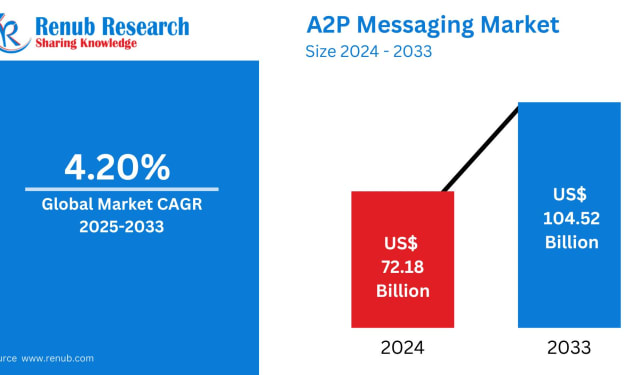
A2P Messaging Market Outlook 2025–2033
Introduction In an era where instant, reliable, and secure communication defines business success, Application-to-Person (A2P) messaging has become one of the most indispensable tools in the global digital economy. From one-time passwords (OTPs) and transaction alerts to delivery updates, customer notifications, and marketing campaigns, A2P messaging has reshaped how enterprises interact with consumers in real time.
By Marthan Sir4 days ago in Futurism



Comments
There are no comments for this story
Be the first to respond and start the conversation.