
What Do We Really Know About the Boundaries of the Solar System?
Space

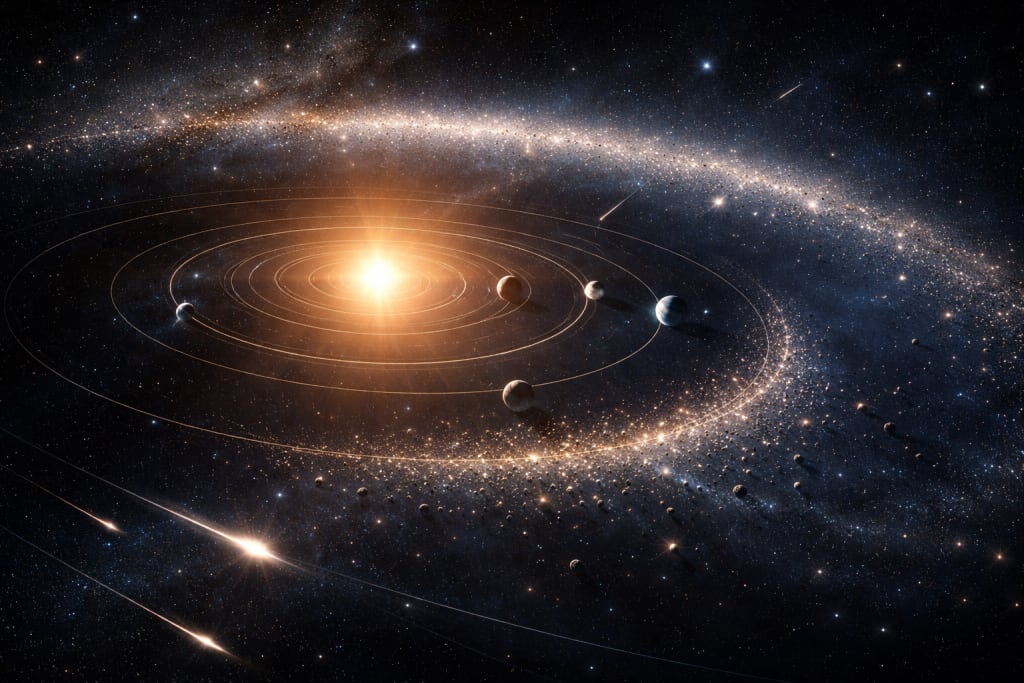
When most people picture the Solar System, they imagine a neat diagram: the Sun at the center, planets orbiting in tidy circles, Pluto somewhere at the edge, and then—nothing. Empty space. The truth, however, is far more complex, fascinating, and mysterious. The Solar System does not end at a clear line, nor does it have a physical “wall.” Instead, it fades gradually into interstellar space through a series of overlapping and poorly understood regions. Even today, scientists cannot agree on a single answer to a deceptively simple question: where does the Solar System actually end?
Why the Solar System Has No Clear Edge
Unlike a planet or a star, the Solar System is not a solid object. It is defined by influence rather than structure. The Sun’s gravity, radiation, and magnetic activity extend far beyond the orbits of the planets, shaping a vast and dynamic environment. As a result, the “boundary” of the Solar System depends entirely on what kind of influence we are measuring.
Are we talking about the region where planets orbit? The limit of the Sun’s gravitational dominance? Or the point where the solar wind gives way to particles from other stars? Each definition leads to a different boundary—and a very different picture of how large our Solar System truly is.
The Planetary Frontier: The Kuiper Belt
The first boundary most people encounter is beyond Neptune, the outermost planet. Here lies the Kuiper Belt, a massive disk of icy objects left over from the early formation of the Solar System. This region extends roughly from 30 to 50 astronomical units from the Sun (one astronomical unit is the distance between Earth and the Sun).
Pluto, once considered the ninth planet, is the most famous Kuiper Belt object, but it is far from alone. Thousands of smaller icy bodies orbit here, including dwarf planets such as Haumea and Makemake. For a long time, astronomers believed this region marked the outer edge of the Solar System. We now know that this was only the beginning.
Beyond Order: The Scattered Disk
Past the Kuiper Belt lies a far less orderly region known as the scattered disk. Objects here follow highly elongated and tilted orbits, likely shaped by past gravitational interactions with Neptune. Some of these bodies travel hundreds of astronomical units away from the Sun before swinging back inward.
Many long-period comets are thought to originate from this region. The strange clustering of certain distant orbits has even led scientists to propose the existence of a hypothetical “Planet Nine”—a massive, unseen planet that could be sculpting these trajectories from afar. While Planet Nine has not yet been observed, its possible existence highlights how little we know about the Solar System’s distant outskirts.
The Gravitational Boundary: The Oort Cloud
If we define the Solar System by the reach of the Sun’s gravity, then its true boundary lies much farther out—in the realm of the Oort Cloud. This theoretical structure is believed to be a vast, spherical shell of icy debris surrounding the Solar System in all directions.
The Oort Cloud may extend as far as 100,000 astronomical units from the Sun, nearly a quarter of the distance to the nearest star system. Unlike the Kuiper Belt, it has never been directly observed. Its existence is inferred from the behavior of long-period comets that appear to fall toward the inner Solar System from random directions.
If the Oort Cloud is real—and most astronomers believe it is—then the Solar System is far larger and more diffuse than most illustrations suggest, blending gradually into the gravitational fields of other stars.
The Magnetic Border: The Heliosphere
There is another way to define the edge of the Solar System: by the reach of the solar wind. The Sun constantly emits a stream of charged particles that forms a giant bubble in space called the heliosphere. Inside this bubble, the Sun’s magnetic influence dominates.
The outer boundary of this bubble is known as the heliopause. In a historic milestone, NASA’s Voyager 1 spacecraft crossed the heliopause in 2012, followed by Voyager 2 in 2018. These missions marked the first time human-made objects entered interstellar space, at least in terms of magnetic and particle influence.
Yet even beyond the heliopause, the Sun’s gravity still holds sway. The Voyagers have left the Sun’s magnetic bubble, but they remain gravitationally bound to the Solar System. Once again, the definition of “outside” depends on perspective.
Where Does Interstellar Space Truly Begin?
Interstellar space does not start abruptly. It is a transition zone where particles from the Sun mix with those from other stars, and where magnetic fields interact and shift. This boundary changes over time as the Solar System moves through the Milky Way and encounters regions of varying interstellar density.
In this sense, the Solar System is not an isolated island but a drifting structure within a vast galactic ocean, constantly shaped by external forces.
What We Know—and What We Don’t
Scientists are confident about several key points:
- The Solar System extends far beyond the planets.
- Its boundaries depend on whether we measure gravity, particles, or magnetic influence.
- The most distant regions have never been observed directly.
At the same time, many questions remain unanswered. Does Planet Nine exist? What is the true shape and density of the Oort Cloud? How often do passing stars disturb the outer Solar System, sending comets toward the inner planets?
Why the Boundaries Matter
Understanding the limits of our Solar System is not just an academic exercise. It helps scientists understand how planetary systems form and evolve elsewhere in the galaxy. By studying our own cosmic neighborhood, we gain insight into the countless star systems scattered across the Milky Way.
Ultimately, the Solar System is not a simple diagram with a clear ending. It is a vast, layered, and dynamic structure whose edges remain blurred and mysterious. And as exploration continues, those boundaries may shift once again—reminding us that even our cosmic home is far less defined than we once believed.
About the Creator
Keep reading
More stories from Holianyk Ihor and writers in Futurism and other communities.
Why Scientists Are Rethinking What Makes a Planet “Habitable”
For much of modern scientific history, the idea of a “habitable planet” seemed relatively straightforward. If astronomers wanted to find life beyond Earth, they needed to look for worlds that closely resembled our own: rocky planets, orbiting at just the right distance from their stars, with mild temperatures and liquid water on the surface. This concept shaped decades of research, telescope design, and space missions.
By Holianyk Ihora day ago in Futurism
About Binding Prometheus
I want to start actively advocating on behalf of my own work, and the most valuable part of my canon is, without a doubt, Binding Prometheus, the play I have been working on since 2019 and only finished in 2023 as part of my MA. The play itself is an amalgamation of a million different inspirations. On one end, it evokes the Ancient Greek myth-play, deriving its own title from the earliest extant work of Western drama we have, Aeschylus’s Prometheus Bound. On the other end, it borrows significantly from the sci-fi bulwarks from over the years, namely Mary Shelley’s Frankenstein and Karel Capek’s Rossum’s Universal Robots. The play could be an episode of Black Mirror, I fear. I don’t know. I’ve only ever seen one episode of Black Mirror.
By Steven Christopher McKnight26 days ago in Futurism
How Tampa Companies Avoid App Downtime During Rapid Growth?
Jonathan Pierce didn’t fear growth. He feared growth without warning. The company’s mobile app was gaining traction faster than forecast. Quarterly active users were up more than 40%. Transaction volume climbed week after week. Marketing campaigns that once felt ambitious now felt dangerous.
By Samantha Blakeabout 15 hours ago in Futurism
Affection and Healing for Yourself
During the night of the last quarter moon, I gathered my ritual supplies. I carefully handled the chunk of black tourmaline that would protect me from your overall negative and narcissistic energy. I carefully walked the house with my stick of selenite in hand, asking the universe to cleanse our working space.
By Alisha Wilkins ✒️🦋🖋️8 days ago in Fiction


Comments
There are no comments for this story
Be the first to respond and start the conversation.