
Wireless Router Market Size and Forecast 2025–2033
How next-generation connectivity, smart homes, and 5G are reshaping the future of global networking


The global wireless router market is entering a phase of accelerated transformation. According to Renub Research, the market is projected to expand from US$ 14.22 billion in 2024 to US$ 29.92 billion by 2033, registering a compound annual growth rate (CAGR) of 8.62% from 2025 to 2033. This robust growth reflects the central role wireless connectivity now plays across households, enterprises, and industrial environments. As high-speed internet becomes a basic utility rather than a premium service, routers are evolving from simple access devices into intelligent, secure, and performance-optimized hubs that power modern digital lifestyles.
At the heart of this expansion are three powerful forces: surging demand for high-speed broadband, the explosive adoption of smart home and IoT ecosystems, and rapid technological innovation—most notably the transition to Wi-Fi 6, Wi-Fi 6E, Wi-Fi 7, and the convergence of wireless networking with 5G. Together, these trends are not only enlarging the addressable market but also redefining what a “router” means in the connected world.
Understanding the Wireless Router Market
A wireless router is a networking device that connects the internet from a modem and distributes it wirelessly to multiple devices—smartphones, laptops, smart TVs, security systems, and IoT appliances—without physical cabling. By converting incoming data into radio signals, routers enable seamless connectivity across homes, offices, campuses, and industrial sites.
Today’s routers are far more than simple transmitters. They support multiple frequency bands, advanced encryption protocols, mesh networking, parental controls, cloud management, and increasingly, AI-driven traffic optimization. The integration of features such as Wi-Fi 6/6E, multi-gigabit ports, mesh systems, and smart home compatibility allows modern routers to manage dense networks and heavy bandwidth demands with greater stability and lower latency.
The result is a market that spans consumer electronics, enterprise networking, telecom infrastructure, and industrial connectivity. From enabling remote work and online education to supporting real-time gaming, cloud computing, and smart manufacturing, wireless routers are now mission-critical infrastructure.
Market Growth Drivers
1. Rising Demand for High-Speed Internet
The digital economy depends on fast, reliable connectivity. Video streaming in 4K and 8K, cloud-based applications, real-time collaboration tools, and immersive gaming all require low latency and high throughput. As broadband speeds increase globally, households and businesses must upgrade to routers capable of handling multi-gigabit connections. This continuous cycle of bandwidth demand and device upgrades directly fuels market expansion.
2. Smart Homes and IoT Proliferation
From connected thermostats and lighting systems to voice assistants, cameras, and appliances, the average home now hosts dozens of internet-connected devices. Each additional endpoint increases network load and complexity. Mesh Wi-Fi systems, tri-band routers, and AI-based traffic management are becoming essential to ensure consistent performance. In parallel, industrial IoT deployments in factories, logistics, healthcare, and utilities are creating new demand for rugged, secure, and scalable wireless networking.
3. Technological Advancements: Wi-Fi 6, Wi-Fi 7, and 5G
The shift from older standards to Wi-Fi 6/6E has delivered higher speeds, improved capacity, and better performance in device-dense environments. The emergence of Wi-Fi 7—with ultra-low latency, multi-link operation, and unprecedented throughput—marks the next leap forward. At the same time, the rollout of 5G is accelerating demand for hybrid solutions, including cellular routers and industrial wireless VPN routers, particularly in remote and mobile applications.
4. Remote Work, Online Education, and Digital Entertainment
Post-pandemic work models have normalized home offices, video conferencing, and cloud collaboration. Educational institutions increasingly rely on digital classrooms, while entertainment consumption has shifted decisively toward streaming and online gaming. These behavioral shifts have permanently raised baseline connectivity requirements, making high-performance routers a necessity rather than an upgrade.
Competitive Landscape: Leading Manufacturers
The wireless router market is characterized by a mix of global networking giants, telecom providers, and consumer electronics specialists. Key players include:
Cisco Systems (Founded 1984, USA)
Cisco is a cornerstone of enterprise and service-provider networking. Its portfolio spans routers, switches, wireless controllers, access points, and advanced security solutions. Cisco’s products are used by governments, corporations, and telecom operators worldwide, enabling scalable, secure connectivity across complex networks.
AT&T (Founded 1885, USA)
AT&T provides wireless communication, broadband, fiber, and advanced connectivity services. Through brands such as AT&T Fiber and AT&T Business, the company delivers integrated networking solutions to both consumers and enterprises, combining hardware, connectivity, and managed services.
Verizon Communications (Founded 1983, USA)
Verizon offers wireless and wireline communications, cloud services, security, and IoT connectivity. Its networking solutions serve small businesses, large enterprises, and public sector organizations, with a growing focus on 5G-enabled applications and edge computing.
Comcast (Founded 1963, USA)
Through Xfinity and Comcast Business, Comcast delivers broadband, wireless, video, and voice services. Its consumer routers and gateways are widely deployed in North America and Europe, supporting high-speed residential and business connectivity.
Charter Communications (Founded 1993, USA)
Charter provides internet, video, voice, and mobile services to residential and commercial customers. Its business networking solutions include fiber connectivity, data networking, and managed Wi-Fi services for enterprises and government clients.
Product Innovation and Market Momentum
Technological innovation continues to define competition in the wireless router market.
Lumen Technologies (December 2023) introduced a custom-designed Wi-Fi 7-capable device for its Quantum Fiber multi-gig customers. By delivering faster speeds and enhanced reliability over Wi-Fi 6/6E, Lumen’s solution sets a new benchmark for smart homes and high-performance business networks.
Viasat (July 2024) launched its Secure Wireless Hub (SWH), a wearable tactical gateway developed with U.S. Special Operations Command. Designed for mobile ground forces, this rugged solution highlights how wireless routing is expanding into defense, emergency response, and mission-critical communications.
These developments illustrate a broader trend: routers are becoming specialized platforms tailored to gaming, enterprise, industrial, and tactical use cases.
SWOT Insights: Key Competitors
Netgear
Strengths: Netgear is renowned for its premium networking solutions, strong brand recognition, and advanced technology portfolio. Product lines such as Nighthawk and Orbi are widely adopted by gamers, smart home users, and small businesses seeking high speed, robust security, and mesh networking. Continuous R&D investment, user-friendly interfaces, and global distribution channels give Netgear a strong competitive edge.
TP-Link Technologies
Strengths: TP-Link combines low-cost manufacturing with a diversified product portfolio, enabling it to serve both budget-conscious consumers and enterprise customers. With one of the world’s largest market shares in networking devices, TP-Link benefits from economies of scale, broad global distribution, and a reputation for reliability and ease of use. Its offerings range from entry-level routers to advanced Wi-Fi 6 and business-grade solutions.
Recent Developments Shaping the Market
Huawei Technologies (February 2022)
Huawei unveiled IntelligentRAN, a new wireless network architecture designed to help carriers build autonomous networks with service operation intelligence and simplified operations. By integrating data analytics, AI models, and decision-making at the network level, Huawei’s approach aims to deliver consistent user experiences, zero service waiting, and optimized energy efficiency—demonstrating how intelligence is becoming integral to wireless infrastructure.
ASUS (October 2025)
ASUS Republic of Gamers announced the ROG Rapture GT-BE19000AI, described as the world’s first AI router. Built for gaming, streaming, and smart home environments, the device emphasizes automation, performance optimization, and next-generation reliability, highlighting the growing role of AI in consumer networking.
Sustainability: A Growing Competitive Differentiator
Environmental responsibility is becoming an important strategic dimension in the wireless router market.
D-Link Corporation
D-Link has embedded sustainability across product design, manufacturing, and packaging. Its routers prioritize energy efficiency, recyclable components, and eco-friendly chipsets compliant with global standards such as RoHS and WEEE. The company is reducing plastic usage, investing in greener manufacturing processes, and extending firmware updates to lengthen product life cycles—supporting both environmental goals and customer value.
Tenda Technology Co., Ltd.
Tenda focuses on energy-efficient networking devices, environmentally responsible sourcing, and reduced material waste. By meeting global energy standards, optimizing component efficiency, and using recyclable packaging, Tenda minimizes environmental impact. The company also emphasizes product longevity through long-term software support and encourages repair over replacement, aligning affordability with sustainability.
As regulators and consumers increasingly prioritize eco-friendly technology, such initiatives are likely to influence purchasing decisions and corporate partnerships.
Market Segmentation and Structural Outlook
The wireless router market can be analyzed across several dimensions:
By Type: Single-band, dual-band, tri-band, mesh systems, and cellular/industrial routers.
By Application: Residential, commercial, enterprise, industrial, defense, and public sector.
By Technology: Legacy Wi-Fi standards, Wi-Fi 6/6E, Wi-Fi 7, and 5G-enabled solutions.
By Geography: North America, Europe, Asia-Pacific, Latin America, and the Middle East & Africa.
Historical Trends
Earlier market growth was driven primarily by residential broadband adoption and the transition from wired to wireless networks. Over time, demand diversified into enterprise and industrial applications, with mesh systems and business-grade security becoming mainstream.
Forecast Analysis
Between 2025 and 2033, the market is expected to nearly double in value. Growth will be strongest in regions experiencing rapid urbanization, smart city initiatives, and digital infrastructure investments—particularly Asia-Pacific and parts of Latin America and the Middle East.
Market Share Dynamics
While established players such as Cisco, Huawei, and Qualcomm dominate enterprise and infrastructure segments, consumer markets remain highly competitive, with Netgear, TP-Link, ASUS, D-Link, Linksys, Ubiquiti, Zyxel, and others vying for differentiation through performance, design, price, and sustainability.
Strategic Themes for Industry Leaders
Across leading companies—including Cisco, AT&T, Verizon, Comcast, Charter, Lumen, Viasat, Netgear, TP-Link, Huawei, ASUS, D-Link, Linksys (Belkin), Tenda, Zyxel, Ubiquiti, Buffalo (Melco), Legrand, Qualcomm, and Belkin—several common strategic priorities are emerging:
Technology Leadership: Rapid adoption of Wi-Fi 7, AI-driven traffic management, and multi-gigabit connectivity.
Security and Privacy: Integration of advanced encryption, intrusion detection, and zero-trust architectures.
Partnerships and Ecosystems: Collaborations with telecom operators, cloud providers, and smart home platforms.
Sustainability: Energy-efficient designs, recyclable materials, and circular-economy practices.
Global Expansion: Targeting emerging markets with affordable, scalable networking solutions.
Final Thoughts
The wireless router market is no longer a niche within consumer electronics—it is a foundational pillar of the global digital economy. With Renub Research projecting growth from US$ 14.22 billion in 2024 to US$ 29.92 billion by 2033 at a CAGR of 8.62%, the sector stands at the intersection of connectivity, automation, and intelligent infrastructure.
As households become smarter, enterprises more data-driven, and industries increasingly connected through IoT and 5G, routers will continue to evolve into sophisticated, secure, and sustainable networking platforms. Companies that combine technological innovation with user-centric design and environmental responsibility will define the next decade of wireless connectivity.
In an era where digital access shapes productivity, education, entertainment, and even national competitiveness, the wireless router is no longer just a device—it is the gateway to the future of communication.
About the Creator
Diya Dey
Market Analyst
About Binding Prometheus
I want to start actively advocating on behalf of my own work, and the most valuable part of my canon is, without a doubt, Binding Prometheus, the play I have been working on since 2019 and only finished in 2023 as part of my MA. The play itself is an amalgamation of a million different inspirations. On one end, it evokes the Ancient Greek myth-play, deriving its own title from the earliest extant work of Western drama we have, Aeschylus’s Prometheus Bound. On the other end, it borrows significantly from the sci-fi bulwarks from over the years, namely Mary Shelley’s Frankenstein and Karel Capek’s Rossum’s Universal Robots. The play could be an episode of Black Mirror, I fear. I don’t know. I’ve only ever seen one episode of Black Mirror.
By Steven Christopher McKnight13 days ago in Futurism
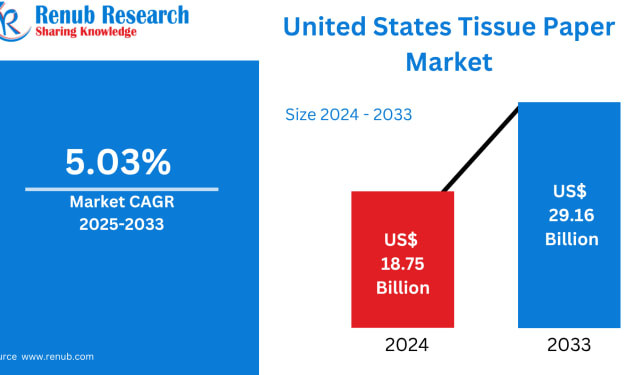
United States Tissue Paper Market Size and Forecast 2025–2033
United States Tissue Paper Market Outlook The United States Tissue Paper Market is expected to reach US$ 29.16 billion by 2033, growing from US$ 18.75 billion in 2024, at a compound annual growth rate (CAGR) of 5.03% from 2025 to 2033. This steady expansion reflects increasing hygiene awareness, rising demand for disposable products across households and institutions, and strong innovation in eco-friendly and premium tissue paper offerings. As lifestyles become more convenience-oriented and sustainability becomes a key purchasing factor, tissue paper products are evolving from basic commodities into branded, value-added essentials.
By Aaina Oberoi5 days ago in Futurism



Comments
There are no comments for this story
Be the first to respond and start the conversation.