
Washing Moon Dust for Helium-3: The New Space Gold Rush
Space

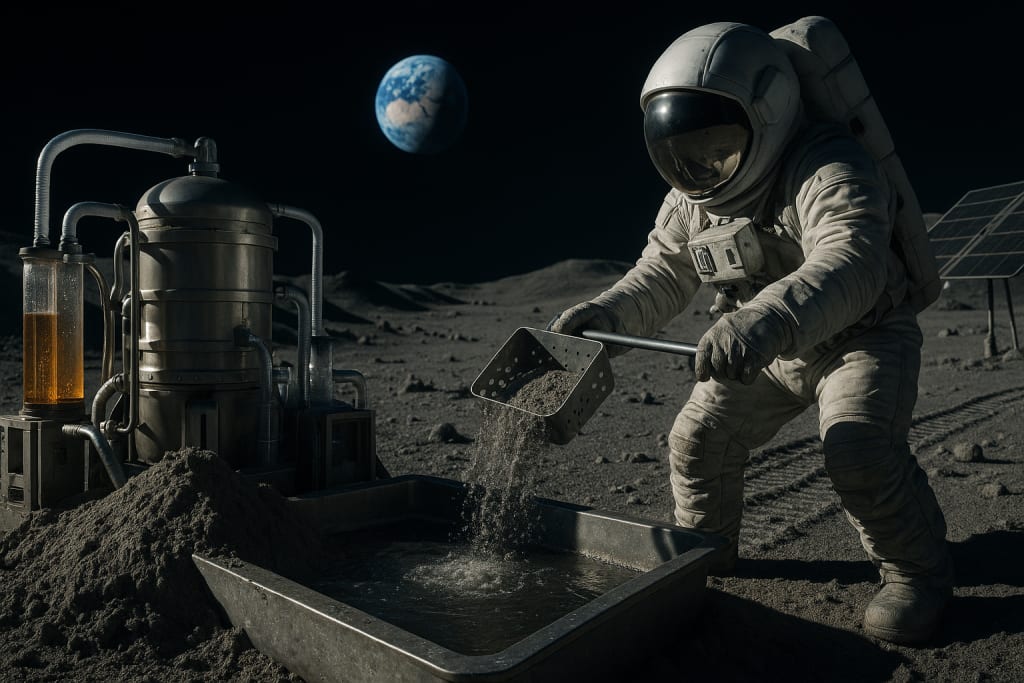
The Promise of a Lunar Treasure
For decades, the Moon has been more than a symbol of human curiosity — it’s been a promise. A promise of knowledge, exploration, and now, perhaps, limitless clean energy. Among all the minerals and exotic materials believed to lie within its dusty surface, one element stands out as a true cosmic prize: helium-3.
This rare isotope could revolutionize how humanity powers its world. Unlike fossil fuels or even current nuclear technologies, helium-3 offers the tantalizing potential for fusion energy without radioactive waste. But there’s a catch — it’s not easily accessible. Extracting it from the Moon’s surface may require a process as unusual as it is ambitious: washing lunar soil, or regolith, to harvest the tiny trapped atoms within.
What Makes Helium-3 So Special?
Helium-3 is an isotope of helium with two protons and one neutron — a lightweight, stable version of the element we use in balloons and cryogenics. It’s vanishingly rare on Earth, but the Moon’s surface, bombarded for billions of years by solar wind, is infused with it.
In theory, helium-3 could fuel nuclear fusion reactors that generate vast amounts of energy without the deadly radiation or long-lived waste associated with today’s nuclear power plants. Just one kilogram of helium-3 could release as much energy as burning 50 million liters of oil. That’s enough to power a city for weeks — cleanly and safely.
Scientists dream of a future where helium-3 becomes the cornerstone of a new energy economy. The challenge, however, lies in how to get it.
How the Moon Became a Reservoir of Helium-3
Unlike Earth, the Moon lacks both a magnetic field and a thick atmosphere. That means it’s directly exposed to the solar wind — a stream of charged particles ejected from the Sun. Over eons, these particles, including helium-3 ions, became embedded in the top few meters of lunar regolith — the fine, powdery dust that covers the surface.
The concentration is small — only about 20 to 30 parts per billion — but because the Moon’s surface area is so vast, scientists estimate there could be millions of tons of helium-3 locked in the upper layers. That’s enough, some researchers say, to meet Earth’s energy needs for centuries.
From Heat to Wash: A Cleaner Way to Mine the Moon
Traditionally, scientists have proposed heating lunar soil to around 700–900°C to release trapped gases like helium-3. But this process would demand enormous amounts of energy — ironically, more than the Moon can easily provide.
That’s where the idea of regolith washing comes in. Instead of baking the soil, engineers could use chemical or liquid extraction methods to “wash out” the gases embedded in the dust. Imagine a lunar washing machine that uses specialized solvents or ionic liquids to draw out helium atoms from microscopic pores in the soil.
After the washing process, the solution would be cooled and distilled, isolating the helium-3 for collection. This method could be far more energy-efficient than heating — and it might even allow astronauts to extract other valuable elements, such as oxygen, hydrogen, and rare metals, all from the same batch of regolith.
Engineering the Impossible
Still, the concept sounds easier than it is. The Moon’s surface is a brutal environment — temperatures swing from -170°C to +120°C, and radiation levels are deadly without shielding. Water, the most obvious washing solvent, is scarce. Scientists are exploring alternatives like liquid ammonia or ionic liquids that could survive in lunar vacuum conditions without evaporating.
Then there’s the question of infrastructure. Mining on the Moon would require autonomous robots, solar furnaces, and mobile refineries capable of operating with minimal human intervention. Every gram of equipment launched from Earth adds millions to the mission cost, so designing lightweight, self-sustaining systems is crucial.
The technical and financial barriers are immense — but so are the potential rewards.
The New Lunar Economy
Space agencies and private companies alike are already eyeing this cosmic gold rush. China’s Chang’e missions have returned samples of lunar soil, and the United States’ Artemis program aims to establish a permanent base on the Moon by the 2030s. Mining helium-3 is on both nations’ long-term radar.
Commercial players like Blue Origin and ispace are also studying how to process lunar materials on-site. If successful, the Moon could become the first extraterrestrial industrial zone, supplying fuel not just for Earth, but for deeper space missions — including Mars.
Some economists even speculate that helium-3 could one day become the “oil of the 22nd century”, traded globally as the clean energy source that powers an interplanetary civilization.
Conclusion: Dust to Destiny
The idea of washing Moon dust for helium-3 may sound like science fiction, but so did landing on the Moon half a century ago. What was once a poetic dream — “to touch the stars” — is evolving into a practical vision: to mine them.
If humanity succeeds, the same gray dust that once clung to astronauts’ boots could one day light up our cities, fuel our spaceships, and usher in a new era of boundless, clean energy — an age powered by the very breath of the Sun itself.
About the Creator
Keep reading
More stories from Holianyk Ihor and writers in Futurism and other communities.
Rebel Worlds: Exoplanets with Reverse Rotation and Bizarre Atmospheres
When astronomers began discovering planets beyond our Solar System in the 1990s, most expected to find familiar worlds — something like a Hot Jupiter here, a cold Neptune there, maybe the occasional rocky Earth-twin. Instead, the universe responded with a cosmic smirk and delivered a catalog of planets so strange that even science fiction writers would hesitate to invent them. Among the most mind-bending of these discoveries are exoplanets with reverse (retrograde) rotation and wildly abnormal atmospheres — worlds that defy planetary logic and challenge our understanding of physics.
By Holianyk Ihor3 months ago in Futurism
About Binding Prometheus
I want to start actively advocating on behalf of my own work, and the most valuable part of my canon is, without a doubt, Binding Prometheus, the play I have been working on since 2019 and only finished in 2023 as part of my MA. The play itself is an amalgamation of a million different inspirations. On one end, it evokes the Ancient Greek myth-play, deriving its own title from the earliest extant work of Western drama we have, Aeschylus’s Prometheus Bound. On the other end, it borrows significantly from the sci-fi bulwarks from over the years, namely Mary Shelley’s Frankenstein and Karel Capek’s Rossum’s Universal Robots. The play could be an episode of Black Mirror, I fear. I don’t know. I’ve only ever seen one episode of Black Mirror.
By Steven Christopher McKnight16 days ago in Futurism
Saudi Arabia Software Market: AI Integration, Vision 2030, Enterprise Solutions & Growth Outlook
Saudi Arabia's software market thrives on Vision 2030 initiatives, driving demand for cloud-native solutions and AI-integrated enterprise tools that empower sectors like fintech and healthcare with seamless digital transformation. According to IMARC Group's latest research publication, Saudi Arabia software market size reached USD 8.1 Billion in 2025. The market is projected to reach USD 23.5 Billion by 2034, exhibiting a growth rate (CAGR) of 12.57% during 2026-2034.
By Jeffrey Wilson2 days ago in Futurism


Comments
There are no comments for this story
Be the first to respond and start the conversation.