
Rebel Worlds: Exoplanets with Reverse Rotation and Bizarre Atmospheres
Space

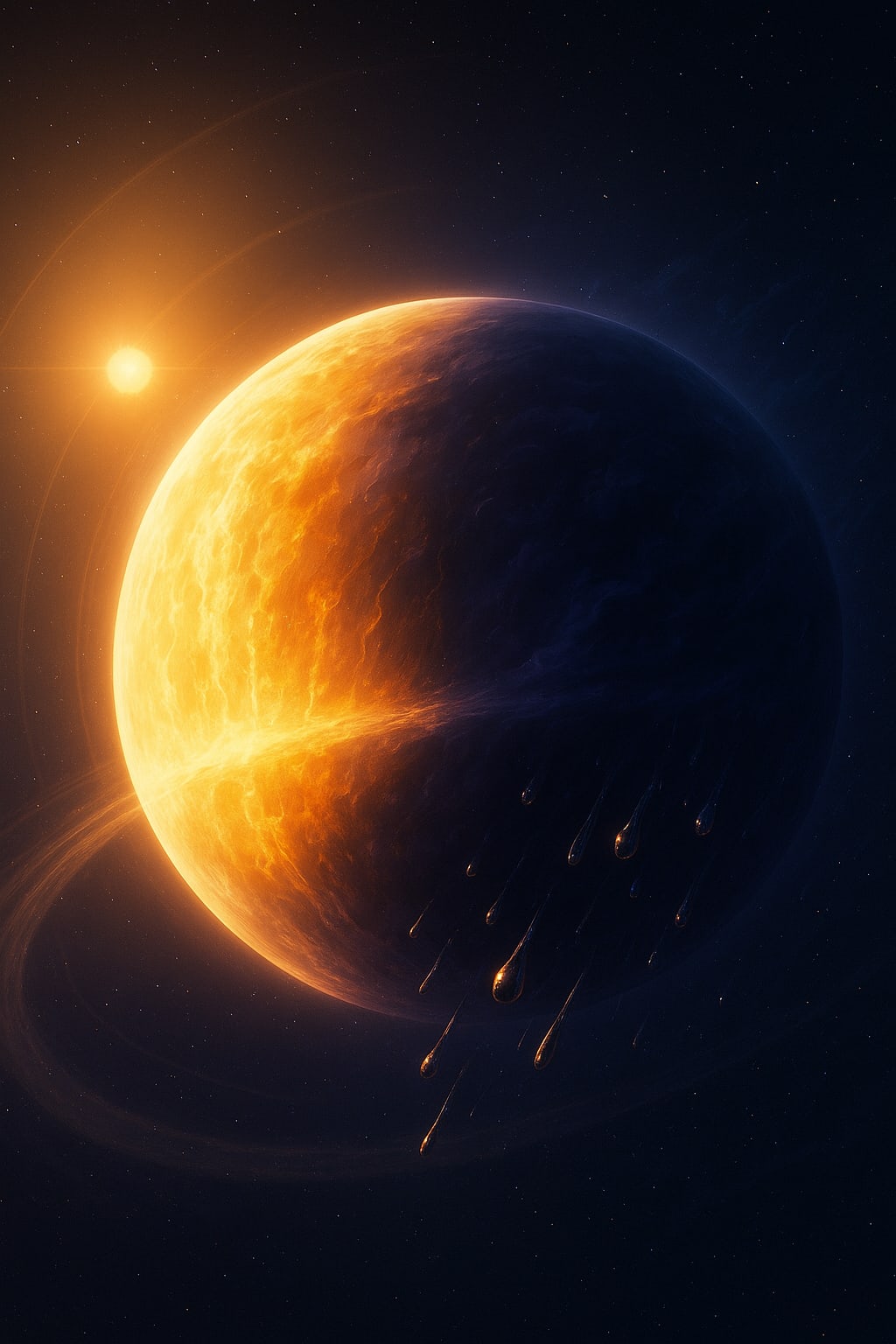
When astronomers began discovering planets beyond our Solar System in the 1990s, most expected to find familiar worlds — something like a Hot Jupiter here, a cold Neptune there, maybe the occasional rocky Earth-twin. Instead, the universe responded with a cosmic smirk and delivered a catalog of planets so strange that even science fiction writers would hesitate to invent them. Among the most mind-bending of these discoveries are exoplanets with reverse (retrograde) rotation and wildly abnormal atmospheres — worlds that defy planetary logic and challenge our understanding of physics.
These planets don’t just bend the rules. They flip the cosmic table.
What Does “Reverse Rotation” Actually Mean?
In our Solar System, almost every planet spins and orbits in the same general direction — a counterclockwise motion when viewed from above the Sun’s north pole. But there are exceptions, even at home: Venus spins backward, and Uranus rolls sideways like a drunken bowling ball. Still, these oddballs are nothing compared to what astronomers have found in other star systems.
In exoplanetary science, “retrograde motion” can mean three different types of planetary rebellion:
- A planet can rotate backward on its own axis
- It can orbit its star in the opposite direction of the star’s rotation
- Or, in extreme cases, it can do both — a full gravitational punk-rock statement
One of the first confirmed examples was WASP-17b, a gas giant about twice the size of Jupiter. Its orbit runs opposite to the spin of its star — imagine a car driving the wrong way down a cosmic highway on purpose. Researchers believe this backwards orbit was likely caused by violent interactions early in the system’s history — perhaps an ancient collision or gravitational bullying from another massive planet.
Atmospheres from Another Universe
Reverse rotation might sound extreme, but the real madness begins in the atmosphere. Many retrograde exoplanets — especially the so-called Hot Jupiters that orbit scorchingly close to their stars — possess climates so extreme that Earth’s worst natural disasters look like gentle breezes.
Scientists have observed:
Atmospheric Oddity What Happens on These Worlds
Supersonic winds Up to 5–7 km/s, faster than a bullet
Vaporized metals Iron, titanium, or aluminum drifting as gas
Temperatures hotter than
molten steel 2,000–3,000°C on the day side
Glass or metal rain Falling diagonally due to violent winds
One of the most infamous examples is HD 189733b, where tiny particles of silicate form razor-sharp glass rain driven by hurricane-force winds. And on WASP-76b, iron literally evaporates on the star-facing side and then condenses into droplets on the night side, creating storms of molten metal. Imagine standing under a cloudburst of liquid iron — assuming you hadn’t already vaporized.
These planets don’t have “weather” as we know it. They have cosmic chaos.
Why Do These Atmospheric and Orbital Oddities Happen?
Astronomers have pieced together several leading theories:
- Gravitational chaos during planetary formation — collisions, migrations, and violent orbital reshuffling in young star systems can twist planets into backward orbits.
- Disruption from a third body — another star or massive planet can warp gravitational alignment, forcing bizarre orbital angles.
- Tidal forces from extreme proximity — Hot Jupiters orbit so close to their stars that they get gravitationally kneaded like dough, producing intense jet streams and temperature imbalances.
In short, these planets are the products of cosmic trauma — gravitational scars written into their atmospheres and rotations.
Why These Planets Matter
Retrograde exoplanets are more than just scientific curiosities. They serve as natural laboratories for some of astronomy’s biggest questions:
- How stable are planetary atmospheres under extreme conditions?
- How often do planetary systems experience violent rearrangements?
- Could unusual climates produce unexpected chemical environments — maybe even ones relevant to life?
One of the most humbling lessons so far is that our Solar System is not the cosmic standard — it’s the cosmic exception. What we once assumed to be “normal planet behavior” is only one small possibility out of many.
What Comes Next
With a new generation of telescopes — including the James Webb Space Telescope (JWST) and the upcoming Extremely Large Telescope (ELT) — scientists are now beginning to analyze atmospheric chemistry in unprecedented detail. Soon, we may be able to read the “weather reports” of alien worlds layer by layer.
And who knows? We might eventually find a retrograde Earth-like world — a planet where the sun rises in the west, storms rage with exotic elements, and the climate follows rules unknown to us. It would be familiar, yet profoundly alien.
The universe is not just stranger than we imagine — it’s stranger than we can imagine.
And exoplanets with reverse rotation and bizarre atmospheres are proof.
About the Creator
Keep reading
More stories from Holianyk Ihor and writers in Futurism and other communities.
Nuclear Engines for the Journey to Mars: Why NTR and NEP May Change Everything
For decades, Mars has been the big red prize of human space exploration. We’ve landed rovers, taken selfies on its dusty plains, and mapped its canyons and craters in high resolution. And yet, no human has ever set foot there. The biggest obstacle isn’t distance itself — it’s time. With today’s chemical rockets, a crewed flight to Mars would take six to nine long months one way, and the entire mission could stretch to two or even three years. That means more radiation exposure, more psychological pressure, more supplies, and more risk.
By Holianyk Ihor3 months ago in Futurism
About Binding Prometheus
I want to start actively advocating on behalf of my own work, and the most valuable part of my canon is, without a doubt, Binding Prometheus, the play I have been working on since 2019 and only finished in 2023 as part of my MA. The play itself is an amalgamation of a million different inspirations. On one end, it evokes the Ancient Greek myth-play, deriving its own title from the earliest extant work of Western drama we have, Aeschylus’s Prometheus Bound. On the other end, it borrows significantly from the sci-fi bulwarks from over the years, namely Mary Shelley’s Frankenstein and Karel Capek’s Rossum’s Universal Robots. The play could be an episode of Black Mirror, I fear. I don’t know. I’ve only ever seen one episode of Black Mirror.
By Steven Christopher McKnight15 days ago in Futurism
Egypt Paper Packaging Market: Sustainability Trends, Material Innovation & Growth Outlook
According to IMARC Group's latest research publication, Egypt Paper Packaging Market size reached USD 1,570.1 Million in 2024. Looking forward, IMARC Group expects the market to reach USD 2,090.2 Million by 2033, exhibiting a growth rate (CAGR) of 3.23% during 2025-2033.
By Abhay Rajputabout 24 hours ago in Futurism


Comments
There are no comments for this story
Be the first to respond and start the conversation.