
Children in Space: Science Fiction or an Inevitable Reality?
Space

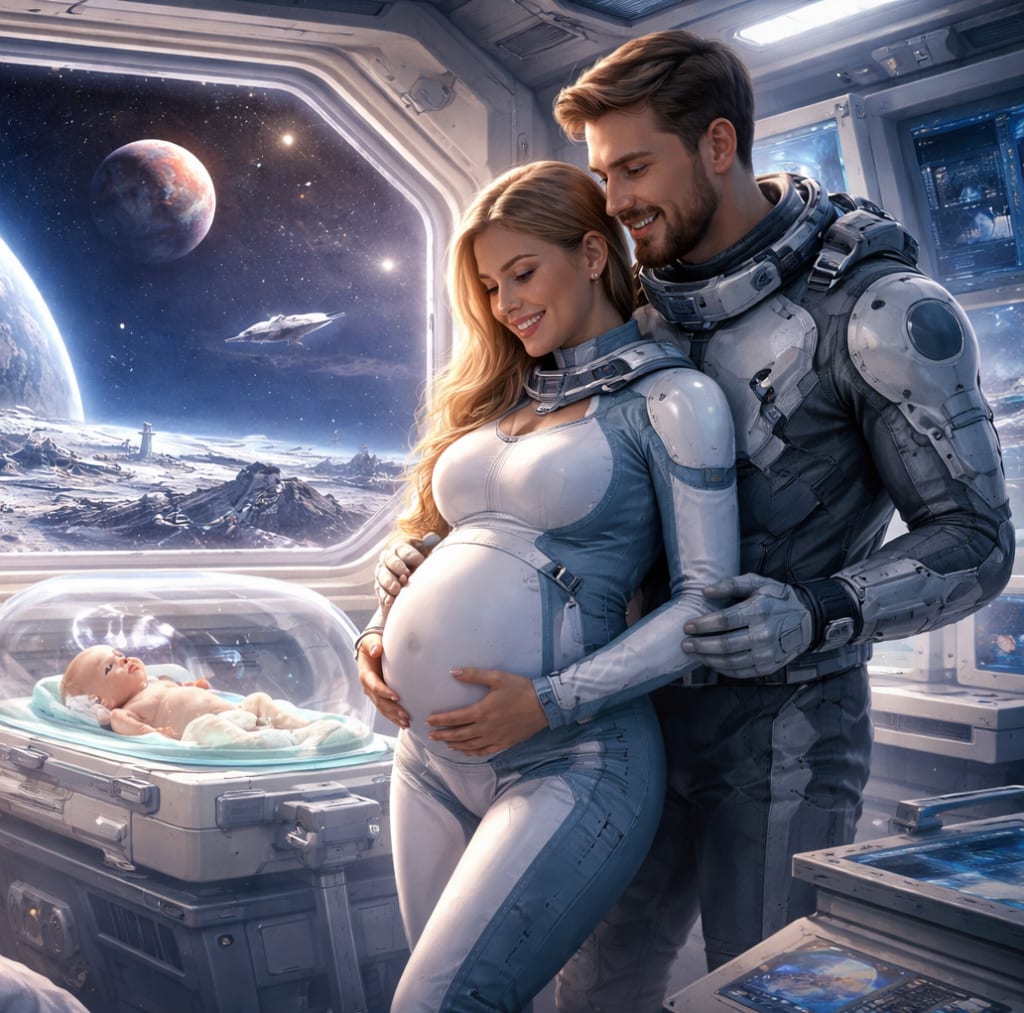
For decades, the idea of children being born in space belonged firmly to the realm of science fiction. From futuristic novels to blockbuster movies, space-born humans were portrayed as exotic symbols of humanity’s cosmic future. Yet today, this question is slowly moving from imagination into serious scientific and ethical discussion. As plans for long-term missions to the Moon, Mars, and even permanent space settlements gain momentum, one unavoidable issue emerges: if humans are going to live in space for years or generations, what happens to reproduction and childhood beyond Earth?
Is the idea of children in space still fantasy—or are we standing at the threshold of a new chapter in human evolution?
Is Pregnancy Possible Outside Earth?
From a purely biological standpoint, pregnancy is deeply tied to Earth’s environment. Gravity, radiation levels, atmospheric pressure, and natural day–night cycles all play a role in shaping human reproduction. Space, however, is a radically different setting.
The most critical unknown factor is microgravity. On Earth, gravity influences everything from blood circulation to how organs are positioned inside the body. In orbit or deep space, gravity is either extremely weak or entirely absent. Experiments with animals have shown that fertilization can occur in microgravity, but what follows is far more uncertain. Studies involving rodents revealed difficulties with embryo implantation, abnormal development, and changes in gene expression during early growth stages.
Another major concern is cosmic radiation. Outside Earth’s protective magnetic field, astronauts are exposed to high-energy particles that can damage DNA. For adults, this already increases cancer risk. For an embryo—where cells are dividing rapidly and forming vital organs—the danger is far greater. Even small levels of DNA damage at this stage could lead to developmental disorders or long-term health issues.
In theory, pregnancy in space might be possible. In practice, science has yet to demonstrate that it can happen safely.
The Main Medical Risks
When discussing children in space, medical risks extend far beyond pregnancy itself. They affect every stage of development—from conception to adulthood.
1. Genetic and Cellular Damage
Radiation exposure can cause mutations that may not be immediately visible at birth. These changes could manifest later as chronic diseases, neurological disorders, or weakened immune systems.
2. Bone and Muscle Development
On Earth, gravity constantly stimulates bone growth and muscle strength. Astronauts lose bone density and muscle mass even after short missions. A child growing up in low gravity might develop a weaker skeletal structure, making life on Earth—or even higher-gravity environments—extremely difficult.
3. Cardiovascular and Organ Development
The human heart and circulatory system evolved to pump blood against gravity. In microgravity, these systems function differently. A child born and raised in space might develop a cardiovascular system adapted to low gravity but poorly suited for Earth conditions.
4. Childbirth in Space
The act of giving birth itself is another unresolved challenge. Gravity assists the natural process of labor on Earth. In weightlessness, fluids behave unpredictably, and traditional medical procedures may not work as intended. Entirely new obstetric protocols would be required.
5. Immune System Challenges
Even adult astronauts experience weakened immune responses in space. For a child, whose immune system is still developing, this could lead to increased vulnerability to infections and environmental stressors.
Why Scientists Are Already Discussing This
Given these risks, it might seem premature to talk about children in space at all. Yet the topic is increasingly present in scientific journals, space agencies, and ethical debates.
The reason is simple: human space ambitions are changing. Missions to Mars are expected to last two to three years, and concepts for permanent lunar bases and orbital habitats extend far beyond temporary exploration. Private space companies openly speak about long-term settlements rather than short visits.
A space colony without reproduction would remain dependent on Earth forever. Crew members would age, return, or die, and the population could never become self-sustaining. For space to become a true extension of human civilization, reproduction cannot be ignored.
There is also scientific value in addressing this question. Studying reproduction and development in space provides insights into fundamental biological processes, such as how gravity influences cell differentiation, aging, and tissue regeneration. These discoveries could lead to medical breakthroughs on Earth as well.
Finally, there is an ethical dimension. If humans permanently live beyond Earth, can society legitimately deny them the right to form families and have children?
What This Means for Space Colonies
If humanity ever decides that children in space are acceptable and safe, the implications will be profound.
First, space habitats would need to transform from technical outposts into true living environments. This includes advanced radiation shielding, specialized maternity and pediatric care, psychological support systems, and possibly rotating habitats that generate artificial gravity.
Second, a new generation of humans could emerge—people who have never lived on Earth. Children raised on Mars or in orbital cities might be physically adapted to lower gravity and different environmental conditions. Returning to Earth could be painful, dangerous, or even impossible for them.
Third, social structures would change. A colony with children is no longer a mission; it is a society. Education, culture, laws, and identity would evolve differently from Earth-based norms. Over time, space-born humans might see themselves not as explorers from Earth, but as citizens of entirely new worlds.
Science Fiction or the Next Step?
At present, the birth of children in space remains beyond our technological and medical capabilities. The risks are too high, and the unknowns too numerous. Yet history shows that many ideas once considered impossible—flight, space travel, living in orbit—became reality faster than expected.
The fact that scientists are already asking these questions suggests something important: humanity is seriously considering a future beyond Earth. If we truly aim to become a multi-planetary species, we will eventually have to confront the most fundamental issue of all—not just how to survive in space, but how to live, grow, and pass life on to the next generation among the stars.
Children in space may not be tomorrow’s reality—but they are no longer just a fantasy.
About the Creator
Keep reading
More stories from Holianyk Ihor and writers in Futurism and other communities.
New Missions to Pluto: What Awaits Future Explorers
For decades, Pluto was a distant point of light at the edge of the Solar System—mysterious, poorly understood, and largely ignored. Even after its reclassification as a dwarf planet in 2006, Pluto never truly lost its scientific importance. On the contrary, the historic flyby of NASA’s New Horizons spacecraft in 2015 transformed Pluto from an abstract concept into a complex, dynamic world. Mountains of water ice, vast nitrogen glaciers, layered hazes, and signs of ongoing geological activity stunned scientists and raised a crucial question: was that brief encounter enough?
By Holianyk Ihora day ago in Futurism
About Binding Prometheus
I want to start actively advocating on behalf of my own work, and the most valuable part of my canon is, without a doubt, Binding Prometheus, the play I have been working on since 2019 and only finished in 2023 as part of my MA. The play itself is an amalgamation of a million different inspirations. On one end, it evokes the Ancient Greek myth-play, deriving its own title from the earliest extant work of Western drama we have, Aeschylus’s Prometheus Bound. On the other end, it borrows significantly from the sci-fi bulwarks from over the years, namely Mary Shelley’s Frankenstein and Karel Capek’s Rossum’s Universal Robots. The play could be an episode of Black Mirror, I fear. I don’t know. I’ve only ever seen one episode of Black Mirror.
By Steven Christopher McKnight22 days ago in Futurism
What EdTech Apps in San Diego Overlook About Engagement?
Dr. Aaron Mitchell didn’t question whether his product was successful. Districts renewed contracts. Teachers completed onboarding. Administrators praised alignment with curriculum standards. From every institutional angle, the app was doing exactly what it was designed to do.
By Mary L. Rodriquezabout 14 hours ago in Futurism



Comments
There are no comments for this story
Be the first to respond and start the conversation.