
Unveiling the Mysteries of the Red Planet
The Enduring Search for Life on Mars


The red-hued planet Mars has long sparked curiosity about the possibility of extraterrestrial life existing just beyond Earth's boundaries. While the notion of alien life on Mars may seem relegated to the realms of science fiction, recent scientific discoveries have fueled optimism that microscopic Martian life may yet be found. This comprehensive article delves into the major developments that suggest Mars could harbor subterranean oases where microbes persist, despite the planet's harsh exterior.
The Allure of the Red Planet
The fascination with Mars stretches back centuries, intertwined with mythical stories and speculation by early astronomers who marvelled at its distinct reddish colouration, earned by an iron-rich surface. Contemporary understanding has been shaped by major milestones in space exploration beginning in the 1960s. NASA's early Mariner and Viking missions represented humanity's first emissaries to study Mars up close through orbital surveys and landing probes on the alien terrain.
While the Viking landers of the 1970s yielded no definitive detection of life, the wealth of images and data provided revelatory glimpses into Martian geology. These early encounters reinforced visions of Mars as a frozen world, with an atmosphere too thin to support liquid water on its surface. Yet later discoveries would reveal Mars still holds some watery secrets beneath its barren façade.
The revelations began in 2015 when NASA's Mars Reconnaissance Orbiter captured photographic evidence of what may be intermittent flows of salty liquid water down Martian slopes, manifesting as dark streaks dubbed recurring slope lineae. The notion that liquid water can emerge on the surface, albeit temporarily, strongly hints at larger reservoirs trapped underground. Even briny, or salty, water could allow microbial "extremophiles" to endure in subterranean havens.
The Search for Methane and Organics
Another major clue came in 2013 when NASA's Curiosity rover identified mysterious spikes of methane in the Martian atmosphere. On Earth, methane results primarily from either geological processes or microbial life. Determining if Martian methane has a biological origin could confirm present-day habitability. As one NASA scientist described it, "It's like having a smoke alarm go off in the house and not knowing whether it's from something on the stove or if there's a real fire." Future missions will carry more sensitive instruments to unravel the methane enigma.
Studies of the Martian soil, known as regolith, likewise show chemical ingredients necessary for life, including carbon, nitrogen, and sulfur. However, toxic compounds known as perchlorates also reside in the dusty surface layer. While inhospitable to many life forms, some extremophile species on Earth can withstand similarly harsh settings. If adapted Martian microbes exist, the subsurface could offer refuge. As one astrobiologist theorized, when it comes to Mars, "we have to get the chemistry right before we can follow the biology."
Messages From Mars in the Form of Meteorites
Though Mars seems distant, pieces of the planet have travelled across space as meteorites before landing on Earth. While most Martian meteorites originate from volcanic eruptions or asteroid impacts, some scientists propose they may also encapsulate microfossils from ancient Martian life. Though hotly contested, studying these meteorites provides a unique chance to reconstruct Mars' past habitability. As methods improve, secrets locked inside Martian rocks may finally reveal if life once existed on our nearest planetary neighbour.
What the Future Holds
To date, no mission has conclusively detected life on Mars. Yet cumulatively, the evidence paints Mars as far from sterile. Methane spikes imply ongoing geological or biological processes; seasonal flows signify ample subsurface water. As technology progresses, future efforts will build on these discoveries. Plans are underway for more advanced rovers, drills to extract samples from beneath the harsh surface terrain, and even sample return missions that could bring Martian material back to Earth for the highest level of scientific scrutiny.
With each revelation about the possibilities of liquid water, complex chemistry and hidden subsurface environments, Mars reveals itself to be far more dynamic than the barren wasteland of popular imagination. Rather than a static freeze-frame, Mars more closely resembles a planet in flux, kept active by interior geological churning and potentially, by hardy microbial communities adapting to dramatic changes on its surface over billions of years. Far from a dead relic, Mars likely still holds untold secrets that may very well point to life beyond Earth.
As declared by NASA Administrator Jim Bridenstine, "the day is coming when we land humans on Mars. And when we do that, we're going to want to know that we're able to identify lifeforms on that surface." Until that pioneering moment arrives, robotic emissaries will continue unravelling Mars' mysteries one discovery at a time, writing the prologue in humanity's search for life among the stars.
About the Creator
Tracey te Braake
I love writing and I want to bring joy to my readers as they lose themselves in my words.
Keep reading
More stories from Tracey te Braake and writers in Futurism and other communities.
Exploring the Cosmos
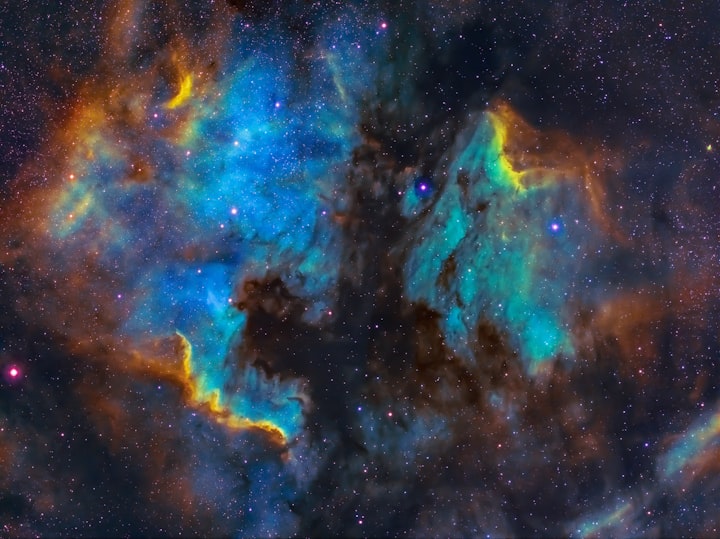
From the dawn of civilization, people have cast their eyes upon the night sky, captivated by its mesmerizing beauty. In the modern era, this insatiable curiosity propels us to venture across vast cosmic distances, striving to unravel the mysteries that define our place within the cosmos. We want to find our place in the universe and as we look towards our neighbours Venus and Mars, this brings up the question of whether we as humans are able to venture this far into space.
By Tracey te Braake2 years ago in Futurism
About Binding Prometheus
I want to start actively advocating on behalf of my own work, and the most valuable part of my canon is, without a doubt, Binding Prometheus, the play I have been working on since 2019 and only finished in 2023 as part of my MA. The play itself is an amalgamation of a million different inspirations. On one end, it evokes the Ancient Greek myth-play, deriving its own title from the earliest extant work of Western drama we have, Aeschylus’s Prometheus Bound. On the other end, it borrows significantly from the sci-fi bulwarks from over the years, namely Mary Shelley’s Frankenstein and Karel Capek’s Rossum’s Universal Robots. The play could be an episode of Black Mirror, I fear. I don’t know. I’ve only ever seen one episode of Black Mirror.
By Steven Christopher McKnight21 days ago in Futurism
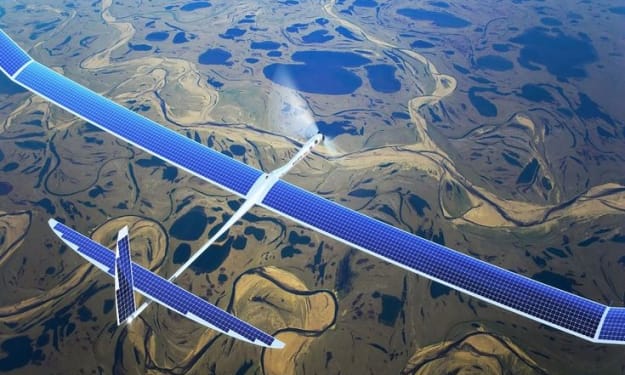
Solar-Powered UAV Market: Zero-Fuel Operations, Long-Duration Missions & Growth Drivers
According to IMARC Group's latest research publication, global solar-powered UAV market size reached USD 401.0 Million in 2024. Looking forward, IMARC Group expects the market to reach USD 867.3 Million by 2033, exhibiting a growth rate (CAGR) of 8.5% during 2025-2033.
By Andrew Sullivan7 days ago in Futurism


Comments
There are no comments for this story
Be the first to respond and start the conversation.