
Asia Pacific Injectable Drug Delivery Market Poised to Surge 60% to USD 282 Billion by 2031
Strategic Expansion in China, Innovation in Self-Administration Devices, and Rising Demand for Patient-Centric Solutions Position Region as Global Growth Leader

The Asia Pacific injectable drug delivery market is set to experience transformative growth, expanding from USD 176.96 billion in 2026 to USD 282.22 billion by 2031, representing a robust compound annual growth rate (CAGR) of 9.8%. This strategic market expansion signals critical opportunities for pharmaceutical executives, medical device manufacturers, and healthcare infrastructure investors across the region's rapidly evolving therapeutic landscape.
Download PDF Brochure of APAC Injectable Drug Delivery Market
What is driving this unprecedented market acceleration?
The convergence of several powerful forces is reshaping the injectable drug delivery ecosystem across Asia Pacific. The accelerating incorporation of biologics, biosimilars, and long-acting injectables is fundamentally transforming treatment paradigms, while the region's expanding patient population and escalating burden of chronic diseases create unprecedented demand for advanced delivery solutions. Strategic investments in formulation science, next-generation device engineering capabilities, and scalable sterile manufacturing capacity are enabling pharmaceutical companies to meet growing patient expectations for self-administration and patient-centric delivery systems.
Why does this matter now for global healthcare leaders?
The expanding pipeline of oncology, immunology, diabetes, and specialty therapies is converging with regional adoption of home-based care models, integrated digital health delivery platforms, and smart connected injection systems. This convergence creates a strategic inflection point where innovation meets market demand, positioning Asia Pacific as the epicenter of injectable drug delivery growth for the next decade.
China has emerged as the dominant force in this market transformation, commanding 36.1% market share in 2025 and projected to register the fastest growth rate through 2031. The nation's booming biologics and biosimilars sector, combined with favorable government investment in healthcare modernization and regulatory reforms accelerating commercialization timelines, establishes China as the strategic anchor market for global pharmaceutical operations.
Which product segments represent the highest-value opportunities?
The formulations segment is projected to capture the strongest growth trajectory at a 10.2% CAGR, reflecting the region's surging demand for biologics, biosimilars, vaccines, and chronic therapeutics. Substantial investments in research infrastructure and the rapid expansion of local biologics production capacity across major Asia Pacific markets are amplifying this segment's momentum. Within formulation packaging, ampoules maintained market leadership with a commanding 43.6% share in 2025, driven by their widespread deployment in hospitals, clinics, and government healthcare programs for vaccination campaigns, antibiotics, anesthetics, and acute care interventions.
Where is therapeutic innovation creating competitive advantage?
The obesity segment is positioned to grow at the fastest rate from 2026 to 2031, while autoimmune diseases accounted for the largest therapeutic share in 2025. The Asia Pacific region is witnessing substantial increases in rheumatoid arthritis, psoriasis, systemic lupus erythematosus, and inflammatory bowel diseases—chronic conditions requiring long-term injectable biologic and biosimilar therapies. Rapid uptake of advanced immunology treatments, enhanced access to specialty physician networks, and accelerating regulatory approvals for targeted biologics and biosimilars are strengthening this segment's market position.
Curative care applications dominated usage patterns with a 66.0% market share, as substantial volumes of injectable therapies across Asia Pacific address acute and chronic conditions demanding immediate therapeutic intervention. Robust demand across oncology, diabetes, infectious diseases, autoimmune disorders, and cardiovascular care solidifies the leadership position of curative applications in hospital and specialty center settings where rapid drug action proves critical.
How are administration methods evolving to meet patient demands?
Dermal-based administration is expected to register the highest CAGR of 10.4%, driven by widespread adoption of microneedle patches, transdermal systems, and minimally invasive delivery platforms across the region. These technologies deliver superior patient handling, reduced pain profiles, and enhanced compliance—critical factors as markets prioritize patient comfort and decentralized care models. High innovation activity in dermal and needle-free solutions, combined with expanding commercial availability in China, Japan, and South Korea, positions this administration route for sustained growth.
Hospitals and clinics dominated end-user segments with 56.4% market share in 2025, maintaining their position as primary treatment centers for acute, chronic, and specialty injectable therapies throughout Asia Pacific. These facilities manage the largest patient volumes while providing professional infrastructure, trained clinical staff, and controlled environments essential for complex biologics, oncology injectables, and emergency medications. Escalating healthcare infrastructure investments and rising hospitalization rates continue reinforcing this segment's market leadership.
Who are the strategic players shaping competitive dynamics?
BD (US), Terumo Corporation (Japan), and Nipro (Japan) have established themselves as star players through extensive global reach and comprehensive product portfolios spanning devices and delivery systems. On the pharmaceutical side, Pfizer Inc. (US), Sanofi (France), and F. Hoffmann-La Roche Ltd (Switzerland) leverage large-scale manufacturing capacity and vast international presence to maintain competitive positioning. The competitive landscape is being reshaped by partnerships between pharmaceutical corporations, device developers, and regional contract development and manufacturing organizations (CDMOs), as well as upcoming innovations including AI-based formulation tools, aseptic manufacturing automation, smart injectors, and wearable delivery systems.
Strategic Market Dynamics Reshaping the Competitive Landscape
The growth trajectory in Asia Pacific's injectable drug delivery sector stems from intensifying demand for outsourced fill-finish services and device development capabilities, coupled with growing emphasis on patient-friendly administration for chronic and specialty conditions. Pharmaceutical and biotechnology companies—the primary customers for advanced injectable solutions—are accelerating their dependence on integrated drug-device expertise, regional outsourcing partnerships, and innovation-led differentiation to maintain competitive advantage.
Critical Growth Driver: Rapid Rise of Chronic Diseases
Injectable therapy adoption is accelerating in direct response to surging incidence rates for diabetes, cancer, cardiovascular diseases, and autoimmune disorders across the region. These chronic conditions overwhelmingly require potent medications administered via injection for optimal therapeutic efficacy. Population growth combined with advancing injectable delivery system technologies is enhancing therapeutic outcomes while driving substantial regional demand for sophisticated formulations and delivery devices.
Market Opportunity: Expanding Biologics and Biosimilars Pipeline
Asia Pacific is emerging as a global epicenter for biologics and biosimilar development, with significant pipeline expansion in oncology, immunology, and metabolic disease therapeutics. Advanced biological therapies demand sophisticated injectable delivery systems, creating robust demand for innovative devices and formulations. Governments and pharmaceutical companies are channeling substantial capital into biologics manufacturing infrastructure, establishing excellent long-term opportunities for device manufacturers and formulation specialists positioned to support this expanding pipeline.
Strategic Challenge: High Cost of Advanced Injectable Devices and Biologic Therapies
Advanced injectable devices designed for biologics and high-viscosity formulations require substantial development and manufacturing investment, constraining affordability in price-sensitive Asia Pacific markets. Biologic drugs carry high treatment costs that further limit widespread adoption, while inadequate reimbursement frameworks restrict patient access across several regional markets. These cost pressures present strategic obstacles to accelerated deployment of next-generation injectable technologies.
Regulatory Complexity: Navigating Fragmented Frameworks
The Asia Pacific region's heterogeneous regulatory environment—characterized by distinct systems, approval timelines, and medical device classification pathways across individual countries—significantly increases market entry complexity for injectable products. Limited regulatory harmonization elevates compliance burdens and development costs, creating barriers to market entry and complicating commercialization strategies for companies seeking regional scale.
Strategic Implications for C-Suite Decision-Makers
The Asia Pacific injectable drug delivery market represents a high-growth, strategically critical opportunity where demographic trends, disease burden, technological innovation, and healthcare infrastructure investment converge. Executives must evaluate integrated strategies encompassing regional manufacturing partnerships, regulatory navigation expertise, patient-centric device innovation, and biologics capability development to capture market leadership in this dynamic landscape.
Organizations positioned to deliver cost-effective solutions addressing chronic disease management, leverage emerging administration technologies, and navigate complex regulatory environments will establish sustainable competitive advantages as the market expands toward USD 282 billion by 2031.
About the Creator
Keep reading
More stories from Juan Martinez and writers in Futurism and other communities.
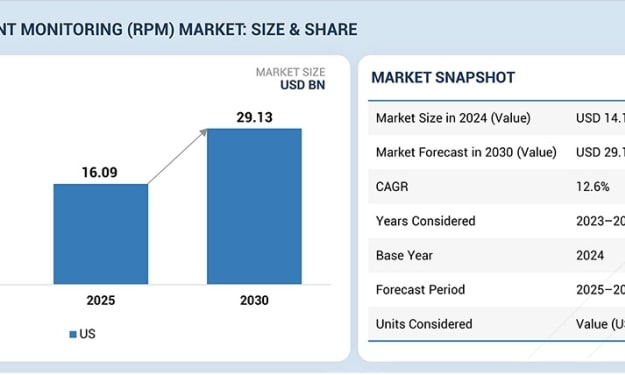
US Remote Patient Monitoring Market Surges to $29.13 Billion by 2030
The Remote Patient Monitoring (RPM) market in the United States is evolving rapidly, becoming a fundamental element of contemporary healthcare systems and a key focus for healthcare leaders across the country. The market was worth $14.15 billion in 2024 and is expected to grow to $16.09 billion in 2025. Forecasts indicate a strong compound annual growth rate (CAGR) of 12.6% until 2030, with a total market value of $29.13 billion anticipated by the close of the decade.
By Juan Martinez14 days ago in Futurism
Silicon of the South: 7 Atlanta App Agencies Changing the Tech Landscape
I remember walking through Tech Square a few years ago and feeling a quiet hum that I couldn't quite place. It wasn't just the usual city noise. It was the sound of a place beginning to realize its own potential. For a long time, Atlanta was known for big soda, big airlines, and big logistics. But lately, when I sit in a coffee shop in Midtown, the conversations around me have changed. People aren't just talking about moving goods; they’re talking about moving data.
By Mary L. Rodriquez6 days ago in Futurism
Saudi Arabia 5G Chipset Market: Deployment Growth, Device Adoption & Technology Innovation
The Saudi Arabia 5G chipset market size reached USD 95.9 Million in 2025. Looking forward, IMARC Group expects the market to reach USD 966.1 Million by 2034, exhibiting a growth rate of 29.26% during 2026-2034.
By Faisal Al-Harbi7 days ago in Futurism
The Angry Man in Your House
"If you grow up with an angry man in your house, there will always be an angry man in your house" This statement has caused plenty of controversy online, people say its a statement that blames victims while also undermining those who break traumatic cycles to form health relationships... but if I'm honest now that I'm in my 30s it makes more sense to me than ever, and I'd argue that its not just about fathers and uncles.
By S. A. Crawford3 days ago in Humans



Comments
There are no comments for this story
Be the first to respond and start the conversation.