
A Mysterious Relic Galaxy: A Frozen Echo of the Early Universe
Space

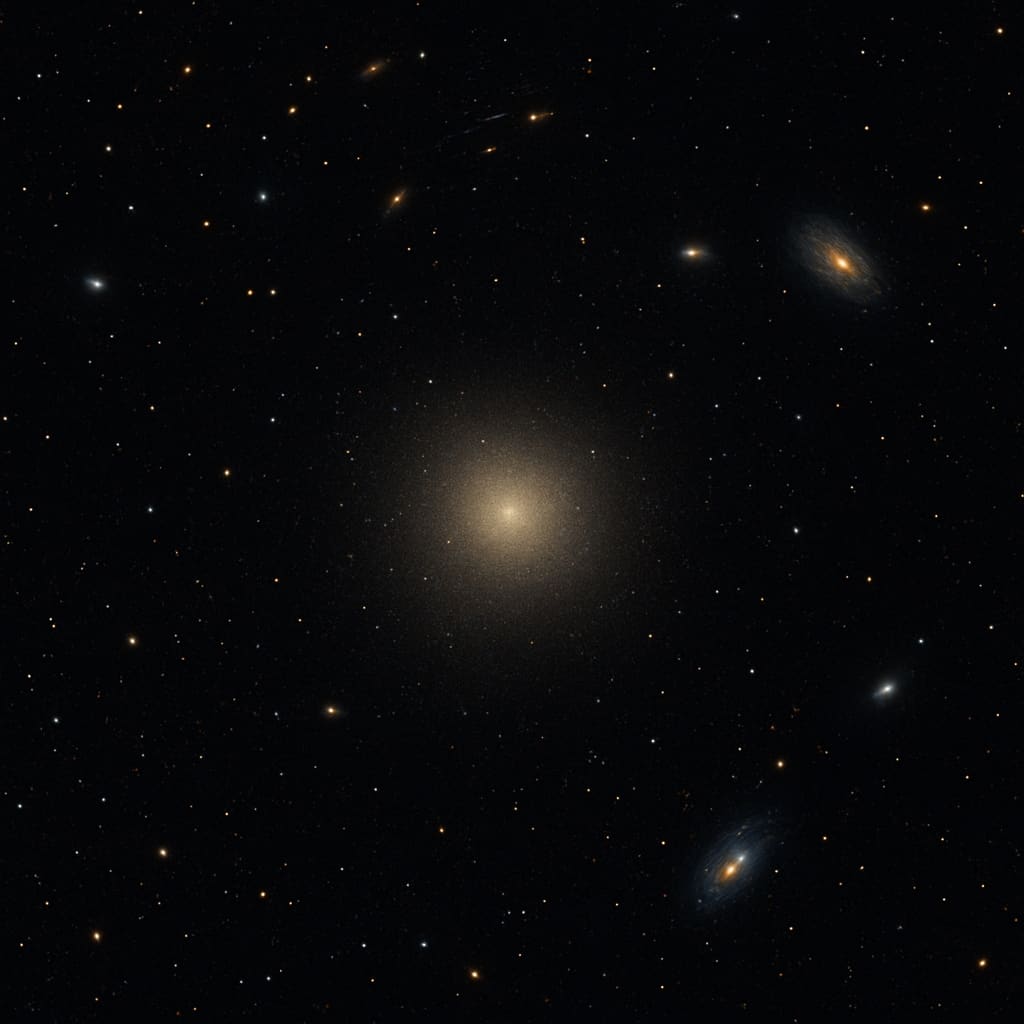
Every time astronomers point their most advanced telescopes toward the depths of the cosmos, they are essentially peering back in time. Light from the most distant galaxies travels for billions of years before reaching us, carrying with it precious clues about the infancy of our Universe. Recently, researchers announced a remarkable discovery: a new relic galaxy that has preserved the characteristics of some of the very first cosmic structures born after the Big Bang.
This galaxy is not just another faint smudge on the astronomer’s map — it is a living fossil, a cosmic time capsule that holds secrets about how the first stars and galaxies were formed.
What Exactly Is a Relic Galaxy?
The term “relic galaxy” refers to a rare type of system that has remained largely unchanged since its birth, more than 12 billion years ago. Unlike the Milky Way, which has been shaped by countless mergers, collisions, and waves of star formation, relic galaxies avoided the usual cosmic drama. They never grew much larger, never fused with other galaxies, and never experienced a significant “second generation” of star birth.
The stars inside them are ancient, containing very few “metals” — the astronomical term for all elements heavier than helium. Since heavier elements are forged in the hearts of stars and spread across the cosmos through supernova explosions, their absence suggests that the stars of relic galaxies were formed at the dawn of cosmic history, before the Universe was chemically enriched.
The New Discovery
The recently identified relic galaxy is unusually compact and faint, almost ghost-like compared to modern galaxies. Yet it shines with a story billions of years old. Its stellar population suggests that nearly all of its stars were born in the first two billion years after the Big Bang. Since then, the galaxy seems to have gone quiet, frozen in time, showing no signs of active star formation.
What makes it so extraordinary is its “purity.” Spectroscopic analysis reveals that its stars lack the heavier elements we see in most other galaxies today. In other words, this galaxy carries the same chemical fingerprint that the earliest galaxies of the Universe would have had.
It is as if someone pressed pause on its evolution right after it formed.
Why It Matters
For cosmologists and astrophysicists, relic galaxies are priceless laboratories. They allow us to test the predictions of the Big Bang theory and models of galaxy formation in a way that no simulation on a computer ever could.
By studying this galaxy, scientists hope to answer key questions:
- What did the very first galaxies look like?
- How did stars form when there were almost no heavy elements available?
- Why did some galaxies, like this one, stop evolving, while others grew into giants like the Milky Way?
Every observation of a relic galaxy is like holding up a mirror to the early Universe.
A Survivor Against All Odds
One of the greatest puzzles is how such a fragile system managed to survive for billions of years without being consumed by larger galaxies. Most small galaxies were eventually swallowed by their bigger neighbors — our Milky Way alone has devoured dozens over its lifetime.
So how did this one escape destruction? Astronomers propose several explanations. Perhaps it was located in a quiet, low-density region of space, far away from galaxy clusters and violent interactions. Or maybe its orbit and motion through the cosmos kept it isolated from cosmic predators. Whatever the reason, this galaxy has remained a solitary witness to the Universe’s earliest chapter.
It is not an exaggeration to say that this tiny system is like a coral reef surviving a million storms — fragile yet enduring, vulnerable yet untouched.
The Role of Modern Telescopes
Such discoveries are only possible thanks to the new generation of space observatories. While the Hubble Space Telescope first revealed glimpses of early galaxies, it is the James Webb Space Telescope (JWST) and its successors that now allow scientists to detect faint, compact systems like this one with incredible detail.
With each observation, astronomers are pushing back the frontier of cosmic history. This relic galaxy, in particular, could become a benchmark for future studies, helping scientists fine-tune their models of how galaxies evolve — and why some refuse to evolve at all.
A Message From the Past
In a sense, this galaxy is like a message in a bottle, drifting across the ocean of space for over 13 billion years until it reached us. It tells a story of the Universe before it became rich with elements, planets, and eventually life. It reminds us that our cosmic home, filled with stars, planets, and even us, was once a barren and simple place.
The discovery also sparks the imagination. If a handful of galaxies can remain untouched for billions of years, what else might be hiding in the dark corners of the cosmos, waiting for us to find it?
Final Thoughts
The new relic galaxy is more than just an astronomical curiosity. It is a time machine, a frozen echo of the dawn of creation. By studying it, we come closer to understanding how everything we know — stars, planets, life — emerged from the primordial fireball of the Big Bang.
And perhaps, as more of these galactic fossils are uncovered, we will not just piece together the history of the cosmos but also glimpse the delicate balance that allowed it to evolve into the Universe we call home.
About the Creator
Keep reading
More stories from Holianyk Ihor and writers in Futurism and other communities.
Neutrino Mass Oscillations Measured Through Cosmology for the First Time
In the vast stage of the universe, few players are as elusive as the neutrino. These ghostlike particles stream through everything—our planet, our bodies, even entire stars—without leaving a trace. Every second, trillions of them pass through you, yet you don’t feel a thing. For decades, scientists believed neutrinos were completely massless. But subtle experiments at the end of the 20th century proved otherwise: neutrinos do have mass, however tiny.
By Holianyk Ihor4 months ago in Futurism
About Binding Prometheus
I want to start actively advocating on behalf of my own work, and the most valuable part of my canon is, without a doubt, Binding Prometheus, the play I have been working on since 2019 and only finished in 2023 as part of my MA. The play itself is an amalgamation of a million different inspirations. On one end, it evokes the Ancient Greek myth-play, deriving its own title from the earliest extant work of Western drama we have, Aeschylus’s Prometheus Bound. On the other end, it borrows significantly from the sci-fi bulwarks from over the years, namely Mary Shelley’s Frankenstein and Karel Capek’s Rossum’s Universal Robots. The play could be an episode of Black Mirror, I fear. I don’t know. I’ve only ever seen one episode of Black Mirror.
By Steven Christopher McKnight18 days ago in Futurism
Australia Electric Vehicle Market: Clean Mobility, Smart Transport & Energy Transition
In 2025, Australia electric vehicle (EV) market was valued at USD 21.1 Billion. Looking ahead, the market is expected to surge to USD 205.5 Billion by 2034, exhibiting an exceptional compound annual growth rate (CAGR) of 28.80% during 2026–2034.
By Kevin Cooper6 days ago in Futurism



Comments
There are no comments for this story
Be the first to respond and start the conversation.