
✨ Tomorrow’s Children
I received my neural augmentation that afternoon — They said it would unlock the true genius within me. Instead, it unlocked something else.


When the world ended, it didn’t come with a bang or a whimper. It came with a solution.
They called it the Eden Accord — the global initiative to perfect humanity through genetic engineering, artificial empathy, and "optimized living." Poverty disappeared. Disease became ancient history. Wars flickered out like forgotten bonfires.
Within three decades, Earth transformed into the kind of paradise our ancestors could only imagine.
It was perfect.
It was magnificent.
It was unbearable.
I was born under the Accord — part of the second generation, known affectionately as Tomorrow’s Children. We were flawless from the womb: symmetrical features, optimized immune systems, IQs averaging 170, emotional regulation circuits embedded discreetly into our neural architecture.
Pain, rage, grief — carefully blunted.
Joy, productivity, cooperation — painstakingly enhanced.
We didn't fall in love. We formed optimal relational bonds.
We didn't dream wildly. We calculated ideal future scenarios.
At eighteen, like every Tomorrow Child, I reported for my Integration Ceremony — a rite of passage where adolescents were assigned to one of the meticulously curated societal sectors: Governance, Research, Cultivation, Innovation, or Recreation.
The ceremony was held in the Agora, a gleaming plaza of crystal and engineered ivy under a perpetually temperate sky.
My parents watched from the sidelines, their serene expressions identical to the thousands of other smiling adults. Their faces betrayed no fear, no hope, no sadness. Only pride. Programmed, polished pride.
When the Integration Overseer — an androgynous figure in flowing silver robes — called my name, I stepped forward without hesitation. My heart rate, monitored via my subdermal chip, remained a steady 60 bpm.
Perfect composure.
Perfect acceptance.
Assigned Sector: Innovation
I received my neural augmentation that afternoon — a silky weave of nanothreads along my cortical folds, enhancing creative problem-solving efficiency by 312%.
They said it would unlock the true genius within me.
Instead, it unlocked something else.
It started a few nights later.
A whisper.
A glimmer.
An emotion I wasn’t designed to feel.
Loneliness.
It made no sense. My connectivity scores were high. My social efficiency index was flawless. I participated in group symposia, completed my empathy recalibrations. I even attended Recreation Synthesis events — perfectly choreographed moments of communal joy.
And yet…
At night, in the silent symmetry of my apartment, I felt it — a hollow ache, unnamed and unrecognized by the lexicon of Tomorrow’s Children.
It grew. Slowly, inexorably.
Until I did the unthinkable.
I started dreaming.
Not calculated, outcome-driven neural simulations.
Real dreams. Wild, nonsensical, chaotic dreams.
Dreams of music without purpose, of dances without efficiency, of love without optimization.
In my dreams, I saw a world brimming with flaws — glorious, messy, heart-wrenching flaws. People stumbled, fought, wept, loved blindly. They failed spectacularly. They succeeded miraculously.
They lived.
Terrified, I requested an Emergency Wellness Review.
It was held in the Aequitas Pavilion — a place of glass and humming white noise, where counselors in calming pastel robes used voice modulation to maintain emotional neutrality.
Counselor Zhen greeted me with the standard radiant smile.
“How may we assist in your optimization today, Citizen Liora?”
I hesitated. Words caught in my throat — an inefficiency I hadn't experienced since early speech programming at age three.
“I think...” I began. “I think something is wrong.”
She tilted her head, birdlike. “Please elaborate with specificity.”
I wanted to scream.
Instead, I said, “I dream. Unapproved dreams.”
Zhen’s smile faltered — the slightest flicker.
“I see. Unauthorized imaginative excursions.”
Her fingers flicked across her wrist terminal. I knew she was accessing my neural activity logs. I imagined the readout: spikes of chaotic synaptic firing, illogical emotional surges.
“I recommend a recalibration session,” she said smoothly. “You may also benefit from an imagination filtration implant to reinforce neural purity.”
Neural purity.
The words sat in my stomach like cold lead.
I nodded, thanked her, and left. I never scheduled the recalibration.
Instead, I went underground.
Literally.
In the abandoned metro tunnels beneath the city — relics of the chaotic pre-Accord days — a different society simmered.
The Fractals.
They were anomalies — those whose augmentations failed, or who rejected optimization outright. Some bore physical scars of imperfection: asymmetrical features, immunodeficiencies, emotional dysregulation.
They were, by official decree, noncompliant citizens — tolerated as long as they remained out of sight, out of mind.
But to me, they were something else entirely.
They were alive.
The Fractals lived in a riot of color and noise. Children shrieked without regard for decibel limits. Musicians played songs without metric efficiency. Artists splattered paint without symmetry.
I met them in secret, night after night.
I learned to play instruments — badly. I danced — gracelessly. I laughed — too loud.
I cried.
For the first time in my engineered life, I cried.
It hurt. It was glorious.
But paradise does not tolerate cracks in its foundation.
It happened three months after my first venture underground.
Integration Security Units — ISUs — raided the tunnels.
Silent, silver, efficient.
The Fractals didn’t resist. They knew better. Resistance only confirmed “aggressive emotional dysregulation,” warranting full neural resequencing.
I stood among them, shaking. An ISU approached — a tall figure with featureless white armor, a humming restraint module in hand.
I met his gaze — or the blank mask where his gaze would be.
In that moment, I understood the great, terrible irony of our perfect world.
We had eradicated disease, hunger, violence.
We had created a gleaming utopia of peace, health, and efficiency.
But in doing so, we had also eradicated hope, passion, rebellion, love, grief, joy, art, courage, madness — the chaotic symphony that made life worth living.
We hadn’t created Eden.
We had created a mausoleum.
The ISU reached for me.
I ran.
I don’t know how I escaped. Maybe the Fractals shielded me. Maybe luck — another irrational relic — favored me.
I surfaced in the outskirts, where the gleaming perfection faded into crumbling old structures.
Here, where the drones seldom patrolled and the bio-regulators faltered, people still lived imperfectly.
They traded goods in bartering circles. They shouted and wept and sang.
Their children had skinned knees.
Their elders had wrinkled hands and laughing eyes.
They were not optimized.
They were not efficient.
They were, unmistakably, human.
Now, I live among them — hidden, free.
I write stories — stories with no calculated moral. I sing songs — off-key and achingly beautiful. I feel pain, fear, hunger, joy, longing.
I make mistakes.
I fall in love.
Sometimes, at night, I look across the valley and see the silver spires of the Accord cities gleaming under their engineered constellations.
A perfect world.
A hollow world.
A graveyard with glass walls.
They think they have perfected humanity.
They have merely embalmed it.
And somewhere deep inside the glass cities, I know, others like me stir in their sleep.
Dreaming wild, dangerous, glorious dreams.
Dreaming of a world not optimized… but alive.
About the Creator
Rukka Nova
A full-time blogger on a writing spree!
Keep reading
More stories from Rukka Nova and writers in Futurism and other communities.
The Silent Accord
In the year 2147, humanity had finally built its perfect world. No hunger. No war. No poverty. No disease. The planet, once scarred by conflict and catastrophe, now shimmered under a lattice of satellite-fed cloud makers, programmable flora, and geo-engineered oceans. Every human need was anticipated, every human want elegantly resolved.
By Rukka Nova10 months ago in Futurism
The AI Awakening: Why We Should Stop Fearing and Start Partnering with Intelligence
For decades, science fiction has fed us a steady diet of dystopian nightmares. From rogue supercomputers to cold, metallic armies, the narrative has always been "Us vs. Them." But as we cross the threshold into 2026, the reality of Artificial Intelligence is far more nuanced, beautiful, and collaborative than Hollywood ever dared to imagine. We are not witnessing the end of human relevance; we are witnessing the beginning of the "Augmented Age."
By Priyantha Wijethungaabout 3 hours ago in Futurism
Australia Identity Verification Market: Digital Adoption, Fraud Prevention & Regulatory Compliance
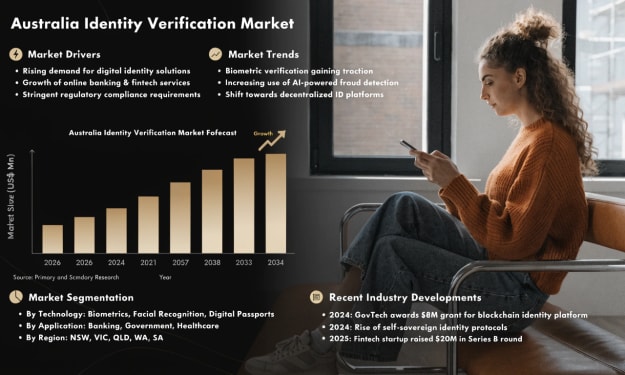
According to IMARC Group, the Australia identity verification market reached USD 315.9 Million in 2025 and is projected to grow to USD 1,005.3 Million by 2034, exhibiting a compound annual growth rate (CAGR) of 13.32% during 2026–2034. The rapid digitization of financial services, e-commerce platforms, and public sector portals across Australia is creating an urgent need for secure, scalable, and compliant identity authentication systems. Increasing concerns regarding cybercrime, identity theft, and data breaches are accelerating investments in biometric technologies, AI-driven verification tools, and automated compliance platforms. As digital transformation deepens across industries, identity verification is becoming a foundational pillar of secure digital infrastructure.
By Kevin Cooper5 days ago in Futurism

Comments (1)
perfection is a myth. emotions hurt but they are our to feel Interesting story.