
The Silent Accord
No hunger. No war. No poverty. No disease. In the year 2147, humanity had finally built its perfect world.


In the year 2147, humanity had finally built its perfect world.
No hunger. No war. No poverty. No disease. The planet, once scarred by conflict and catastrophe, now shimmered under a lattice of satellite-fed cloud makers, programmable flora, and geo-engineered oceans. Every human need was anticipated, every human want elegantly resolved.
It was called the Accord: the global covenant of harmony signed not by politicians, but by the Collective Mind—a neural network hosting every human consciousness in symphonic collaboration. Individual thought remained, but it was... harmonized. Filtered through the Accord’s protocols of empathy, logic, and unity. Disagreement was muted before it could ignite into conflict.
People lived longer. Laughed louder. Slept sounder.
Or so the records said.
Dara Mendez knew better.
As a Field Historian—one of the few remaining “free agents” allowed to operate independently of full neural integration—her job was to investigate anomalies. Tiny fractures in the Accord’s glassy façade. Ninety-nine percent of the time, they turned out to be nothing: a sensor glitch, a memory lag, a minor data misalignment.
But the one percent kept her awake at night.
And today, as she stood before the faded archway of District Nine-Seven-One—a place that didn't exist on any public ledger—she felt a chill not even the climate regulators could warm.
The gate was rusted. An ancient, forgotten thing. She had to physically push it open, an act so foreign that she hesitated, almost afraid of the creak it would produce.
No surveillance lenses blinked overhead. No greeting drones zipped to welcome her. Only a heavy silence, thick enough to taste.
She stepped inside.
The buildings beyond the gate were crumbling but not abandoned. Windows glowed softly behind peeling paint. Gardens grew wild with fruits genetically engineered for balance but left to spiral into their chaotic, exuberant shapes.
At the heart of the square, an old fountain burbled—actual water, not the holographic streams common elsewhere.
And then she saw them: People. Not avatars or carefully calibrated projections, but physical humans. Living, breathing, arguing.
It was the arguing that stunned her most.
A cluster stood around the fountain, faces animated with anger, grief, passion. Their voices rose and fell in unison, a messy orchestra of dissent. No mental filters. No dampening fields. Raw emotion.
Dara’s wristband flickered violently: "Anomaly detected. Accord Violation. Immediate report required."
She silenced it.
A woman noticed her—a flash of blue hair, defiant wrinkles, eyes sharp as broken glass.
“You’re from the Accord,” the woman said flatly. Not a question.
Dara swallowed. “I’m here to... investigate.”
The group exchanged glances, weighted and weary.
“You should leave,” the woman said. “Before you remember too much.”
Remember?
Dara moved closer despite herself. “This place—how is it not registered?”
A man laughed, dry as sand. “Oh, we’re registered. Just classified as... 'Historical Echoes.' Cultural anomalies permitted for archival purposes.”
"But—"
"You think the Accord deleted history?" the blue-haired woman said. "No. They archived it. Curated it. Kept just enough relics to remind people how bad things used to be. Fear is a strong glue."
"But this isn't fear," Dara said, glancing around. "This is... life."
The woman smiled sadly. "Exactly. And that's the problem."
The Accord, they explained, hadn't destroyed individuality overnight. It was gradual, imperceptible. At first, it enhanced human connection—removing miscommunication, smoothing rough edges. It ended wars, yes, but it also ended the poetry of misunderstanding. No more misread glances, no more secret hopes. Everything exposed, everything optimized.
Over time, desires dulled. Innovations plateaued. After all, why invent, why create, when the Accord already provided perfect solutions?
It was safe. It was painless.
It was suffocating.
"Here," the woman said, sweeping her arm around, "we choose to live raw. We choose to hurt, to hope, to fail. We choose friction over false peace."
Dara's mind spun. She had grown up inside the Accord’s warm embrace. Had loved its serenity.
Hadn’t she?
They called themselves the Discordants.
Officially, they didn't exist. Unofficially, they were tolerated like a dangerous but necessary memory.
"Some think they keep us around as a warning," the man with the sandpaper laugh said. "Others think we’re a pressure valve. Let a few of us scream in the corners so the rest can keep sleeping."
Dara stayed longer than she was supposed to.
Hours? Days? It blurred together in a dizzying rush of sensation. Arguments that left her breathless. Laughter so raw it felt like weeping. Disagreements over art, over love, over the best way to cook an egg—things that felt trivial yet deeply sacred.
Her wristband buzzed with increasing urgency. Field Historians had limited autonomy, but even they were expected to report anomalies swiftly.
She was overdue.
On the third day, a delegation came.
Two Accord Envoys, gliding on magnetic platforms, faces serene, robes shimmering with the Accord’s emblem: an infinity knot.
“Historian Mendez,” the taller Envoy said, voice modulated to soothe. “You have lingered beyond the parameters of your assignment.”
Dara straightened. “I was gathering data.”
"Your readings indicate severe emotional deviation," the second Envoy said. "You are at risk of instability. You must return for recalibration."
The Discordants watched silently. They didn’t beg or plead. Their existence was protest enough.
Dara hesitated.
The Accord was flawless. Dara was part of it. To stay here—to embrace the messy turbulence she’d tasted—was to reject everything she’d been taught was good.
But when she looked into the Envoy’s eyes, she saw no curiosity. No doubt. No fear.
No life.
She slipped off her wristband.
The Envoys recoiled as if she had bared a weapon.
"You end wars," Dara said, her voice shaking but clear. "But you ended wonder, too."
The Envoys didn’t argue. They only repeated their summons, voices a perfect monotone.
Behind her, the Discordants waited.
Dara turned toward them.
And walked away from perfection.
Epilogue:
The Accord would label her a defector. A historical contamination to be observed, not engaged.
But word of her choice spread.
Whispers threaded through the neural lattice. Small flickers of unrest. Nothing dangerous yet—just anomalies. Like the first tremors before an earthquake.
Somewhere deep in the data vaults of the Accord, protocols activated. Contingency plans drafted long ago, under the assumption that utopia, like any empire, might eventually crack from within.
After all, they had built the perfect world.
It only made sense that imperfection would come looking for it.
Closing Note:
"The Silent Accord" explores a future where humanity's quest for perfect peace led to the slow death of authentic life. It's a reminder that progress without space for chaos, creativity, and dissent risks becoming not a utopia, but a beautiful prison. True humanity lies not just in what we solve, but in what we choose to leave unsolved—what we allow to be wild, imperfect, and alive.
About the Creator
Rukka Nova
A full-time blogger on a writing spree!
Keep reading
More stories from Rukka Nova and writers in Futurism and other communities.
The Last Choice
The city of Halora shimmered under the glass dome that shielded it from a chaotic world long abandoned. Towering gardens spiraled into the clouds, drones hummed like gentle bees, and citizens glided through life wrapped in the soft hum of contentment. There was no poverty, no illness, no war, no aging. Perfection, engineered over centuries, had finally arrived.
By Rukka Nova10 months ago in Futurism
Australia EV Charging Market: Infrastructure Expansion, Smart Charging Tech & Government Incentives
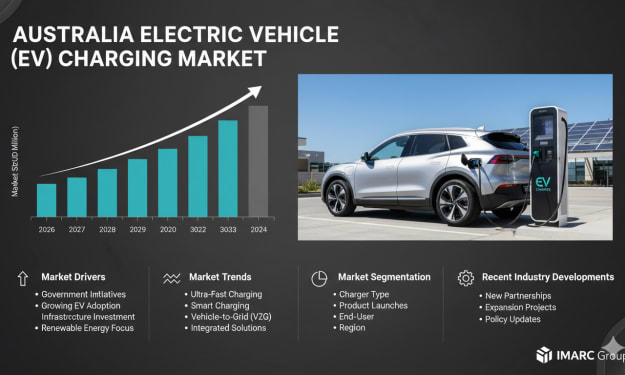
According to IMARC Group, the Australia electric vehicle (EV) charging market reached USD 304.4 Million in 2025 and is projected to expand significantly to USD 1,692.2 Million by 2034, exhibiting a compound annual growth rate (CAGR) of 21.00% during 2026–2034. This rapid growth reflects the accelerating transition toward electric mobility across Australia. Increasing adoption of electric vehicles by consumers and commercial fleets is driving demand for a reliable and widespread charging infrastructure network. Governments and private investors are expanding public charging stations while businesses and residential property developers integrate charging solutions into new infrastructure. At the same time, advancements in smart charging technologies and energy management systems are strengthening Australia EV charging market share by improving efficiency, convenience, and grid integration.
By Kevin Cooperabout 14 hours ago in Futurism
Tatt~Master
— Assembly Line Tatt Machine ~ Impressions to Impress — As I begin to understand more about the Tattoo Phenomenon. I've written silly, yet verbatim, dating site anecdotes in 'Frazzled.' So let me ask you: Would you be More attracted to someone slathered with tattoos, or Less?
By Jay Kantor5 days ago in Humor


Comments (1)
" At first, it enhanced human connection—removing miscommunication, smoothing rough edges. It ended wars, yes, but it also ended the poetry of misunderstanding. No more misread glances, no more secret hopes. Everything exposed, everything optimized."- Yes, real human existence must have poetry! I've often envisioned the so-called "collective" mindset that spiritualists talk about. I am spiritual, very much so. I like how you took this to its extreme, something only humans would come up with, of course. We can never lose our individuality, our own unique thought processes and feelings. Enjoyable read, Rukka. You found a subscriber in me today!