
Power Market in Saudi Arabia: Renewable Integration, Demand Growth & Infrastructure Upgrades Under Vision 2030
How renewable energy integration, grid modernization, and rising electricity demand are reshaping generation strategies and investment priorities in Saudi Arabia’s power sector.

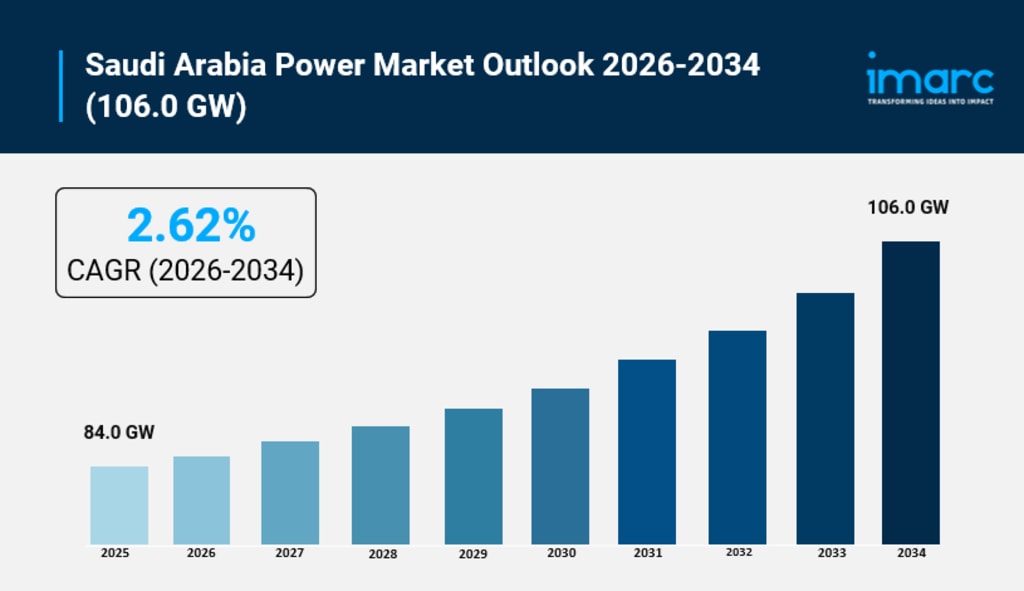
According to IMARC Group's latest research publication, the Saudi Arabia power market size reached 84.0 GW in 2025. Looking forward, IMARC Group estimates the market to reach 106.0 GW by 2034, exhibiting a CAGR of 2.62% from 2026-2034.
How AI is Reshaping the Future of Saudi Arabia Power Market
- Predictive Grid Management: AI algorithms analyze real-time weather and consumption data from 11 million smart meters to forecast power demand with remarkable precision, preventing overloads and costly imbalances while optimizing generation and grid feed-in across solar-powered regions like NEOM.
- Smart Grid Automation: Distribution network automation reached 40% completion, with AI-driven systems enabling proactive incident response, accelerating recovery times, and improving service reliability through analysis of smart-meter data that supports data-driven decision-making across the Kingdom's modernizing electricity infrastructure.
- Renewable Energy Optimization: AI systems dynamically balance renewable inputs from solar and wind sources in real-time, maintaining grid stability while reducing reliance on fossil-fuel backups, ensuring seamless integration of variable renewable energy across Saudi Arabia's expanding 64 GW clean energy portfolio.
- Advanced Control Centers: Nine AI-powered control centers under development will leverage cutting-edge technology for precise real-time monitoring and grid management, enabling optimal performance through automated load flow analysis, demand forecasting, and instant response to distribution network fluctuations.
- Energy Storage Intelligence: AI-driven battery energy storage systems manage 8 GWh of operational capacity and optimize 22 GWh under development, intelligently dispatching stored renewable energy during peak demand periods while ensuring grid balance and supporting the national 48 GWh storage target.
How Vision 2030 is Revolutionizing Saudi Arabia Power Industry
Vision 2030 is fundamentally transforming Saudi Arabia's power sector through massive investments in renewable energy and grid modernization. The Kingdom has committed USD 270 billion toward clean energy infrastructure, targeting 50% electricity generation from renewables and 130 GW total capacity, split between 58.7 GW solar and 40 GW wind. Major initiatives include USD 8.3 billion for 15 GW of solar and wind projects operational by 2028, USD 8.4 billion for NEOM's 3.9 GW green hydrogen facility producing 600 tonnes daily, and over 4.5 GW awarded to Masdar, TotalEnergies, and EDF for projects including the 1.5 GW Dawadmi Wind Energy Project. Saudi Arabia has already connected 12.3 GW of renewable capacity to the grid from nearly 64 GW under development, while deploying 8 GWh battery storage with an additional 22 GWh in progress toward 48 GWh by 2030. The power sector aims for a 55% emissions reduction, supported by SAR 12.3 billion (USD 3.3 billion) in solar PV agreements delivering 5,500 MW. Nine advanced control centers and 40% grid automation enhance reliability, while projects like Sakaka Solar Plant and the 400 MW Dumat Al Jandal wind farm demonstrate tangible progress toward net-zero by 2060.
Request Your Free Sample Report with Market Forecast Highlights
Saudi Arabia Power Market Trends & Drivers:
Renewable energy expansion is reshaping Saudi Arabia's power generation landscape at unprecedented scale. The Kingdom has increased connected renewable capacity by over 300% recently, with 12.3 GW of clean energy now integrated into the national grid from nearly 64 GW under development. ACWA Power leads with 34 GW of solar and wind projects across 21 developments in Saudi Arabia, backed by USD 17 billion in joint investments with Badeel and Saudi Aramco Power Company. Power purchase agreements signed for eight projects delivering 10.9 GW of combined gas-fired and solar capacity demonstrate systematic diversification. The Sakaka Solar Plant delivers low-cost renewable power through 1.2 million panels, while the 400 MW Dumat Al Jandal wind farm produces energy at a remarkable 1.57 cents per kilowatt-hour through the 600 MW AlGhat project. Major developments like Bisha (3,000 MW solar), Humaij (3,000 MW solar), and Starah (2,000 MW wind) are attracting billion-dollar financing from international banks. The USD 8.4 billion NEOM green hydrogen facility combining 3.9 GW of solar, wind, and battery storage represents the world's largest commercially-based clean hydrogen installation.
Smart grid modernization and digitalization are revolutionizing power infrastructure management across the Kingdom. The government allocated SAR 12 billion for AI initiatives under Vision 2030, driving deployment of 11 million smart meters by Saudi Electricity Company over three years, enabling real-time monitoring and detailed usage insights. Distribution network automation reached 40% completion, surpassing international best practices for return on investment, with nine advanced control centers scheduled for completion providing precise real-time grid monitoring. The smart grid network market reached USD 765.59 million and is expanding rapidly with IoT sensors, AI analytics, and blockchain-based tracking enhancing operational efficiency. Smart grids facilitate seamless renewable integration by managing variability from solar and wind sources while maintaining stability through automated load balancing. Digital platforms analyze consumption patterns, predict demand fluctuations, and optimize energy distribution during peak periods. NEOM's USD 500 billion smart city incorporates cutting-edge zero-emission transport systems powered entirely by renewables.
Government-led infrastructure investments and policy reforms are accelerating capacity expansion throughout the power sector. The Public Investment Fund channels massive funds into renewable ventures while de-risking large-scale projects, having committed to achieving 70% of the Kingdom's renewable energy target capacity through strategic partnerships. The National Renewable Energy Program uses competitive bidding to ensure transparency and cost-efficiency, attracting international firms including Marubeni Corporation, TotalEnergies, and Korea Electric Power Corporation. Power purchase agreements spanning up to 50 years provide stable revenue streams and reduce market volatility exposure for developers. Saudi Power Procurement Company acts as principal buyer, having launched projects with 43 GW total capacity and signed agreements for 38 GW while connecting 10.21 GW to the grid. The Carbon Circular Economy Framework endorsed during Saudi Arabia's G20 presidency encourages carbon capture, utilization, and storage technology partnerships. Research hubs like King Abdullah Petroleum Studies and Research Centre foster collaboration between universities, startups, and global clean tech firms.
Saudi Arabia Power Market Industry Segmentation:
The report has segmented the market into the following categories:
Generation Source Insights:
- Thermal
- Hydro
- Renewable
- Others
Regional Insights:
- Northern and Central Region
- Western Region
- Eastern Region
- Southern Region
Competitive Landscape:
The competitive landscape of the industry has also been examined along with the profiles of the key players.
Recent News and Developments in Saudi Arabia Power Market
- December 2025: ACWA Power, Badeel, and Saudi Aramco Power Company achieved USD 8.2 billion financial close to develop 15 GW of renewable energy across seven projects in Saudi Arabia, including five solar PV plants (Bisha 3,000 MW, Humaij 3,000 MW, Khulis 2,000 MW, Afif1 2,000 MW, Afif2 2,000 MW) and two wind farms (Starah 2,000 MW, Shaqra 1,000 MW), operational between 2027-2028.
- August 2025: ACWA Power, Saudi Electricity Company, and Korea Electric Power Corporation secured SAR 12.8 billion (USD 3.4 billion) senior debt financing for Rumah 1 and Nairyah 1 independent power producer projects with combined 3,600 MW capacity, backed by international lenders including Export-Import Bank of Korea, demonstrating growing investor confidence.
- July 2025: Saudi Arabia signed power purchase agreements worth SAR 31 billion (USD 8.3 billion) with ACWA Power-led consortium for seven solar and wind projects totaling 15,000 MW capacity, representing the largest global capacity signed for renewable energy projects in a single phase under the National Renewable Energy Program.
- February 2025: ACWA Power signed a 50-year power purchase agreement for the Qurayyah combined-cycle gas turbine project, a 3 GW plant in Eastern Province with USD 3.57 billion investment featuring carbon capture readiness and supporting Saudi Arabia's dual strategy of gas and renewable energy expansion.
Note: If you require specific details, data, or insights that are not currently included in the scope of this report, we are happy to accommodate your request. As part of our customization service, we will gather and provide the additional information you need, tailored to your specific requirements. Please let us know your exact needs, and we will ensure the report is updated accordingly to meet your expectations.
About the Creator
Jeffrey Wilson
Hello, I’m Jeffrey Wilson, a market research specialist with over 9 years of experience in uncovering consumer insights and driving data-backed strategies.
Keep reading
More stories from Jeffrey Wilson and writers in Futurism and other communities.
Saudi Arabia Logistics Market: Supply Chain Optimization, Infrastructure Growth & Regional Hub Expansion
According to IMARC Group's latest research publication, the Saudi Arabia logistics market size was valued at USD 55.29 Billion in 2025 and is projected to reach USD 83.41 Billion by 2034, growing at a compound annual growth rate of 4.67% from 2026-2034.
By Jeffrey Wilson9 days ago in Futurism
About Binding Prometheus
I want to start actively advocating on behalf of my own work, and the most valuable part of my canon is, without a doubt, Binding Prometheus, the play I have been working on since 2019 and only finished in 2023 as part of my MA. The play itself is an amalgamation of a million different inspirations. On one end, it evokes the Ancient Greek myth-play, deriving its own title from the earliest extant work of Western drama we have, Aeschylus’s Prometheus Bound. On the other end, it borrows significantly from the sci-fi bulwarks from over the years, namely Mary Shelley’s Frankenstein and Karel Capek’s Rossum’s Universal Robots. The play could be an episode of Black Mirror, I fear. I don’t know. I’ve only ever seen one episode of Black Mirror.
By Steven Christopher McKnight17 days ago in Futurism
Saudi Arabia E-Commerce Market: Rising Online Adoption, Digital Payments & Demand Growth
According to IMARC Group's latest research publication, Saudi Arabia e-commerce market size reached USD 222.9 Billion in 2024. The market is projected to reach USD 708.7 Billion by 2033, exhibiting a growth rate (CAGR) of 12.8% during 2025-2033.
By Suhaira Yusuf6 days ago in Futurism
Silver Screen Magic with Mae West
American actress and singer Mae West became a popular film actress during the Great Depression. She started entertaining in vaudeville, then performed on Broadway, and finally went to Hollywood. She signed up with Paramount Pictures and made her debut in the 1932 film “Night After Night.” She also starred in musicals, comedies, and crime dramas. The American Film Institute named her one of the best classic Hollywood actresses.
By Rasma Raisters5 days ago in Geeks


Comments
There are no comments for this story
Be the first to respond and start the conversation.