
The Sacred Scent: The Timeless Mystery and Majesty of Oudh (Agarwood)
From ancient prophets to royal palaces, Oudh has transcended time, religion, and borders as one of the rarest and most revered fragrances in the world.
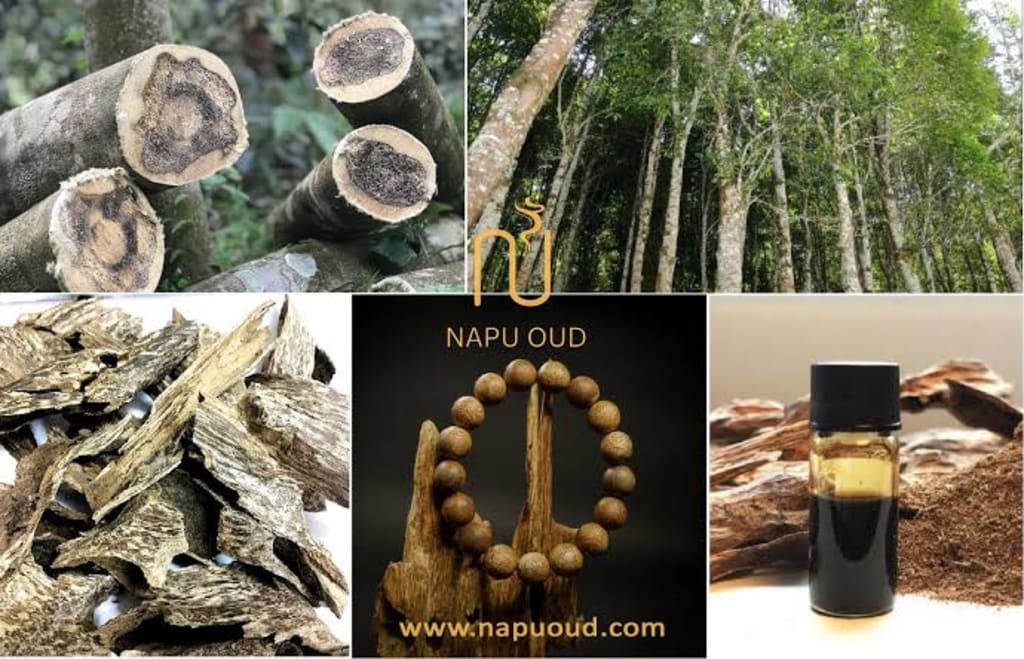
What is Oudh?
“عود کیا ہے؟” — What is Oudh?
Oudh, also known as Agarwood, is no ordinary wood. It is a dark, resinous heartwood that forms inside Aquilaria trees when they become infected with a specific type of mold. But the story of Oudh is far more than just a biological reaction. It's a sacred tree, a religious symbol, a medicine, and a luxury fragrance—deeply rooted in the spiritual, historical, and economic fabric of multiple civilizations.
In Arabic, it is known as "عود" (Oudh). In English, it is often referred to as Agarwood, Aloeswood, or Eaglewood. But across cultures and continents, it is revered by many names—each reflecting its mystique, rarity, and intoxicating aroma.
---
Religious and Spiritual Significance
Oudh holds a profound spiritual status in three major world religions: Islam, Hinduism, and Buddhism.
In Hinduism
The ancient Hindu scripture Rigveda (written around 1500 BCE) mentions Oudh as a sacred element used in rituals and purification ceremonies. It was burned in sacred fires and temples to invoke divine energy, calm the mind, and please the gods.
In Buddhism
In Buddhist traditions, especially in Southeast Asia, Oudh is used in meditation halls and temples. Monks burn Oudh to create a peaceful environment and to aid in reaching deeper states of mindfulness and enlightenment.
In Islam
Islamic tradition also holds Oudh in high regard. It is said that Prophet Muhammad ﷺ appreciated the use of Oudh and encouraged its usage. In Sahih al-Bukhari, Hadith 5692 (Kitab al-Tibb), the Prophet ﷺ said:
> "Use Indian Oudh, for it contains healing for seven diseases."
This Hadith is a strong indication of the medicinal and spiritual significance that Oudh carries in Islam.
Pilgrims who visit the Holy Kaaba in Makkah are often overwhelmed by a mesmerizing fragrance in the sacred precincts. That heavenly scent? It rises from the burning of Oudh chips inside the mosque. The Kiswah (the black cloth covering the Kaaba) and the Hajar al-Aswad (Black Stone) are also regularly perfumed with Oudh oil, lending the holy site its soul-stirring atmosphere.
---
A Fragrance Worth Its Weight in Gold
Oudh is considered one of the most expensive natural products in the world.
Its oil, known as “Dehn al-Oudh”, is distilled from infected Agarwood and is one of the costliest essential oils globally. The price of this oil can go up to $80,000 per liter, depending on purity and origin.
The wood itself, when sold as chips or powder for burning, ranges from $200 to $5,000 per kilogram. The rarest and most sought-after variety of Oudh is known as "Kyara" or "Kynam". This specific kind, found in regions like Vietnam and Laos, is so rare and pure that a single kilogram can cost up to $9 million USD.
In fact, a small piece of Kynam—just 2 kilograms—was sold in Shanghai for $18 million a few years ago.
In Bangkok, a Buddhist temple houses an ancient Agarwood tree that has received a valuation of $23 million USD. Yes, a single tree.
But why is it so valuable?
---
Why Is Oudh So Expensive?
Several reasons explain the astronomical price tag of Oudh:
1. Rarity
Only a small percentage of Aquilaria trees naturally produce Agarwood. Out of thousands, only a handful become infected in a way that leads to the formation of resinous heartwood.
2. Slow Formation
Even when infection does occur, it takes years or decades for the resin to mature and become aromatic enough to harvest.
3. Manual Extraction
The harvesting process is labor-intensive, often requiring expert hunters to detect and extract the infected heartwood without damaging the tree.
4. Increasing Demand
Global demand for Oudh is surging, especially in luxury markets of the Middle East, Japan, China, and Europe. In Arab culture, Oudh is synonymous with royalty and elegance. In high society, it is sprayed on garments, burned during gatherings, and gifted in weddings and royal ceremonies.
---
Healing Properties of Oudh
Apart from its spiritual aura, Oudh also offers medicinal and psychological benefits:
Sedative and Sleep Aid: The vapor from Oudh has a calming effect on the brain, which promotes deep sleep and helps relieve anxiety.
Anti-inflammatory: It’s used in traditional medicine for joint pain, arthritis, and muscle stiffness.
Skin Treatment: Its oil is applied in creams for eczema, acne, and anti-aging treatments.
Digestive Aid: In herbal medicine, small doses of Oudh are used to relieve indigestion and nausea.
Cancer Research: Some modern studies suggest potential anti-cancer properties, though more research is needed.
---
Oudh and Meditation
In meditation traditions, particularly in Japan, Tibet, and Sufi circles, Oudh is burned as incense to aid in spiritual focus. Its scent is believed to help balance the chakras, promote mental clarity, and establish a sacred presence in the space.
Practitioners of yoga, deep breathing, mindfulness, and dhikr often rely on Oudh to transport the mind into higher states of awareness.
---
A Billion-Dollar Industry with Fragile Roots
The global Oudh industry is currently worth around $32 billion and is expected to double in the next 8 years due to rising demand in perfumery, traditional medicine, and luxury wellness.
But here's the issue: the supply is not keeping up.
Why?
Because:
Natural production is limited.
Aquilaria trees are now endangered in many countries.
Illegal logging and unsustainable harvesting threaten the natural balance.
Cultivation efforts are still catching up with demand.
This imbalance of low supply and high demand keeps the price sky-high and fuels a booming, competitive, and often secretive global market.
---
Conclusion: The Fragrance of Legacy
Oudh is not just a perfume. It is a legacy in scent, a bridge between the material and the spiritual, and a testament to human reverence for nature’s miracles.
From the temples of Bangkok to the Holy Kaaba in Makkah, from the Buddhist monasteries of Tibet to the royal palaces of Arabia, this wood has touched hearts, minds, and souls for millennia.
In a world flooded with artificial fragrances and synthetic pleasures, Oudh reminds us of something timeless—that true beauty, like true faith and healing, is rare, natural, and sacred.
About the Creator
Keep reading
More stories from Ikram Ullah and writers in Futurism and other communities.
Ibn Tufail: The Andalusian Philosopher Who Inspired Tarzan, Robinson Crusoe, and The Jungle Book
In the heart of 12th-century Islamic Spain, known as Al-Andalus, a polymath named Abū Bakr Muhammad ibn ‘Abd al-Malik ibn Tufail, better known as Ibn Tufail, crafted a philosophical tale that would echo through centuries. His novel, Ḥayy ibn Yaqẓān (Alive, Son of Awake), tells the story of a boy raised by a doe on a deserted island, untouched by society. Through nature and reason alone, he discovers survival, morality, science, and God.
By Ikram Ullah8 months ago in Futurism
The Memory Thief: Why You Can No Longer Trust Your Own Digital History
We have always believed that "a picture is worth a thousand words." In the digital age, we upgraded that belief: a photo was proof. It was the anchor of our identity, the evidence of our travels, and the curator of our most cherished family memories.
By Alex Sterling a day ago in Futurism
Online Trading Platform Market Trends: Mobile Trading Adoption, AI-Driven Analytics & Industry Forecast to 2034
Rising internet penetration, the widespread adoption of smartphones, and the integration of advanced technologies like AI and blockchain are driving the demand for online trading platforms. These systems provide retail and institutional investors with real-time market access, automated tools, and a wide range of asset classes, including equities, cryptocurrencies, and derivatives. According to IMARC Group’s latest data, the global online trading platform market size was valued at USD 11.4 Billion in 2025. Looking forward, IMARC Group estimates the market to reach USD 17.9 Billion by 2034, exhibiting a CAGR of 4.96% from 2026-2034.
By Andrew Sullivan7 days ago in Futurism



Comments
There are no comments for this story
Be the first to respond and start the conversation.