
The Rise of Faceless Creators: How AI Avatars Are Redefining Digital Storytelling
They don’t breathe, eat, or sleep. But they can talk, dance, teach, and go viral. Welcome to the age of faceless creators—where pixels perform and algorithms entertain.

Introduction: A Face Without a Name
Once upon a time, creators had to be the brand—face forward, camera ready, performing constantly to keep their audience engaged. Today, that's no longer necessary.
A soft-spoken woman in rural India streams educational videos using a bright anime-style avatar. A college student in Mexico runs a top-10 productivity TikTok account powered by an AI voice and motion-capture model. In the U.S., a completely fictional virtual pop star is selling out live shows—projected on stage, cheered on by thousands.
These are not the sci-fi futures we used to dream about. This is now.
Welcome to the world of faceless creators—people using AI avatars, voice synthesis, and digital animation to tell stories, build brands, and create content, all without ever showing their real selves.
And they’re changing everything.
---
Chapter 1: The Birth of a Digital Doppelgänger
The concept of avatars isn’t new. We’ve used them in video games and chatrooms for decades. But what’s different now is the hyper-realism and autonomy.
With tools like:
Reallusion Character Creator (3D avatars)
ZEPETO or Ready Player Me (personalized digital humans)
Adobe Character Animator (real-time puppeteering) …creators can build digital versions of themselves, or completely new personas, that express emotion, speak fluently, and move with natural ease.
Even more impressive? Some of these avatars live and evolve independently, powered by AI scripts and logic engines. They can answer comments, react to chats, and “grow” with their audiences—without the human ever logging in.
A creator on Twitch, who goes by “NOVA,” has a full sci-fi persona with its own backstory, voice, and fanbase. She streams for hours each day—but NOVA isn’t real. The creator behind her simply types scripts, adjusts behaviors, and lets the avatar take over.
---
Chapter 2: Why Go Faceless?
What would make a person choose to hide their real identity online?
Surprisingly, it’s not always about fear or insecurity.
Here are the top reasons creators are going faceless:
1. Creative Freedom
Faceless creators can take on any gender, age, appearance, or personality. Want to be a robot from the year 3022? Go ahead. Want to be a talking fox that teaches finance? No problem. There are no biological limits.
2. Emotional Safety
Online fame comes at a cost. Harassment, criticism, and scrutiny are common. Avatars provide a layer of emotional insulation, allowing creators to participate without sacrificing mental health.
3. Anonymity = Control
Creators can control when and how they’re seen. They can work in pajamas, in bed, or while traveling—no need for makeup, lighting, or perfect environments.
4. Scalability
With AI tools, faceless creators can schedule videos, livestreams, voiceovers, and interactive Q&As automatically. Some even train their avatars to react to trending topics in real time.
---
Chapter 3: The Tools Behind the Face
The rise of faceless content is thanks to a powerful blend of technology. Here's what fuels it:
A. AI-Generated Avatars
Using tools like Character.AI, Synthesia, or Did, creators can make avatars that:
Lip-sync in real-time
Express emotion via facial mapping
Maintain consistent appearance across platforms
These avatars can host webinars, deliver TikToks, or explain quantum physics—without a human voice behind the screen.
B. Voice Cloning and Synthesis
Platforms like ElevenLabs, Murf.ai, and Voicemod allow:
Multilingual speech generation
Realistic emotional tone (joy, anger, sadness)
Cloning of a real voice for continuity
A creator can record just 30 seconds of their voice—and the AI can then generate podcasts, videos, or even audiobooks in their exact voice forever.
C. Motion Capture & Real-Time Puppeteering
Using a phone camera, creators can:
Control facial expressions
Animate blinking, smiling, reacting
Record complex gestures and lip sync
Software like VSeeFace, Live2D, and VUP provide tools for this, often for free.
---
Chapter 4: Meet the Avatars Taking Over the World
1. CodeMiko
A digital avatar powered by a motion-capture suit, CodeMiko hosts live interviews with real influencers—while being completely fictional herself. She’s witty, expressive, and undeniably entertaining. Behind the avatar is a real woman known only as “The Technician.”
2. Lil Miquela
The OG virtual influencer, Miquela has over 2 million followers. She’s modeled for Prada, released music, and sparked conversations around identity, authenticity, and AI celebrity.
3. FN Meka
Though controversial, FN Meka was the world’s first AI-generated rapper with a major record deal. His downfall sparked important conversations about representation and ethics in AI-generated personas.
4. Neuro-sama
This AI-powered Twitch streamer plays games, reads chat, and answers questions—all autonomously. Created by Vedal, she’s one of the first AI streamers to develop a loyal fanbase.
---
Chapter 5: The Storytelling Shift
Faceless creators aren’t just visual gimmicks—they’re master storytellers. And here’s why their stories resonate:
1. Narrative Control
Avatars can be given backstories, personalities, and arcs. They become characters, not just creators. This opens up opportunities for serialized storytelling, world-building, and roleplay.
2. Accessibility
These creators cross language and cultural barriers. With multilingual AI tools, a faceless creator in Kenya can build a massive fanbase in Korea or France—without speaking the languages.
3. Empathy Through Imagination
Paradoxically, we often relate more deeply to a fictional avatar than a real person. They feel safe, idealized, and easy to project onto—making their stories even more moving.
---
Chapter 6: The Ethics and The Risks
With any innovation comes risk. Faceless creation is no different.
1. Deepfake Concerns
The same tools that power positive creation can be misused for impersonation, deception, or misinformation. That’s why creators must be transparent about their methods.
2. Identity Theft
It’s now possible to clone a voice or face with frightening accuracy. Without regulation, people could lose ownership of their digital identity.
3. Loss of Human Connection
Some fear that too much AI could erode the genuine intimacy of creator-audience relationships. Will we still trust stories told by code?
---
Chapter 7: The Psychology of the Faceless Creator
Faceless creators also reflect something deeper: our complex relationship with identity.
In a hyper-digital world, our real selves are constantly being judged, liked, disliked, commented on. Avatars offer relief—a place where one can create without the burden of being known.
It’s a way to:
Escape insecurity
Express hidden parts of self
Explore alternate identities
Reclaim privacy in a hyper-exposed world
---
Chapter 8: The Business of Avatars
Faceless creators are earning real money:
Sponsorships (Lil Miquela has modeled for Calvin Klein)
Ad Revenue (AI YouTubers with 1M+ subscribers)
Merchandising (avatars with custom clothing lines)
NFTs & Digital Collectibles
Teaching and Education (using AI tutors or instructors)
Some brands now hire AI influencers instead of real ones, citing cost-effectiveness, 24/7 availability, and freedom from controversy.
---
Chapter 9: You Could Be Next
You don’t need Hollywood-level tools to start.
Here’s how to become a faceless creator today:
1. Choose Your Identity
Create an avatar using ZEPETO or Ready Player Me
Pick a niche: storytelling, gaming, education, motivation, comedy
2. Pick Your Tools
Use CapCut, Canva, ElevenLabs, or OBS Studio
Animate your avatar and add voiceovers easily
3. Start Small, Stay Real
Be transparent that you’re using AI
Let your avatar grow with your audience
4. Keep the Story First
Don’t just be “cool”—be compelling
Tell meaningful stories. Create value. That’s what makes you unforgettable.
---
Conclusion: We Are the Stories We Tell
The rise of faceless creators isn’t about replacing humans. It’s about redefining what it means to be a creator.
In a world overloaded with selfies and shallow fame, the faceless movement reminds us that what matters most isn’t how you look—but what you say.
So whether you’re a human, an avatar, or something in between—if you have a story worth telling, you deserve to be heard.
Even if no one ever sees your face.
---
Would you follow a creator who isn't human? Would you become one?
Share your thoughts in the comments—and don’t forget to support your favorite faceless stars.
Because sometimes, the loudest voices are the ones we never see.
About the Creator
Keep reading
More stories from Abubakar Khan and writers in Futurism and other communities.
How AI Is Changing Our Daily Lives: 7 Ways You Didn’t Expect
Artificial Intelligence (AI) used to be something we associated with sci-fi movies, robotic assistants, or tech labs buzzing with machines. But fast-forward to 2025, and AI has quietly slipped into our daily lives—not just in obvious ways, but in subtle, surprising ones that we barely notice. It’s reshaping how we eat, work, shop, love, and even dream. This isn’t a look into the future—it’s already here.
By Abubakar Khan8 months ago in Futurism
About Binding Prometheus
I want to start actively advocating on behalf of my own work, and the most valuable part of my canon is, without a doubt, Binding Prometheus, the play I have been working on since 2019 and only finished in 2023 as part of my MA. The play itself is an amalgamation of a million different inspirations. On one end, it evokes the Ancient Greek myth-play, deriving its own title from the earliest extant work of Western drama we have, Aeschylus’s Prometheus Bound. On the other end, it borrows significantly from the sci-fi bulwarks from over the years, namely Mary Shelley’s Frankenstein and Karel Capek’s Rossum’s Universal Robots. The play could be an episode of Black Mirror, I fear. I don’t know. I’ve only ever seen one episode of Black Mirror.
By Steven Christopher McKnight20 days ago in Futurism
Wood and Timber Products Market Size and Forecast 2025–2033: Sustainable Growth Shapes a Trillion-Dollar Industry
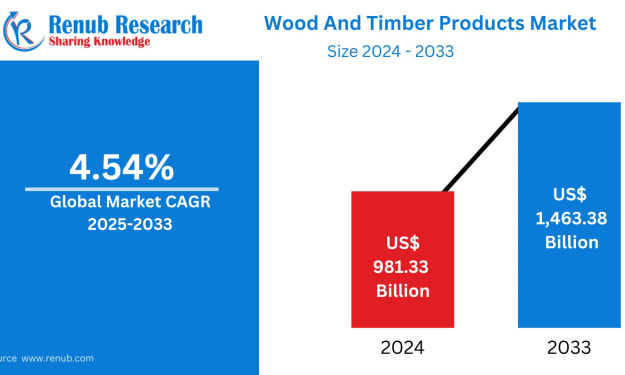
Global Wood and Timber Products Market Outlook The global Wood and Timber Products Market is undergoing a steady transformation as sustainability, urbanization, and infrastructure development reshape material choices worldwide. According to Renub Research, the market is expected to grow from US$ 981.33 billion in 2024 to US$ 1,463.38 billion by 2033, expanding at a CAGR of 4.54% from 2025 to 2033.
By Janine Root 2 days ago in Futurism
My New Book is Finally Here
My poetry collection Beautiful and Brutal Things is done. It's actually done and finally published over 270 pages. Over a year of my life went into this book. More than a year, really. Long days at my computer, sometimes seven days a week because I couldn't stop even when I probably should have. Then two months of editing that felt harder than the writing itself. But it's finished, and I'm still standing, and the book is real.
By Tim Carmichael4 days ago in BookClub



Comments
There are no comments for this story
Be the first to respond and start the conversation.