
The Quiet Emergency
How Global Warming Became the Story of Our Lives

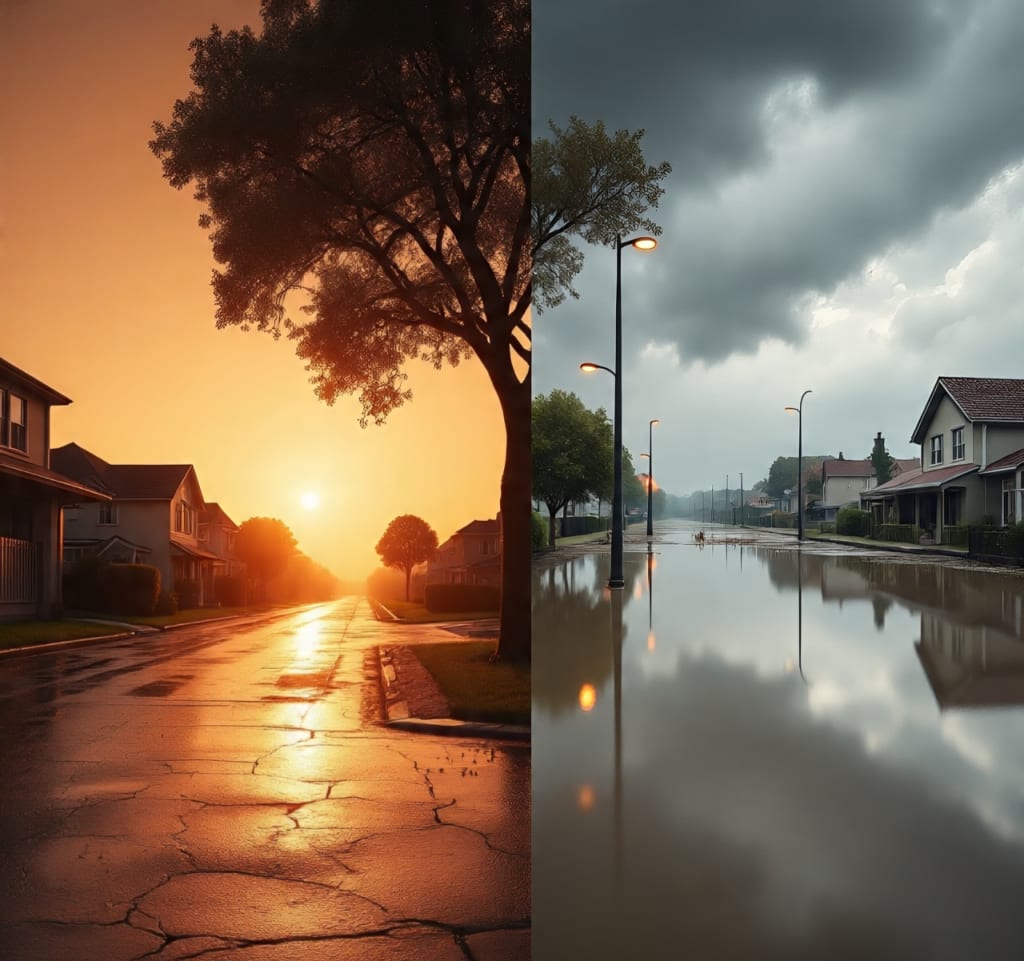
Global warming did not arrive like a disaster movie. There was no single day when the sky fell or the oceans rose without warning. Instead, it crept into our lives quietly—through warmer winters, longer summers, and news headlines we learned to scroll past. It became the kind of emergency that doesn’t scream, only whispers, until one day you realize the whisper has been following you everywhere.
In the United States and the United Kingdom, global warming is often discussed as a political issue, a scientific debate, or a future problem. But the truth is simpler and more unsettling: global warming is already here, shaping how we live, what we eat, where we build, and how safe we feel in our own homes.
At its core, global warming refers to the steady rise in Earth’s average temperature, driven largely by human activity. Burning fossil fuels for energy releases greenhouse gases into the atmosphere, trapping heat that would otherwise escape into space. This process is not new, but its speed is. In just over a century, human behavior has altered the planet’s climate systems faster than many natural systems can adapt.
The consequences are no longer abstract. In the U.S., heatwaves are becoming more intense and more frequent, pushing power grids to their limits and turning ordinary summers into public health crises. Wildfires now consume entire towns, filling the air with smoke that travels thousands of miles. Flooding events once described as “once-in-a-century” now happen with alarming regularity.
Across the UK, the effects are quieter but just as profound. Summers are hotter, placing strain on infrastructure never designed for extreme heat. Rainfall patterns are shifting, leading to flash floods in some regions and drought conditions in others. Coastal communities face rising sea levels that threaten homes, heritage sites, and livelihoods that have existed for generations.
What makes global warming especially dangerous is not just its physical impact, but its ability to widen existing inequalities. Those with fewer resources are often hit first and hardest. Low-income communities are more likely to live in areas vulnerable to flooding, heat stress, or pollution. They also have fewer options to relocate, rebuild, or adapt. Climate change, in this way, becomes a multiplier of injustice.
There is also a psychological toll we rarely discuss. Climate anxiety is rising, particularly among younger generations who feel they are inheriting a damaged planet without having caused the damage themselves. This quiet fear—about the future, about safety, about whether meaningful change will come in time—has become a background noise in modern life.
Yet, global warming is not a story without hope. The same human ingenuity that accelerated the crisis also holds the tools to slow it down. Renewable energy is no longer a distant dream; it is increasingly affordable and efficient. Solar and wind power are reshaping energy grids in both the U.S. and the UK. Electric vehicles are becoming mainstream. Cities are redesigning streets to favor public transport, cycling, and walkable communities.
Individual actions matter, but they are not enough on their own. Real progress depends on systemic change—policies that prioritize clean energy, protect natural ecosystems, and hold major polluters accountable. When governments invest in sustainable infrastructure and when corporations commit to genuine climate responsibility, the ripple effects can be enormous.
Equally important is how we talk about global warming. Fear alone does not inspire change; understanding does. This is not about blaming past generations or shaming present ones. It is about recognizing that we are the first generation to fully understand the consequences of climate change—and possibly the last with a real chance to prevent its worst outcomes.
Global warming is not a distant apocalypse waiting on the horizon. It is the weather outside your window, the price of food at the store, the safety of your neighborhood, and the future your children will inherit. It is a shared story, written by billions of daily choices, policies, and priorities.
The question is no longer whether global warming is real or serious. The question is whether we will continue to treat it as background noise—or finally listen closely enough to act. Because the planet is not asking for perfection. It is asking for urgency, honesty, and the courage to change before the quiet emergency becomes an irreversible one.
About the Creator
About Binding Prometheus
I want to start actively advocating on behalf of my own work, and the most valuable part of my canon is, without a doubt, Binding Prometheus, the play I have been working on since 2019 and only finished in 2023 as part of my MA. The play itself is an amalgamation of a million different inspirations. On one end, it evokes the Ancient Greek myth-play, deriving its own title from the earliest extant work of Western drama we have, Aeschylus’s Prometheus Bound. On the other end, it borrows significantly from the sci-fi bulwarks from over the years, namely Mary Shelley’s Frankenstein and Karel Capek’s Rossum’s Universal Robots. The play could be an episode of Black Mirror, I fear. I don’t know. I’ve only ever seen one episode of Black Mirror.
By Steven Christopher McKnight19 days ago in Futurism
Smart Toys Market Size to Surpass USD 60.0 Billion by 2033 on Interactive Learning Demand & Market Outlook
According to IMARC Group's latest research publication, the global smart toys market size reached USD 18.1 Billion in 2024. Looking forward, IMARC Group expects the market to reach USD 60.0 Billion by 2033, exhibiting a growth rate (CAGR) of 13.52% during 2025-2033.
By Suhaira Yusuf8 days ago in Futurism



Comments
There are no comments for this story
Be the first to respond and start the conversation.