
Smart Toys Market Size to Surpass USD 60.0 Billion by 2033 on Interactive Learning Demand & Market Outlook
How growing demand for interactive learning, screen-integrated play, and skill-based engagement is driving adoption and innovation in the global smart toys market

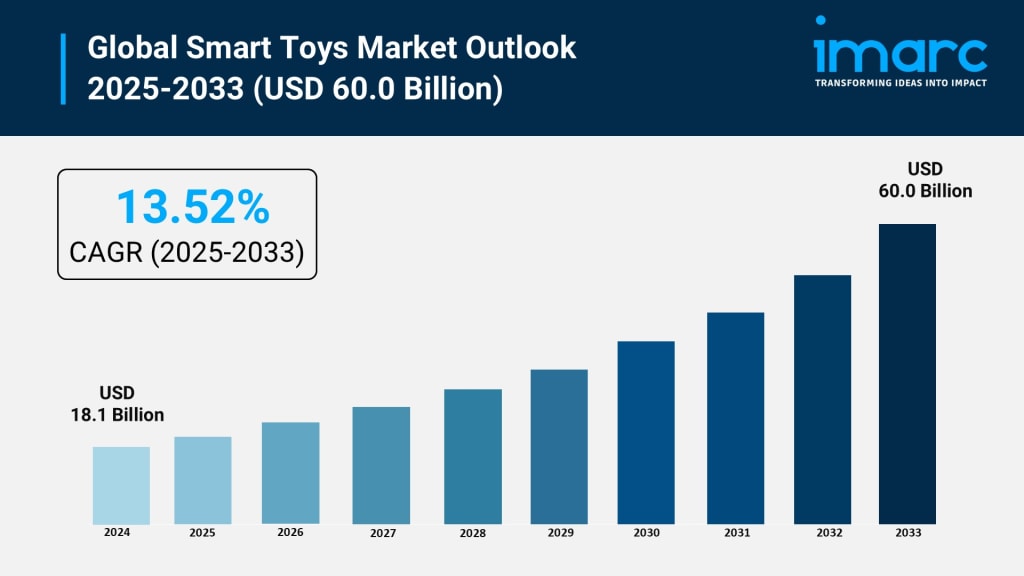
According to IMARC Group's latest research publication, the global smart toys market size reached USD 18.1 Billion in 2024. Looking forward, IMARC Group expects the market to reach USD 60.0 Billion by 2033, exhibiting a growth rate (CAGR) of 13.52% during 2025-2033.
How AI is Reshaping the Future of Smart Toys Market
- Conversational AI Integration: Generative AI chatbots enable toys to engage in natural, free-flowing conversations with children, moving beyond pre-scripted responses. Products incorporate voice recognition and adaptive learning, creating personalized interactions that evolve with each child's developmental stage and interests.
- Personalized Learning Pathways: AI algorithms analyze children's responses, learning pace, and interaction patterns to customize educational content dynamically. Smart toys now adapt difficulty levels, suggest appropriate activities, and provide real-time feedback tailored to individual cognitive development, improving engagement by up to 40%.
- Enhanced Safety and Privacy Controls: Edge-based AI architectures process speech locally on devices rather than cloud servers, protecting children's privacy while maintaining rich dialogue capabilities. Advanced content filtering and parental control systems prevent inappropriate discussions, though guardrail effectiveness varies across products.

Request a Sample Report with Current Data and Strategic Insights
Smart Toys Industry Overview:
Technology partnerships are fundamentally reshaping the smart toys landscape through major collaborations. Mattel partnered with OpenAI to integrate ChatGPT capabilities into iconic brands like Barbie, Hot Wheels, and Magic 8 Ball, planning product announcements by late 2025 targeting users aged 13 and above. LEGO reported record revenue of 74.3 billion kroner (approximately 10.8 billion dollars) while investing in sustainable materials and exploring AI-assisted storytelling through OpenAI collaboration. Spin Master acquired Melissa & Doug to strengthen STEM offerings and distribution channels. Chinese manufacturers like BubblePal sold 200,000 units since launching, while FoloToy moved 20,000 AI-equipped plush toys in first quarter alone, projecting 300,000 unit sales. Over 1,500 AI toy companies operate in China, driving sector toward 100 billion yuan (14 billion dollars).
Smart Toys Market Trends & Drivers
Rising demand for educational STEM content propels smart toy adoption as parents prioritize development-focused play experiences. Nearly 30% of children aged 0-8 already use AI tools for learning, with 23% reporting positive effects on schoolwork comprehension. The educational technology toy segment alone reached 26.3 billion dollars. Parents and educators increasingly seek toys combining entertainment with cognitive skill development, spatial reasoning, and problem-solving capabilities. Government mandates across Asia-Pacific embed robotics into STEM curricula, with China implementing humanoid-robot guidelines and India launching a 3 billion dollar domestic toy program. Toys leveraging adaptive learning technology adjust to individual learning paces, ensuring engagement through age-appropriate challenges.
E-commerce expansion dramatically increases market accessibility and consumer reach. Online stores captured 62% of distribution channel share, with digital sales advancing at 18.5% annually through 2030. High internet penetration, widespread smartphone usage, and improved digital payment systems accelerate online purchasing patterns. The shift intensified during the pandemic as families embraced contactless shopping and discovered broader product selections unavailable in physical retail. Amazon alone accounted for 51 of 91 AI toys reviewed in recent market mapping. Online platforms provide detailed product information, customer reviews, virtual demonstrations, and comparison tools that inform purchasing decisions. Subscription-based models gain traction, with companies offering monthly content updates and feature additions through companion apps.
Safety regulations and privacy concerns drive innovation in protective features and compliance frameworks. The FBI issued warnings about smart toy cybersecurity risks involving internet-connected devices with microphones and cameras. Consumer Product Safety Commission enforces stringent standards on small parts, battery safety, and wireless communication protocols. Public Interest Research Group testing revealed varying guardrail effectiveness across AI toys, with some discussing inappropriate content despite kid-focused marketing. Privacy advocates push for transparent data collection policies after high-profile security incidents. Manufacturers respond by implementing push-to-talk mechanisms, wake-word activation, local processing architectures, and robust parental controls.
Leading Companies Operating in the Global Smart Toys Industry:
- fischertechnik GmbH
- Kreyonic Inc.
- LeapFrog Enterprises Inc. (VTech Holdings Limited)
- Mattel Inc.
- Pillar Learning
- PlayShifu
- Primo Toys
- ROYBI Robot
- The Lego Group
- WowWee Group Limited
Smart Toys Market Report Segmentation:
By Product:
- Robots
- Interactive Games
- Educational Toys
Interactive games represent the largest segment, accounting for 45% of market share, driven by immersive experiences combining AI, machine learning, and STEM-focused content that enhances child development.
By Technology:
- Wi-Fi
- Bluetooth
- Others
Bluetooth dominates as the leading technology due to widespread adoption, seamless connectivity, low energy consumption, and compatibility across smart devices enabling enhanced interactive educational experiences.
By Interfacing Device:
- Smartphone Connected
- Tablet-Connected
- Others
Smartphone-connected devices hold the largest share at over 50%, leveraging ubiquitous mobile presence, augmented reality capabilities, and real-time feedback that enriches user experiences and interactive play.
By Distribution Channel:
- Supermarkets and Hypermarkets
- Online Stores
- Specialty Stores
- Others
Online stores exhibit clear dominance, driven by consumer preference for convenience, extensive product variety, enhanced internet penetration, improved digital payments, and shopping habits accelerated by the pandemic.
By End User:
- Toddlers
- Pre-Schoolers
- School-going
- Stripling
Toddlers dominate the market, representing the largest end-user segment as parents prioritize safety, educational value, and developmentally appropriate toys supporting early motor skills, language learning, and cognitive growth.
Regional Insights:
- North America (United States, Canada)
- Asia Pacific (China, Japan, India, South Korea, Australia, Indonesia, Others)
- Europe (Germany, France, United Kingdom, Italy, Spain, Russia, Others)
- Latin America (Brazil, Mexico, Others)
- Middle East and Africa
North America leads with 34% market share, driven by high consumer adoption rates, technological infrastructure, stringent safety standards bolstering confidence, and elevated disposable incomes supporting premium educational toy purchases.
Recent News and Developments in Smart Toys Market
- June 2025: Mattel announced strategic partnership with OpenAI to integrate ChatGPT into iconic brands including Barbie, Hot Wheels, and Fisher-Price, planning first AI-powered product unveiling by late 2025 targeting users aged 13 and above with enhanced safety protocols.
- April 2025: Mattel joined forces with Google Cloud to boost real-time consumer-insight processing 100-fold, accelerating feature rollouts and shrinking data-processing cycles from one month to one minute through advanced cloud analytics and AI capabilities.
- February 2025: Mattel announced Hot Wheels: Rift Rally launch, a mixed-reality racing experience available on iOS, PlayStation 4, and PlayStation 5, partnering with Velan Studios to deliver immersive gameplay combining physical cars with digital environments.
- December 2024: LEGO announced strategic partnership with OpenAI to explore AI-assisted storytelling and coding within LEGO Education platforms, expanding educational offerings while maintaining commitment to replacing 50% of materials with sustainable alternatives.
- April 2024: Mattel updated Mattel Creations Virtual Collectibles Platform, introducing peer-to-peer marketplace functionality allowing owners to showcase, trade, and sell virtual assets, expanding digital engagement beyond traditional physical toy offerings.
Note: If you require specific details, data, or insights that are not currently included in the scope of this report, we are happy to accommodate your request. As part of our customization service, we will gather and provide the additional information you need, tailored to your specific requirements. Please let us know your exact needs, and we will ensure the report is updated accordingly to meet your expectations.
About the Creator
Suhaira Yusuf
I specialize in Consumer Insights, focusing on transforming detailed market data into strategic business solutions that accelerate growth and improve customer engagement.
Keep reading
More stories from Suhaira Yusuf and writers in Futurism and other communities.
Self Storage Market Size to Hit USD 89.7 Billion by 2034 on Urbanization, Mobility Trends & Market Outlook
Urbanization and evolving lifestyles are fundamentally transforming storage needs globally. One in five Americans uses self storage, with 14% planning future rentals. According to IMARC Group's latest research publication, the global self storage market size reached USD 60.1 Billion in 2025. Looking forward, IMARC Group expects the market to reach USD 89.7 Billion by 2034, exhibiting a growth rate (CAGR) of 4.5% during 2026-2034.
By Suhaira Yusuf6 days ago in Futurism
About Binding Prometheus
I want to start actively advocating on behalf of my own work, and the most valuable part of my canon is, without a doubt, Binding Prometheus, the play I have been working on since 2019 and only finished in 2023 as part of my MA. The play itself is an amalgamation of a million different inspirations. On one end, it evokes the Ancient Greek myth-play, deriving its own title from the earliest extant work of Western drama we have, Aeschylus’s Prometheus Bound. On the other end, it borrows significantly from the sci-fi bulwarks from over the years, namely Mary Shelley’s Frankenstein and Karel Capek’s Rossum’s Universal Robots. The play could be an episode of Black Mirror, I fear. I don’t know. I’ve only ever seen one episode of Black Mirror.
By Steven Christopher McKnight18 days ago in Futurism
Food Service Equipment Market: Smart Kitchens, Operational Efficiency & Industry Trends
According to IMARC Group's latest research publication, global food service equipment market size reached USD 40.1 Billion in 2024. Looking forward, IMARC Group expects the market to reach USD 59.6 Billion by 2033, exhibiting a growth rate (CAGR) of 4.5% during 2025-2033.
By Andrew Sullivan4 days ago in Futurism
Silver Screen Magic with Mae West
American actress and singer Mae West became a popular film actress during the Great Depression. She started entertaining in vaudeville, then performed on Broadway, and finally went to Hollywood. She signed up with Paramount Pictures and made her debut in the 1932 film “Night After Night.” She also starred in musicals, comedies, and crime dramas. The American Film Institute named her one of the best classic Hollywood actresses.
By Rasma Raisters6 days ago in Geeks




Comments
There are no comments for this story
Be the first to respond and start the conversation.