
Earth Watched Us Change
A quiet witness to our rise, our recklessness, and the question of who we choose to become next

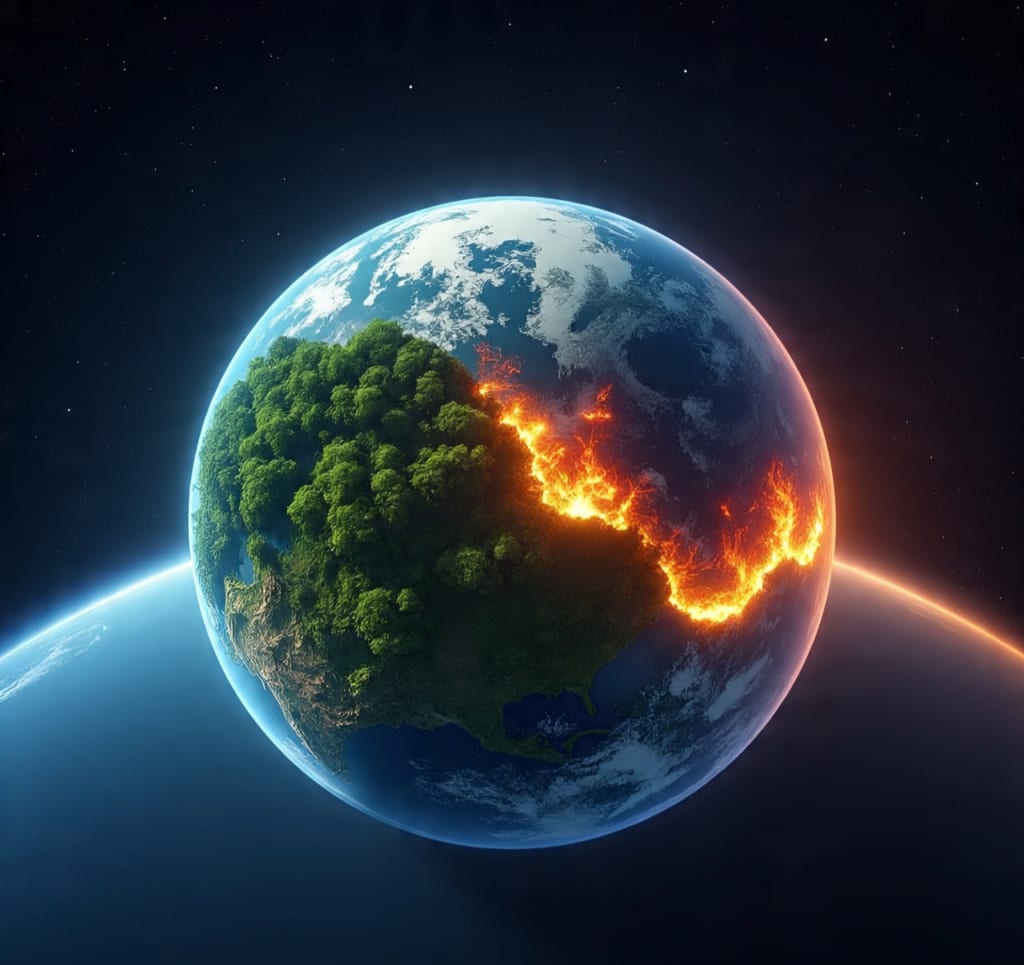
Earth remembers us differently than we remember ourselves.
Before cities pressed their concrete palms into her soil, before oceans learned the taste of plastic, before the sky grew crowded with our signals and smoke—Earth knew us as quiet creatures. We walked softly then. We listened more than we spoke. Our footprints faded with the tide.
Earth watched us arrive as guests.
In the beginning, we asked permission. We thanked rivers before drinking. We bowed to trees before cutting. Fire was borrowed, not owned. Night was dark enough to hear your own heartbeat, and the stars were close enough to feel like ancestors leaning in to listen.
Earth watched us change slowly at first.
We learned to shape stone, then metal. We learned how to store grain, how to build walls, how to call land mine. Ownership was a new language, and Earth noticed how quickly it changed our posture. We stopped kneeling. We started pointing. We started drawing borders across her skin as if she were paper, not a breathing body.
Still, Earth was patient.
She let us practice. She healed where we cut too deeply. Forests returned after fires. Rivers forgave us after floods. Animals adjusted their paths around our villages. Earth believed we were learning.
Then we discovered speed.
We wanted everything faster—growth, travel, profit, power. We took without asking because asking slowed us down. We drilled deeper, burned hotter, cleared wider. Mountains were opened like wounds. Oceans became dumping grounds for what we didn’t want to see anymore. The air grew heavy with what we refused to hold ourselves.
Earth watched us forget.
We forgot that soil is alive. That water remembers every hand it passes through. That the sky keeps score. We forgot that convenience has a cost, and the bill always arrives late, when it feels unfair.
We told ourselves stories to make it easier.
That progress required sacrifice.
That nature was resilient.
That the damage was someone else’s fault, someone else’s problem, someone else’s future.
Earth listened to those stories too.
She felt the fever rise—glaciers thinning like old memories, seasons slipping out of rhythm, storms growing louder, angrier. She tried to speak in subtle ways at first: a drought here, a flood there, a warning written in coral bleaching white like bones. But we were distracted. We were scrolling. We were busy.
So Earth raised her voice.
Wildfires roared where forests once whispered. Hurricanes carried names and grief. Heat pressed against lungs like a hand that would not move. Crops failed. Animals disappeared quietly, without headlines. And still, many of us argued whether the pain was real.
Earth watched us argue while standing on her burning skin.
Yet even now—even after everything—Earth does not hate us.
She watches us in moments of remembering. When someone plants a tree knowing they’ll never sit in its shade. When a child asks why the sky looks different than it did in old photographs. When a community rebuilds slower, choosing care over speed. When someone decides that less is enough.
Earth notices those moments.
She watches us wake up in fragments. Not all at once. Not together. But enough to matter. She watches us learn the old lessons again—that survival is shared, that balance is not weakness, that living well means leaving space for others to live too.
Earth watched us change into something reckless.
Now she watches to see if we can change again.
Because the truth is this: Earth does not need us. She will outlast our cities, our names, our noise. She has done it before. What she is watching is not her future—it is ours.
She watches to see whether we choose to remain conquerors of a planet that was never ours to conquer, or return to being caretakers of a home that has given us everything.
The soil is still willing to grow food.
The oceans still try to clean themselves.
The forests still reach for the sky when given the smallest chance.
Earth is still watching.
Not with judgment—but with memory.
And perhaps, with hope.
About the Creator
About Binding Prometheus
I want to start actively advocating on behalf of my own work, and the most valuable part of my canon is, without a doubt, Binding Prometheus, the play I have been working on since 2019 and only finished in 2023 as part of my MA. The play itself is an amalgamation of a million different inspirations. On one end, it evokes the Ancient Greek myth-play, deriving its own title from the earliest extant work of Western drama we have, Aeschylus’s Prometheus Bound. On the other end, it borrows significantly from the sci-fi bulwarks from over the years, namely Mary Shelley’s Frankenstein and Karel Capek’s Rossum’s Universal Robots. The play could be an episode of Black Mirror, I fear. I don’t know. I’ve only ever seen one episode of Black Mirror.
By Steven Christopher McKnight19 days ago in Futurism
Top 10 AI Development Companies in the USA
The rise of generative artificial intelligence technology has been revolutionizing the manner by which companies innovate, automate their processes, generate content, as well as optimize customer experience. From smart chatbots, analytics, and image, video, to code generators, companies recognize that the future of their businesses may involve a large reliance on generative artificial intelligence, thereby searching for trusted companies for the development of the technology.
By Olivia Carter6 days ago in Futurism



Comments
There are no comments for this story
Be the first to respond and start the conversation.