
Australia Car Market: Consumer Demand, Technology Shift & Mobility Evolution
How changing buyer preferences, vehicle technology and evolving mobility trends are shaping Australia’s car Industry
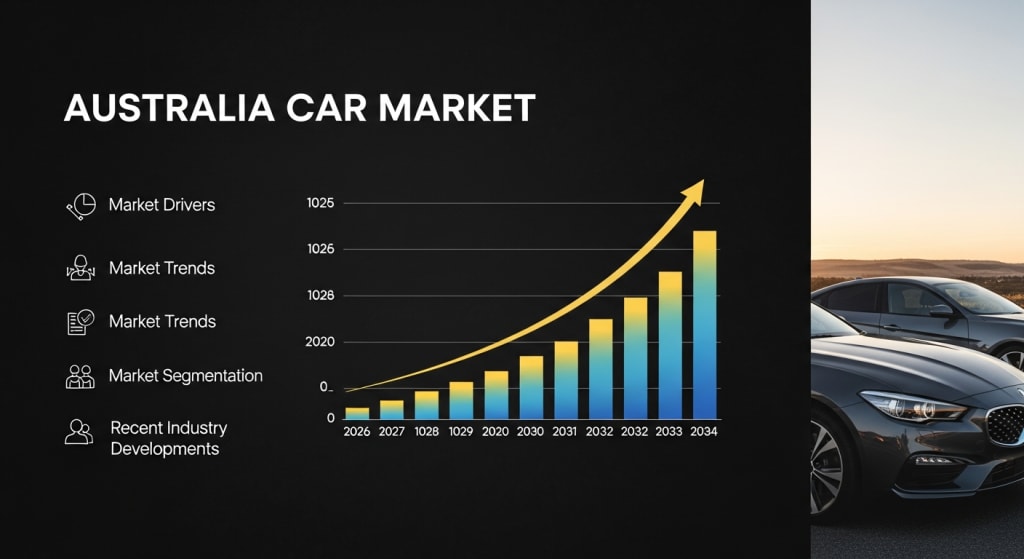
According to IMARC Group, the Australia car market reached a value of USD 21.5 Billion in 2025 and is projected to grow to USD 23.6 Billion by 2034, registering a compound annual growth rate (CAGR) of 1.05% during 2026–2034. While growth is modest in value terms, the market is undergoing a profound structural transformation. Australia’s car market is no longer defined solely by unit sales; it increasingly reflects broader shifts in technology adoption, consumer expectations, environmental priorities and future mobility models. Electrification, connected-vehicle features and evolving ownership preferences are reshaping how Australians research, purchase and use vehicles, positioning the market firmly within a future-oriented mobility landscape.
Why Should Smart Buyers and Investors Know About the Australia Car Market?
A Stable Market Undergoing Structural Transformation
While value growth is moderate, the market’s internal transformation creates opportunities across electrification, software, services and mobility innovation.
High-Impact Purchase Decisions for Consumers
Cars remain one of the largest consumer purchases. Understanding technology trends, fuel options and total ownership costs is essential for making informed, future-ready decisions.
Strategic Opportunities for Automotive and Technology Players
Manufacturers and suppliers that align with electrification, connectivity and safety trends are better positioned to capture long-term value.
Policy and Infrastructure Alignment
Government support for low-emission vehicles and infrastructure development will continue to influence market dynamics and buyer behaviour.
Foundation for Australia’s Future Mobility Landscape
The car market reflects how Australia will move, commute and transport goods in the future, making it a key indicator of broader mobility evolution.
Recent Trends & Developments in the Australia Car Market
May 2025:
Sales of hybrid and electric vehicles continued to rise, supported by broader model availability and improved charging infrastructure. Buyers showed increasing interest in electrified options across both passenger and commercial segments.
November 2024:
Automakers expanded the rollout of advanced safety features as standard equipment, responding to consumer demand for higher safety ratings and enhanced driver assistance.
July 2024:
Digital retail platforms gained traction, with more buyers completing financing pre-approvals and vehicle comparisons online before visiting dealerships, highlighting the shift toward technology-driven purchasing journeys.
The Australia car market is evolving from a traditional vehicle sales environment into a future-focused mobility ecosystem shaped by electrification, digitalisation and changing consumer priorities. Supported by IMARC growth projections, ongoing technology adoption and shifting buyer expectations, the market’s true significance lies in how it is redefining transportation rather than how fast it is growing. For buyers, investors and industry participants, understanding these structural shifts is essential to navigating Australia’s mobility future with confidence and clarity.
Australia Car Market Vision 2050
1. Electrification as a Mainstream Standard
By 2050, electric and hybrid vehicles are expected to represent a substantial share of Australia’s vehicle fleet. Continued improvements in battery technology, charging infrastructure and affordability will make electrified mobility a default option for many buyers.
2. Software-Defined and Connected Vehicles
Cars will increasingly function as connected digital systems, with software playing a central role in performance, safety and user experience. Regular updates and feature enhancements will extend vehicle lifecycles and reshape ownership expectations.
3. Advanced Driver Assistance and Autonomous Capabilities
ADAS features will become standard across most vehicle segments, with gradual progression toward higher levels of autonomous driving in controlled environments. These technologies will improve road safety and driving comfort.
4. Sustainable and Low-Emission Mobility Ecosystems
Vehicle manufacturing, ownership and use will increasingly align with sustainability goals. Lower-emission vehicles, recycled materials and energy-efficient production will influence brand positioning and buyer preference.
5. Evolving Ownership and Usage Models
Car ownership may coexist with subscription models, shared mobility and flexible usage arrangements, particularly in urban centres. Buyers will prioritise access, convenience and adaptability alongside traditional ownership.
What is the Australia Car Market Key Growth Drivers?
Shift Toward Electrified and Hybrid Vehicles
One of the most significant changes in the Australia car market is the steady rise of electric vehicles (EVs) and hybrids. Government incentives, expanding charging infrastructure and improving vehicle range are encouraging buyers to consider alternatives to traditional internal combustion engine (ICE) vehicles. Although ICE vehicles still dominate sales, electrified models are becoming a central part of purchase consideration.
Technology-Driven Buyer Expectations
Australian car buyers increasingly prioritise technology features such as advanced driver-assistance systems (ADAS), digital dashboards, infotainment connectivity and over-the-air software updates. Vehicles are now evaluated as technology platforms as much as transportation tools, elevating the role of innovation in purchasing decisions.
Changing Consumer Preferences and Lifestyle Needs
Urbanisation, remote work patterns and lifestyle changes are influencing vehicle choice. Demand for SUVs, crossovers and dual-cab utes remains strong due to versatility, while compact and fuel-efficient vehicles appeal to city-based consumers focused on operating costs and convenience.
Focus on Safety, Compliance and Long-Term Value
Safety ratings, driver-assistance features and long-term reliability play a critical role in buyer decision-making. Consumers increasingly assess total cost of ownership, including fuel efficiency, servicing costs and resale value, rather than focusing solely on upfront price.
Digitalisation of the Car Buying Journey
Online research, digital comparison tools and virtual showrooms are transforming how Australians shop for cars. Buyers are more informed than ever, often completing most of their evaluation before visiting a dealership, reinforcing the importance of transparent pricing and clear value propositions.
About the Creator
Keep reading
More stories from Shrestha Roy and writers in Futurism and other communities.
Philippines Pharmacovigilance Market: Drug Safety Systems, Regulatory Compliance & Patient Protection
According to IMARC Group, the Philippines pharmacovigilance market reached a value of USD 38.25 Million in 2025 and is projected to expand to USD 91.22 Million by 2034, registering a compound annual growth rate (CAGR) of 9.08% during 2026–2034. This strong growth trajectory reflects the rising importance of structured drug safety monitoring as pharmaceutical consumption increases across the country. Pharmacovigilance plays a critical role in identifying, assessing and preventing adverse drug reactions, ensuring patient safety and regulatory compliance throughout the product lifecycle. As the Philippines’ healthcare and pharmaceutical sectors mature, pharmacovigilance is emerging as a future-ready pillar of public health infrastructure, driven by digital systems, regulatory reform and data-centric safety management.
By Shrestha Roy4 days ago in Futurism
About Binding Prometheus
I want to start actively advocating on behalf of my own work, and the most valuable part of my canon is, without a doubt, Binding Prometheus, the play I have been working on since 2019 and only finished in 2023 as part of my MA. The play itself is an amalgamation of a million different inspirations. On one end, it evokes the Ancient Greek myth-play, deriving its own title from the earliest extant work of Western drama we have, Aeschylus’s Prometheus Bound. On the other end, it borrows significantly from the sci-fi bulwarks from over the years, namely Mary Shelley’s Frankenstein and Karel Capek’s Rossum’s Universal Robots. The play could be an episode of Black Mirror, I fear. I don’t know. I’ve only ever seen one episode of Black Mirror.
By Steven Christopher McKnight12 days ago in Futurism
Starship: A Breakthrough or an Overhyped Project?
Few space projects in modern history have sparked as much debate as Starship, the ambitious launch system being developed by SpaceX. To its supporters, Starship represents nothing less than a revolution — a machine that could make humanity a multi-planetary species and dramatically lower the cost of spaceflight. To critics, it is an overpromised, underproven concept whose technical challenges may outweigh its potential benefits. So which is it: a genuine breakthrough or an overhyped gamble?
By Holianyk Ihor6 days ago in Futurism


Comments
There are no comments for this story
Be the first to respond and start the conversation.