
The Mind Merger Wars: How Sam Altman's New Bet Sets Up a Brain Chip Showdown with Elon Musk
Sam Altman challenges Elon Musk neuralink project

The rivalry between Silicon Valley's most powerful tech visionaries has entered a startling new frontier—the human brain itself. Sam Altman, CEO of OpenAI, is launching **Merge Labs**, a neural technology startup positioned as a direct competitor to Elon Musk's Neuralink. This move transforms their already bitter feud over artificial intelligence into a high-stakes race to dominate the **brain-computer interface (BCI)** market, where the ultimate prize is nothing less than redefining human evolution.
### Chapter 1: From AI Allies to Cerebral Enemies
The roots of this clash trace back to 2015, when Musk and Altman co-founded OpenAI as a non-profit research initiative. Musk provided the **majority of early funding** and championed its mission to develop safe artificial intelligence. By 2018, however, their partnership imploded spectacularly. Musk quit OpenAI’s board following an **internal battle for control**, later accusing Altman of a "deceit of Shakespearean proportions" when OpenAI transitioned to a for-profit model. Their feud has since spilled onto social media, with Musk suing OpenAI and Altman accusing Musk of manipulating his platform X (formerly Twitter) to "**harm his competitors**" .
### Chapter 2: Neuralink’s Head Start
Musk’s Neuralink, founded in 2016, has established itself as the BCI frontrunner:
- **Human Trials Underway**: Neuralink has implanted chips in seven patients, including Noland Arbaugh (quadriplegic) and Bradford Smith (ALS). These allow thought-controlled computer use for writing, gaming, and video editing .
- **Aggressive Expansion**: Musk plans **20,000 implants annually by 2031**, targeting $1B in revenue. The company recently secured UK trial approvals after raising $650M at a $9B valuation .
- **Surgical Approach**: Neuralink’s coin-sized N1 chip uses 1,024 electrodes threaded into the brain via robotic surgery—a highly invasive but high-precision method .
*Table: Neuralink’s Progress vs. Rivals*
| **Company** | **Key Technology** | **Human Trials** | **Funding/Valuation** | Primary Focus |
|-------------------|----------------------------------------|------------------|----------------------------|-----------------------|
| Neuralink | Invasive chip with 1,024 electrodes | Yes (7 patients) | $650M raised / $9B valuation | Medical restoration, AI symbiosis |
| Merge Labs (Altman) | Undisclosed (likely less invasive) | No | Seeking $250M / $850M valuation | Broad human-AI integration |
| Paradromics | High-data-rate neural sensor | Early stage | $100M+ | Communication for paralysis |
| Synchron | Stentrode via blood vessels (minimally invasive) | Yes | $75M+ | Motor impairment support |
### Chapter 3: Altman’s "Merge" Vision Takes Physical Form
Altman’s fascination with human-machine integration isn’t new. In 2017, he published a **semantic blog post** titled "The Merge," predicting that humans would fuse with AI between 2025–2075. He speculated this could involve "**plugging electrodes into our brains**" or bonding deeply with AI chatbots . Now, he’s turning theory into reality:
- **Stealth Startup**: Merge Labs is co-founded with Alex Blania (CEO of Altman’s eyeball-scanning project Worldcoin). Though Altman won’t run day-to-day operations, he’s deeply involved strategically .
- **AI-Driven BCIs**: Merge aims to leverage OpenAI’s AI advances to create **higher-bandwidth**, more responsive neural interfaces. Its $850M valuation and $250M funding round (led by OpenAI’s venture arm) signal serious ambition .
- **Less Invasive?**: Early reports suggest Merge may prioritize **scalable, non-surgical approaches**—a key differentiation from Neuralink’s brain surgery requirement .
### Chapter 4: Why This Rivalry Changes Everything
This clash isn’t just personal—it accelerates BCI innovation while raising existential questions:
- **The "Why" Behind the Tech**: Both billionaires warn that merging with AI is essential for human survival. Musk claims it prevents "**super-intelligent AI from getting out of control**," while Altman argues humans risk becoming an "**evolutionary tree branch**" without it .
- **Medical vs. Mainstream**: Neuralink initially targets paralysis and neurological disorders. Merge’s broader vision hints at applications for **healthy users seeking cognitive enhancement** .
- **Public Feeds Innovation**: Their competition draws funding and talent into the BCI field. Startups like Paradromics and Synchron also benefit, advancing less invasive alternatives .
### Chapter 5: Minefields Ahead
Neither titan faces a smooth path:
- **Neuralink’s Challenges**: Safety concerns persist after early test animals died. Regulatory scrutiny remains intense for brain surgery-based tech .
- **Merge’s Uphill Battle**: Details are scarce, and Altman’s association with Worldcoin—criticized for **exploitative data practices in developing countries**—raises ethical red flags .
- **The X Factor**: Their feud recently escalated when Musk accused Apple of antitrust violations for favoring OpenAI’s apps. Altman fired back: "**Elon manipulates X to benefit himself**" .
*Table: Philosophical Differences in the BCI Race*
| **Visionary** | **Primary Goal** | **Timeline Prediction** | **Key Concerns** | Approach to AI Integration |
|---------------|--------------------------------------|-------------------------|-----------------------------|----------------------------|
| **Elon Musk** | Prevent AI dominance via symbiosis | Urgent (next decade) | "AI will outpace humans" | Direct neural linkage for control |
| **Sam Altman**| Evolve humanity via AI partnership | Gradual (2025–2075) | "Humans risk obsolescence" | Multimodal (chatbots, implants) |
### The Future: Beyond the Chip Wars
As Neuralink scales and Merge emerges from stealth, their rivalry could democratize BCIs or deepen societal divides. Altman’s bet represents a **pivotal shift**—from software-based AI (ChatGPT) to hardware that embeds it in our biology. Meanwhile, Musk’s lead in human trials gives him data Merge lacks. Yet both share a core belief: the future belongs to those who **blur the line between mind and machine**. Their race isn’t just about chips—it’s about who defines what it means to be human in an age of artificial superintelligence.
*"The merge can take a lot of forms... But I think a merge is probably our best-case scenario."*
—Sam Altman (2017)
About the Creator
Keep reading
More stories from Danyal Hashmi and writers in Futurism and other communities.
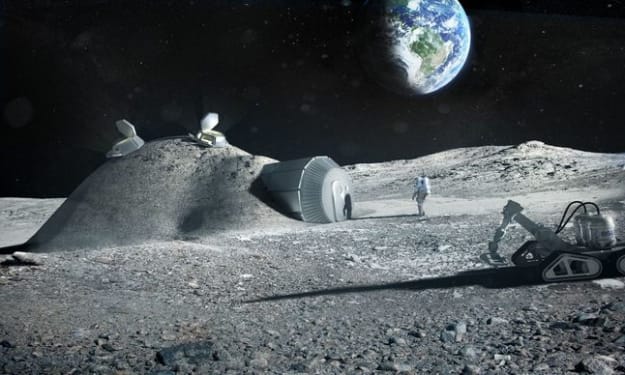
Elon Musk’s Lunar Dream: Will SpaceX Build a New World on the Moon by 2030?
## **Introduction: The Race to the Moon** The year is 2030. A crimson SpaceX Starship, emblazoned with the company’s iconic logo, touches down on the dusty plains of the Moon’s south pole. Inside, a crew of astronauts—engineers, scientists, and visionaries—step onto the lunar surface, not as visitors, but as pioneers of humanity’s first permanent off-world settlement. This is Elon Musk’s bold vision: a self-sustaining lunar colony, a stepping stone to Mars, and a new chapter in human civilization.
By Danyal Hashmi5 months ago in Futurism
About Binding Prometheus
I want to start actively advocating on behalf of my own work, and the most valuable part of my canon is, without a doubt, Binding Prometheus, the play I have been working on since 2019 and only finished in 2023 as part of my MA. The play itself is an amalgamation of a million different inspirations. On one end, it evokes the Ancient Greek myth-play, deriving its own title from the earliest extant work of Western drama we have, Aeschylus’s Prometheus Bound. On the other end, it borrows significantly from the sci-fi bulwarks from over the years, namely Mary Shelley’s Frankenstein and Karel Capek’s Rossum’s Universal Robots. The play could be an episode of Black Mirror, I fear. I don’t know. I’ve only ever seen one episode of Black Mirror.
By Steven Christopher McKnight18 days ago in Futurism
Smart Toys Market Size to Surpass USD 60.0 Billion by 2033 on Interactive Learning Demand & Market Outlook
According to IMARC Group's latest research publication, the global smart toys market size reached USD 18.1 Billion in 2024. Looking forward, IMARC Group expects the market to reach USD 60.0 Billion by 2033, exhibiting a growth rate (CAGR) of 13.52% during 2025-2033.
By Suhaira Yusuf6 days ago in Futurism



Comments
There are no comments for this story
Be the first to respond and start the conversation.