
Elon Musk’s Lunar Dream: Will SpaceX Build a New World on the Moon by 2030?
A Futuristic Vision of Humanity’s First Off-World Colony
## **Introduction: The Race to the Moon**
The year is 2030. A crimson SpaceX Starship, emblazoned with the company’s iconic logo, touches down on the dusty plains of the Moon’s south pole. Inside, a crew of astronauts—engineers, scientists, and visionaries—step onto the lunar surface, not as visitors, but as pioneers of humanity’s first permanent off-world settlement. This is Elon Musk’s bold vision: a self-sustaining lunar colony, a stepping stone to Mars, and a new chapter in human civilization.
But will this dream become reality? As SpaceX accelerates its Starship program and NASA’s Artemis missions pave the way for lunar habitation, the question looms: **Can Elon Musk truly build a new world on the Moon by 2030?**
---
## **Chapter 1: The Blueprint for a Lunar Colony**
### **SpaceX’s Starship: The Workhorse of Lunar Colonization**
At the heart of Musk’s lunar ambitions is **Starship**, SpaceX’s fully reusable super-heavy launch vehicle. Designed to carry 100+ tons of cargo and passengers to the Moon, Starship is central to establishing infrastructure—habitats, power plants, and life-support systems .
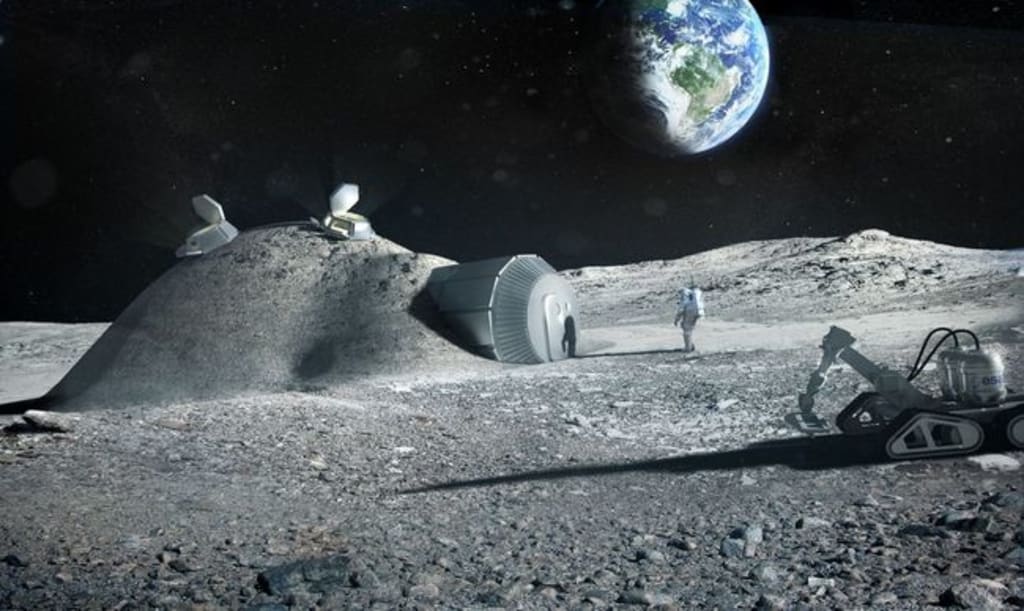
- **Lunar Base Alpha**: Musk envisions a modular base, constructed from prefabricated habitats transported by Starship. These structures would be buried under regolith for radiation protection.
- **Nuclear Power**: NASA’s plans to deploy a **100-kilowatt nuclear reactor by 2030** could provide continuous energy during the Moon’s two-week nights, where solar power fails .
- **Resource Utilization**: Ice deposits at the lunar poles could be mined for water, oxygen, and hydrogen fuel, reducing reliance on Earth .
### **The Artemis Partnership**
While Musk has criticized NASA’s Artemis program as "inefficient," SpaceX remains a key player, contracted to develop the **Starship Human Landing System (HLS)** for Artemis III (2027) . Success here could fast-track SpaceX’s independent lunar ambitions.
---
## **Chapter 2: The Challenges Ahead**
### **Technical Hurdles**
1. **Orbital Refueling**: Starship requires in-space refueling for lunar missions—a feat never before attempted at scale. SpaceX plans to test this in 2025 .
2. **Radiation & Extreme Temperatures**: Lunar settlers face deadly cosmic rays and temperatures swinging from -250°F to 250°F. Shielding solutions remain experimental .
3. **Life Support**: Closed-loop systems for air, water, and food are untested for long-term lunar habitation.
### **Political & Financial Risks**
- **Funding**: NASA’s budget fluctuates, and SpaceX’s Mars focus could divert resources from lunar projects .
- **Geopolitical Tensions**: The U.S., China, and Russia are racing to claim lunar territory, risking conflicts over resource-rich zones .
---
## **Chapter 3: A Day in the Life of a Lunar Colonist (2030)**
Imagine waking up in **Moon Base Alpha**, a cluster of pressurized domes nestled in the Shackleton Crater. The nuclear reactor hums softly, powering hydroponic farms where genetically modified crops thrive under artificial sunlight. Outside, robotic rovers scout for ice deposits while a Starship lands, delivering fresh supplies from Earth.
- **Work**: Colonists repair solar arrays, conduct experiments in low gravity, and test 3D-printed construction techniques.
- **Leisure**: Virtual reality simulates Earth’s beaches, while low-gravity sports like "lunar hoops" become a pastime.
- **Challenges**: Communication delays with Earth (1.3 seconds) are manageable, but medical emergencies require AI-assisted surgery.
---
## **Chapter 4: The Road to 2030—Will Musk Succeed?**
### **Optimistic Scenario: A Thriving Outpost**
If SpaceX and NASA hit key milestones—
- **2026**: Uncrewed Starship lands on Moon, testing landing and resource extraction .
- **2027**: Artemis III delivers astronauts near the south pole, with SpaceX’s HLS .
- **2028-2030**: Cargo Starships deploy habitats, reactors, and rovers, enabling permanent occupation.
By 2030, a **dozen scientists and engineers** could be living on the Moon, laying the groundwork for expansion.
### **Pessimistic Scenario: Delays and Setbacks**
- **Starship failures**: Explosions or refueling issues could push timelines back .
- **Budget cuts**: Political shifts may defund NASA’s lunar ambitions .
- **Competition**: China’s lunar base plans (2035) could outpace U.S. efforts .
---
## **Conclusion: Humanity’s Giant Leap**
Elon Musk’s dream of a lunar colony by 2030 is audacious—but not impossible. With **Starship’s breakthroughs, NASA’s support, and private-sector innovation**, a small but functional Moon base could emerge this decade. However, the path is fraught with technical, financial, and political obstacles.
One thing is certain: **the Moon will no longer be a distant symbol, but a second home for humanity**. Whether Musk leads this charge or shares it with global partners, the 2030s may mark the dawn of a multi-planetary civilization.
**Final Thought:**
*"The Moon is not a destination—it’s a gateway. Mars awaits, but first, we must conquer our celestial neighbor."* —Elon Musk .
About the Creator
Keep reading
More stories from Danyal Hashmi and writers in Futurism and other communities.
Sight Unseen: How Elon Musk’s Neuralink Gave Vision to the Blind
For 28-year-old Daniel Carter, the world had been a symphony of sounds, textures, and memories—but never colors, never shapes. Born blind due to a rare genetic disorder that destroyed his optic nerves, Daniel had never seen his mother’s face, the blue of the sky, or the glow of a sunset. He had adapted brilliantly—navigating life with a cane, mastering braille, and even becoming a talented pianist—but the question always lingered in the back of his mind: *What does the world really look like?*
By Danyal Hashmi5 months ago in Futurism
About Binding Prometheus
I want to start actively advocating on behalf of my own work, and the most valuable part of my canon is, without a doubt, Binding Prometheus, the play I have been working on since 2019 and only finished in 2023 as part of my MA. The play itself is an amalgamation of a million different inspirations. On one end, it evokes the Ancient Greek myth-play, deriving its own title from the earliest extant work of Western drama we have, Aeschylus’s Prometheus Bound. On the other end, it borrows significantly from the sci-fi bulwarks from over the years, namely Mary Shelley’s Frankenstein and Karel Capek’s Rossum’s Universal Robots. The play could be an episode of Black Mirror, I fear. I don’t know. I’ve only ever seen one episode of Black Mirror.
By Steven Christopher McKnight18 days ago in Futurism
Luxury Goods Market: Millennials, Gen Z Influence & Future Demand Patterns
According to IMARC Group's latest research publication, global luxury goods market size reached USD 296.9 Billion in 2025. Looking forward, IMARC Group expects the market to reach USD 407.2 Billion by 2034, exhibiting a growth rate (CAGR) of 3.57% during 2026-2034.
By Andrew Sullivan7 days ago in Futurism


Comments
There are no comments for this story
Be the first to respond and start the conversation.