
The LinkedIn Profile Map: Your Underrated CI Weapon
Weekly Winning Strategies


The LinkedIn Profile Map: Your Underrated CI Weapon: Weekly Winning Strategies
If you’re doing competitive intelligence without enterprise tools, this is for you.
You don’t need Klue.
And you don’t need a Crayon.
You need 90 minutes a week, LinkedIn’s search bar, and the discipline to think like an analyst, not a browser.
By tracking how a competitor’s team is shifting—who they’re hiring, what they’re renaming, where they’re posting—you can build a working theory of their go-to-market and product roadmap before they tell the world.
This isn’t guesswork.
It’s people-watching at scale.
And it works.
Why LinkedIn Profiles Are a Map, Not a Mirror
Too many founders treat LinkedIn like a resume database.
But here’s the real value: it’s a forward-looking map of company intent.
- Every new job title is a strategic signal.
- Every content theme is a positioning experiment.
- And every regional hire is growth.
LinkedIn profiles don’t reflect where a company is. They reflect where it’s going.
Case Study: How a FinTech Startup Beat a Competitor to LATAM
In 2023, we were advising a bootstrapped B2B FinTech startup—under 50 people, targeting mid-sized accounting firms in the US.
One of their biggest threats was a US-based Series B competitor with aggressive growth targets and a slicker product. Let’s call them LedgerIQ (not the real name).
By Q1, LedgerIQ had a steady content stream, standard hiring in the US, and a strong foothold in SMB finance.
Nothing out of the ordinary.
But one junior product marketer at my client’s company noticed something weird.
“LedgerIQ just hired a Spanish-speaking CS manager based in Mexico City… but they don’t support Spanish yet.”
That single data point kicked off an analysis of a LinkedIn profile map.
Here’s what they found:
Five new hires in Mexico, Argentina, and Colombia—titles included Regional Partnerships Manager, LATAM Marketing Lead, Spanish-Speaking Implementation Specialist
Job descriptions hinted at “go-to-market launch planning,” “local compliance adaptation,” and “Spanish-language onboarding”
No public announcement had been made. The website still said “US only.”
Content strategy on LinkedIn had subtle shifts—more mentions of “multi-currency,” “international expansion,” “LATAM opportunities”
Within three weeks, we were confident: LedgerIQ was quietly prepping for a LATAM expansion.
My client immediately accelerated its Spanish-language onboarding experience, expanded partnerships with two LATAM accounting software vendors, and began producing localised lead-gen content.
By the time LedgerIQ officially launched in LATAM—93 days later—my client had already landed six anchor clients in the region.
Small signals. Big edge.
How to Build a LinkedIn Profile Map in 5 Steps
You don’t need tools or APIs. You just need focus and a spreadsheet. Here’s how:
1. Identify Key Competitor Personas
Map out 5–10 roles that could isolate a change in their strategy. Examples:
- Product Marketing Manager
- Regional Sales Lead
- Partner Manager
- Solutions Architect
- Implementation Specialist
These roles are usually tied to go-to-market or geographic expansion.
2. Track Title Changes and New Hires
Use LinkedIn search filters:
- Company? (Your Competitor)
- Location? (Emerging Region or is it Global)
- Date Posted? Past Month or sooner? What have they posted in the past?
Look for:
- Title changes (e.g., “Sales Enablement → GTM Strategy Lead”)
- New team members in unexpected locations
- Promotions into newly formed teams (e.g., “Head of LATAM GTM”)
3. Analyse Job Descriptions
Even if you can’t see full listings, check archived job posts on Google Jobs or Wayback Machine.
Focus on:
- GTM language (launch, expansion, product rollout)
- Geography
- New feature mentions (AI, embedded finance, B2B payments, etc.)
- Language or compliance-specific requirements
These clues often beat press releases by months.
4. Watch for Content Pattern Shifts
Follow 5–10 employees from marketing, sales, and product on LinkedIn. Don’t track the brand account—it’s often sanitised.
What to look for:
- New hashtags
- Language localisation
- Geography mentions
- Specific verticals (e.g., “new tools for LATAM tax workflows”)
You’ll spot the new positioning themes long before they go on the website.
5. Log and Compare Monthly
Don’t try to “analyse” every post.
Instead, log 5–10 consistent signals across 3–6 months:
- Growth in regional headcount
- Recurring content themes
- Job post terminology
- Partner manager hires
- Internal title standardisation (e.g., everyone becomes “Customer Experience Architect” — why?)
This lets you see movement patterns over time—not just one-off guesses.
A Strategic Timeline
By tracking team changes, regional hires, and job language, you can model the likely strategy path your competitor is on.
Here’s a simplified example from a real CI map:
- The point isn’t to be 100% right.
- The point is to move 90 days earlier than your competition.
When This Fails: What NOT to Do
A few common mistakes kill the value of this approach:
- Over-indexing on individual hires
- One CS rep in Brazil doesn’t mean a launch is coming. Wait for a pattern.
- Watching only the company page
- Brand content is usually lagging behind reality. Track individual employees.
- Not timestamping your observations
- Without a timeline, your insights lose predictive power.
- Assuming silence means inactivity
If a competitor goes quiet, it often means they’re building. Not scaling back. It can often mean inactivity, of course. Until it doesn’t. But if you aren’t looking, then you will never know the difference anyway.
Why This Works So Well in B2B SaaS
SaaS GTM motion is resource-heavy and slow to pivot.
Which means:
- Every regional expansion requires hiring in advance
- Every product feature needs enablement and marketing alignment
- Every ICP shift changes who they hire and how they title those hires
The hiring plan becomes the roadmap.
And LinkedIn is where that plan leaks first.
The Takeaway: Quiet Patterns Beat Loud Launches
If you wait for a competitor to make an announcement, you’ve already lost the edge.
But if you build the muscle of watching the people behind the company—before the company updates its homepage—you can:
Predict product bets
See market expansion 3–6 months early
Detect ICP pivots
Spot pricing strategy changes
And if you’re small?
This is how you win against competitors 10x your size.
Because you’re watching while they’re busy shipping.
Bottom line?
Competitor strategy leaks through people, not press releases.
Track them. Then you’ll spot the playbook before the rest of the market catches on.
https://www.octopusintelligence.com/the-linkedin-profile-map-your-underrated-ci-weapon/
About the Creator
Octopus Competitive Intelligence
THE GLOBAL COMPETITIVE INTELLIGENCE AGENCY
we find the answers to beat your competitors
Make better decisions
Win more business
Enter the right markets
See what’s next
Keep reading
More stories from Octopus Competitive Intelligence and writers in Futurism and other communities.
How to Predict a Competitor’s Product Launch
How to Predict a Competitor’s Product Launch from Patent Filings, GitHub, and Trademark Records: Weekly Winning Strategies Most companies react to competitor launches 6 months too late—but patent filings, GitHub commits, and trademark applications reveal product roadmaps 18-24 months in advance.
By Octopus Competitive Intelligence4 months ago in Futurism
About Binding Prometheus
I want to start actively advocating on behalf of my own work, and the most valuable part of my canon is, without a doubt, Binding Prometheus, the play I have been working on since 2019 and only finished in 2023 as part of my MA. The play itself is an amalgamation of a million different inspirations. On one end, it evokes the Ancient Greek myth-play, deriving its own title from the earliest extant work of Western drama we have, Aeschylus’s Prometheus Bound. On the other end, it borrows significantly from the sci-fi bulwarks from over the years, namely Mary Shelley’s Frankenstein and Karel Capek’s Rossum’s Universal Robots. The play could be an episode of Black Mirror, I fear. I don’t know. I’ve only ever seen one episode of Black Mirror.
By Steven Christopher McKnight20 days ago in Futurism
Wood and Timber Products Market Size and Forecast 2025–2033: Sustainable Growth Shapes a Trillion-Dollar Industry
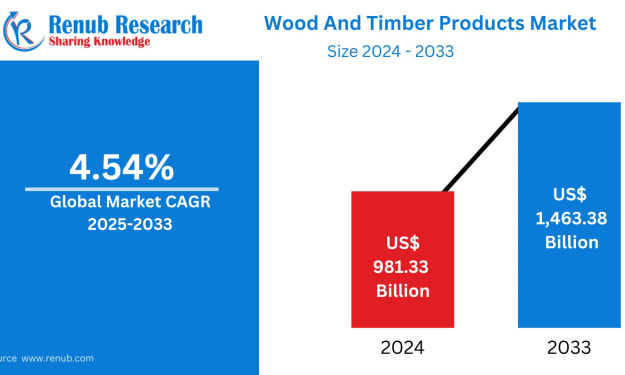
Global Wood and Timber Products Market Outlook The global Wood and Timber Products Market is undergoing a steady transformation as sustainability, urbanization, and infrastructure development reshape material choices worldwide. According to Renub Research, the market is expected to grow from US$ 981.33 billion in 2024 to US$ 1,463.38 billion by 2033, expanding at a CAGR of 4.54% from 2025 to 2033.
By Janine Root 2 days ago in Futurism



Comments
There are no comments for this story
Be the first to respond and start the conversation.