
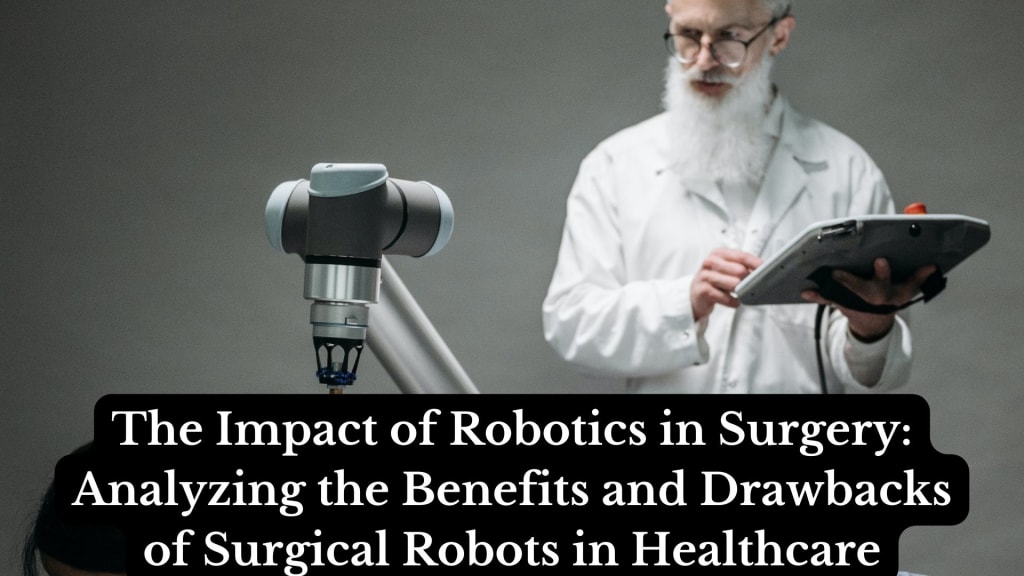
The Impact of Robotics in Surgery: Analyzing the Benefits and Drawbacks of Surgical Robots in Healthcare
Precision and Reduced Recovery Time versus Potential Drawbacks

Introduction:
Surgical procedures have come a long way since the days of manual operations. With advancements in technology, surgical robots have become increasingly popular in the healthcare industry. These robots are designed to assist surgeons in performing complex procedures with greater precision and accuracy, leading to reduced recovery times and improved outcomes for patients. However, as with any new technology, there are potential drawbacks to consider. In this blog, we will analyze the use of surgical robots in healthcare, their benefits, and potential drawbacks.
Benefits of Surgical Robots:
Surgical robots are designed to provide numerous benefits to both surgeons and patients.
Precision: One of the most significant benefits of surgical robots is their precision. Robots can make extremely precise incisions, allowing for greater accuracy and minimizing damage to surrounding tissues and organs. This precision can also lead to reduced recovery times and less scarring for patients.
Enhanced Visualization: Surgical robots offer enhanced visualization capabilities that provide surgeons with a clear and precise view of the surgical site. This allows them to identify potential complications and minimize the risk of errors during the procedure.
Reduced Risk of Infection: Surgical robots utilize sterile instruments, reducing the risk of contamination and infection. This is especially important in procedures where the risk of infection is high, such as surgeries involving the gastrointestinal tract.
Greater Range of Motion: Surgical robots provide surgeons with a greater range of motion and dexterity, allowing them to access hard-to-reach areas of the body. This can be particularly beneficial in procedures involving delicate structures such as blood vessels or nerves.
In addition to precision, surgical robots can also provide surgeons with a greater range of motion and dexterity. This allows them to access hard-to-reach areas of the body, which may not be possible with traditional surgical methods. The enhanced visualization provided by robotic systems also allows surgeons to see the surgical site in greater detail, enabling them to identify potential complications and minimize the risk of errors during the procedure.
Another benefit of surgical robots is the reduced risk of infection. With traditional surgical methods, there is always a risk of infection due to the opening of the body. However, surgical robots utilize sterile instruments, reducing the risk of contamination and infection.
Drawbacks of Surgical Robots:
While surgical robots offer numerous benefits, there are also potential drawbacks to consider. One of the primary concerns is the cost of the technology. Surgical robots can be expensive to acquire and maintain, which can limit access for smaller healthcare facilities and hospitals.
There are also concerns about the learning curve associated with using surgical robots. Surgeons require extensive training to become proficient in operating these systems, and there is a risk of errors during the learning process. Additionally, the reliance on technology can make it challenging for surgeons to develop their manual skills, which could be problematic in the event of a technical malfunction.
Another potential drawback is the lack of tactile feedback. With traditional surgical methods, surgeons can feel the tissues and organs they are operating on, providing valuable feedback and enhancing their precision. However, with surgical robots, this feedback is not available, which could lead to a loss of tactile sensitivity and potentially compromise the accuracy of the procedure.
Conclusion:
In conclusion, the use of surgical robots in healthcare has revolutionized the way surgeries are performed. The benefits of surgical robots, including increased precision, reduced recovery time, and decreased risk of infection, have led to improved outcomes for patients. However, there are also potential drawbacks to consider, including the cost of the technology, the learning curve for surgeons, and the lack of tactile feedback. As with any new technology, it is essential to carefully weigh the benefits and drawbacks before deciding whether to adopt surgical robots in healthcare facilities. With continued advancements in technology and ongoing research, surgical robots have the potential to transform the field of surgery and improve patient outcomes for years to come.
About the Creator
GelStories
I am Melfred and I am passionate, and I like reading and writing. In this page I am going to write many stories covering many interesting subjects such as lifestyle, business, investments, school, science, cuisine, culture, etc. Welcome!
Keep reading
More stories from GelStories and writers in Futurism and other communities.
The Impact of Robotics in Surgery: How Precision and Efficiency are Revolutionizing Medical Procedures
Introduction Robotic surgery is a relatively new field that has revolutionized surgical procedures. In robotic surgery, a surgeon uses a computer console to control robotic arms that perform the surgical procedure. The robotic arms have tiny instruments attached to them that can move with a range of motion beyond the human hand, allowing for greater precision and dexterity. This technology is rapidly evolving and becoming more widespread in the healthcare industry. In this blog, we will explore the benefits and drawbacks of robotic surgery and the impact it is having on medical procedures.
By GelStories3 years ago in Futurism
About Binding Prometheus
I want to start actively advocating on behalf of my own work, and the most valuable part of my canon is, without a doubt, Binding Prometheus, the play I have been working on since 2019 and only finished in 2023 as part of my MA. The play itself is an amalgamation of a million different inspirations. On one end, it evokes the Ancient Greek myth-play, deriving its own title from the earliest extant work of Western drama we have, Aeschylus’s Prometheus Bound. On the other end, it borrows significantly from the sci-fi bulwarks from over the years, namely Mary Shelley’s Frankenstein and Karel Capek’s Rossum’s Universal Robots. The play could be an episode of Black Mirror, I fear. I don’t know. I’ve only ever seen one episode of Black Mirror.
By Steven Christopher McKnight19 days ago in Futurism
Australia Car Market: Consumer Demand, Technology Shift & Mobility Evolution
According to IMARC Group, the Australia car market reached a value of USD 21.5 Billion in 2025 and is projected to grow to USD 23.6 Billion by 2034, registering a compound annual growth rate (CAGR) of 1.05% during 2026–2034. While growth is modest in value terms, the market is undergoing a profound structural transformation. Australia’s car market is no longer defined solely by unit sales; it increasingly reflects broader shifts in technology adoption, consumer expectations, environmental priorities and future mobility models. Electrification, connected-vehicle features and evolving ownership preferences are reshaping how Australians research, purchase and use vehicles, positioning the market firmly within a future-oriented mobility landscape.
By Shrestha Roy7 days ago in Futurism



Comments
There are no comments for this story
Be the first to respond and start the conversation.