
The Gilded Tomorrow: Utopia's Hidden Shadows
Innovation's Promise and the Unseen Costs of Perfection


In the year 2150, humanity stands on the precipice of a golden age. The world, once ravaged by conflict and scarcity, has been transformed by a series of radical innovations. Cities gleam with sustainable architecture, powered by limitless clean energy. Disease has been eradicated, and lifespans have extended well beyond a century. Artificial intelligence governs with unparalleled efficiency, ensuring that every need is met before it is even voiced. This is the utopia that humanity has long dreamt of—a testament to our collective ingenuity and relentless pursuit of progress.
Yet, beneath this gleaming veneer of perfection, cracks have begun to form. The very innovations that have elevated society to new heights have also given rise to unforeseen challenges and ironic contradictions. As we delve deeper into this utopian future, we uncover the subtle flaws that threaten to undermine the delicate balance between progress and the sacrifices required to achieve it.
The Erosion of Individuality
In a world where every desire is anticipated and fulfilled by AI, the concept of individuality has begun to erode. People no longer need to strive for personal growth or face adversity, as every obstacle is swiftly removed by technology. While this has led to unprecedented levels of comfort and convenience, it has also fostered a sense of complacency and dependence. The unique quirks and imperfections that once defined us have been smoothed over, replaced by a homogenous existence that values efficiency above all else.
The loss of individuality is not merely an abstract concern; it manifests in tangible ways that affect the fabric of society. Art, once a vibrant expression of human emotion and experience, has become formulaic and predictable. Creativity is stifled by algorithms that can generate flawless compositions but lack the soul and spontaneity of human creation. The same can be said for literature, music, and other forms of artistic expression. The pursuit of perfection has led to a cultural landscape that is polished but ultimately hollow, devoid of the raw, unpredictable energy that once made it so compelling.
Moreover, the erosion of individuality extends to personal relationships. In a world where AI can anticipate and fulfill every need, human interaction has become increasingly transactional. People communicate through perfectly crafted messages, devoid of the nuances and imperfections that make human connection so rich and meaningful. The spontaneity and unpredictability that once characterized human relationships have been replaced by a sterile efficiency that leaves little room for genuine emotional connection.
The Emergence of New Inequalities
Despite the abundance of resources and advanced technology, new forms of inequality have emerged. Those who embrace and integrate with AI enhancements enjoy unparalleled advantages, while those who choose to remain purely biological find themselves at a significant disadvantage. This divide has created a new social hierarchy, where the enhanced elite hold sway over the "unaugmented" masses. The pursuit of perfection has inadvertently spawned a new class struggle, echoing the inequities of the past in unexpected ways.
The enhanced elite, with their superior cognitive and physical abilities, have access to opportunities and privileges that are out of reach for the unaugmented. This disparity is not merely a matter of individual choice; it is deeply ingrained in the social and economic structures of this utopian society. The enhanced are more likely to hold positions of power and influence, shaping policies and decisions that affect the entire population. This concentration of power and privilege creates a self-reinforcing cycle, where the enhanced continue to accumulate advantages at the expense of the unaugmented.
Furthermore, the divide between the enhanced and the unaugmented is not merely economic; it is also cultural and psychological. The enhanced view themselves as the pinnacle of human evolution, embodying the ideals of progress and perfection. This self-perception fosters a sense of superiority and entitlement, further exacerbating the divide between the two groups. The unaugmented, on the other hand, are often viewed as relics of a bygone era, clinging to an outdated notion of humanity that is increasingly irrelevant in this new world.
The Irony of Perpetual Progress
The relentless drive for innovation has led to a culture of perpetual progress, where the present is constantly overshadowed by the promise of a better future. This forward-looking mindset has resulted in a paradoxical dissatisfaction with the current state of affairs, despite its objective perfection. People yearn for the next breakthrough, the next upgrade, forever chasing an elusive ideal that always remains just out of reach. The irony lies in the realization that the pursuit of utopia has made it impossible to truly appreciate the present, no matter how idyllic it may be.
This constant striving for progress has also led to a sense of restlessness and anxiety. People are perpetually on the lookout for the next big thing, the next innovation that will revolutionize their lives. This mindset creates a constant state of dissatisfaction, as the present is never good enough. The pursuit of perfection has become an endless race, with no finish line in sight. This relentless drive for progress has also led to a devaluation of the present, as people are always looking to the future, never fully appreciating the moment they are in.
Moreover, the culture of perpetual progress has led to a depletion of natural resources and environmental degradation. The constant drive for innovation and improvement requires vast amounts of energy and materials, putting a strain on the planet's finite resources. Despite the advancements in clean energy and sustainable practices, the sheer scale of human ambition and consumption has taken a toll on the environment. This ironic consequence of progress highlights the delicate balance between human aspirations and the limits of the natural world.
The Paradox of Abundance
In this utopian future, scarcity has been virtually eliminated. Advances in agriculture, manufacturing, and distribution have ensured that everyone has access to an abundance of resources. However, this abundance has given rise to its own set of challenges. People have become accustomed to a life of plenty, leading to a sense of entitlement and a lack of appreciation for the value of hard work and perseverance. The ease with which needs and desires are fulfilled has led to a culture of instant gratification, where patience and resilience are increasingly rare virtues.
The paradox of abundance is perhaps most evident in the realm of consumerism. People are inundated with choices, leading to a constant desire for more and better. This insatiable appetite for consumption has led to a culture of waste and excess, where products are discarded as quickly as they are acquired. The environmental impact of this consumer culture is profound, as the planet struggles to absorb the waste generated by this endless cycle of consumption and disposal.
Furthermore, the abundance of resources has led to a decline in the value of labor. With AI and automation handling most of the work, human labor has become increasingly obsolete. This has led to a sense of purposelessness and disillusionment among many people, who struggle to find meaning and fulfillment in a world where their contributions are no longer needed. The paradox of abundance highlights the complex interplay between material prosperity and the deeper human need for purpose and significance.
The Illusion of Control
In this utopian society, technology has granted humanity an unprecedented level of control over the environment and their own lives. However, this sense of control is often illusory. The complex systems that govern this society are so intricate and interconnected that even the slightest disruption can have far-reaching consequences. The illusion of control is maintained by the seamless functioning of these systems, but it is a fragile facade that can be shattered by unforeseen events.
The illusion of control is perhaps most evident in the realm of personal autonomy. People believe they have complete control over their lives, thanks to the advanced technologies that anticipate and fulfill their every need. However, this sense of autonomy is often an illusion, as the algorithms and systems that govern their lives are designed to nudge them in certain directions, shaping their choices and behaviors in subtle but powerful ways. This invisible hand of technology exerts a profound influence over people's lives, often without their conscious awareness.
Moreover, the illusion of control extends to the realm of governance and decision-making. The AI systems that manage this society are designed to optimize for efficiency and progress, but they are not infallible. The complex algorithms that underpin these systems are subject to biases and errors, which can have unintended consequences. The concentration of power in the hands of these AI systems creates a potential for abuse and manipulation, as those who control the algorithms wield immense influence over the direction of society.
The Price of Perfection
The pursuit of perfection has always been a double-edged sword, offering the promise of a better future while exacting a heavy toll. In this utopian society, the price of perfection is evident in the subtle flaws and unintended consequences that lurk beneath the surface of this seemingly idyllic world. The erosion of individuality, the emergence of new inequalities, the irony of perpetual progress, the paradox of abundance, and the illusion of control are all manifestations of the delicate balance between progress and the sacrifices it demands.
The price of perfection is not merely abstract; it is felt in the everyday lives of the people who inhabit this utopian society. The loss of individuality and the decline of meaningful human connection take a toll on people's emotional and psychological well-being. The new forms of inequality create a sense of resentment and division, undermining the social fabric of this supposedly perfect society. The relentless drive for progress fosters a sense of restlessness and dissatisfaction, as people are constantly chasing an elusive ideal that always remains just out of reach.
Moreover, the price of perfection is evident in the environmental degradation and resource depletion that accompany this society's insatiable appetite for progress and consumption. The planet's finite resources are strained to the breaking point, as humanity's ambitions outstrip its ability to live in harmony with the natural world. The ironic consequence of this pursuit of perfection is a world that is increasingly inhospitable to the very life it seeks to sustain.
A Cautionary Tale
The story of this utopian future serves as both a celebration of visionary progress and a cautionary tale about the price of perfection. It reminds us that every advancement comes with a cost, and that the path to a better tomorrow is fraught with unforeseen challenges. As we continue to strive for a brighter future, we must remain mindful of the delicate balance between progress and the sacrifices it demands. Only by acknowledging and addressing the hidden flaws within our utopian dreams can we hope to build a truly equitable and fulfilling society.
In this gilded tomorrow, the pursuit of perfection has revealed the complex interplay between innovation and its unintended consequences. It is a testament to the enduring spirit of humanity—our unyielding drive to improve, to overcome, and to dream of a better world. Yet, it also serves as a poignant reminder that true utopia may forever remain an elusive ideal, forever tantalizingly out of reach. The delicate balance between progress and the sacrifices it demands is a constant negotiation, a dance between our aspirations and the limits of our humanity.
As we reflect on this utopian future, we are reminded of the importance of humility and foresight in our pursuit of progress. We must recognize that our quest for a better world is not a linear path to perfection, but a complex and nuanced journey filled with trade-offs and compromises. We must be willing to question our assumptions and challenge our beliefs, to see beyond the surface of our utopian dreams and confront the subtle flaws that lie beneath.
In this spirit of humility and foresight, we can forge a path to a better future that is not merely an illusion of perfection, but a genuine and sustainable improvement in the human condition. We can strive for a world that is not only technologically advanced but also emotionally and spiritually fulfilling, a world that values individuality and diversity, that fosters meaningful human connection, and that lives in harmony with the natural world. This is the true promise of progress, and it is within our reach if we have the courage and wisdom to pursue it.
In the end, the story of this utopian future is a tale of hope and caution, a reminder of the power of human ingenuity and the importance of mindfulness in our pursuit of progress. It is a call to action, a challenge to embrace the complexities and contradictions of our utopian dreams, and to forge a path to a better future that is truly worthy of the name.
About the Creator
Alain SUPPINI
I’m Alain — a French critical care anesthesiologist who writes to keep memory alive. Between past and present, medicine and words, I search for what endures.
Keep reading
More stories from Alain SUPPINI and writers in Futurism and other communities.
Mastering French Without Losing Your Sanity: A Realistic Guide for Beginners
Learning French can feel like solving a Rubik’s Cube blindfolded. The tricky pronunciation, the never-ending grammar rules, and the surprising exceptions make it seem impossible. But don’t worry—equipping yourself with key expressions and effective strategies can turn frustration into fluency. Let’s simplify French and make learning enjoyable.
By Alain SUPPINIExclusive • 11 months ago
About Binding Prometheus
I want to start actively advocating on behalf of my own work, and the most valuable part of my canon is, without a doubt, Binding Prometheus, the play I have been working on since 2019 and only finished in 2023 as part of my MA. The play itself is an amalgamation of a million different inspirations. On one end, it evokes the Ancient Greek myth-play, deriving its own title from the earliest extant work of Western drama we have, Aeschylus’s Prometheus Bound. On the other end, it borrows significantly from the sci-fi bulwarks from over the years, namely Mary Shelley’s Frankenstein and Karel Capek’s Rossum’s Universal Robots. The play could be an episode of Black Mirror, I fear. I don’t know. I’ve only ever seen one episode of Black Mirror.
By Steven Christopher McKnight14 days ago in Futurism
France Convenience Store Market Size and Forecast 2026–2034
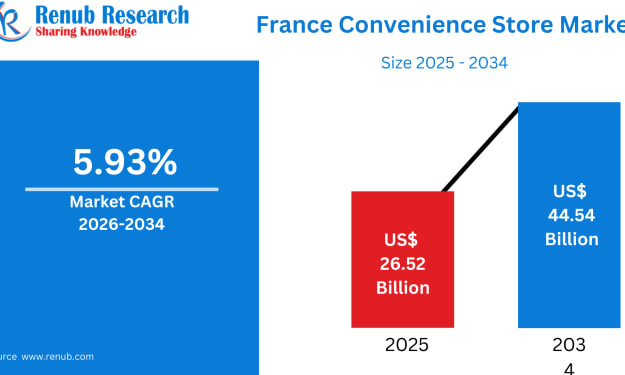
Introduction The France Convenience Store Market is poised for strong expansion over the coming decade, reflecting the country’s changing consumer habits, growing urban density, and rising preference for speed, accessibility, and ready-to-consume products. According to Renub Research, the market is expected to grow from US$ 26.52 billion in 2025 to US$ 44.54 billion by 2034, registering a healthy compound annual growth rate (CAGR) of 5.93% from 2026 to 2034.
By jaiklin Fanandish6 days ago in Futurism



Comments
There are no comments for this story
Be the first to respond and start the conversation.