
The Geometry of the Universe: Flat, Closed, or Infinite?
Space

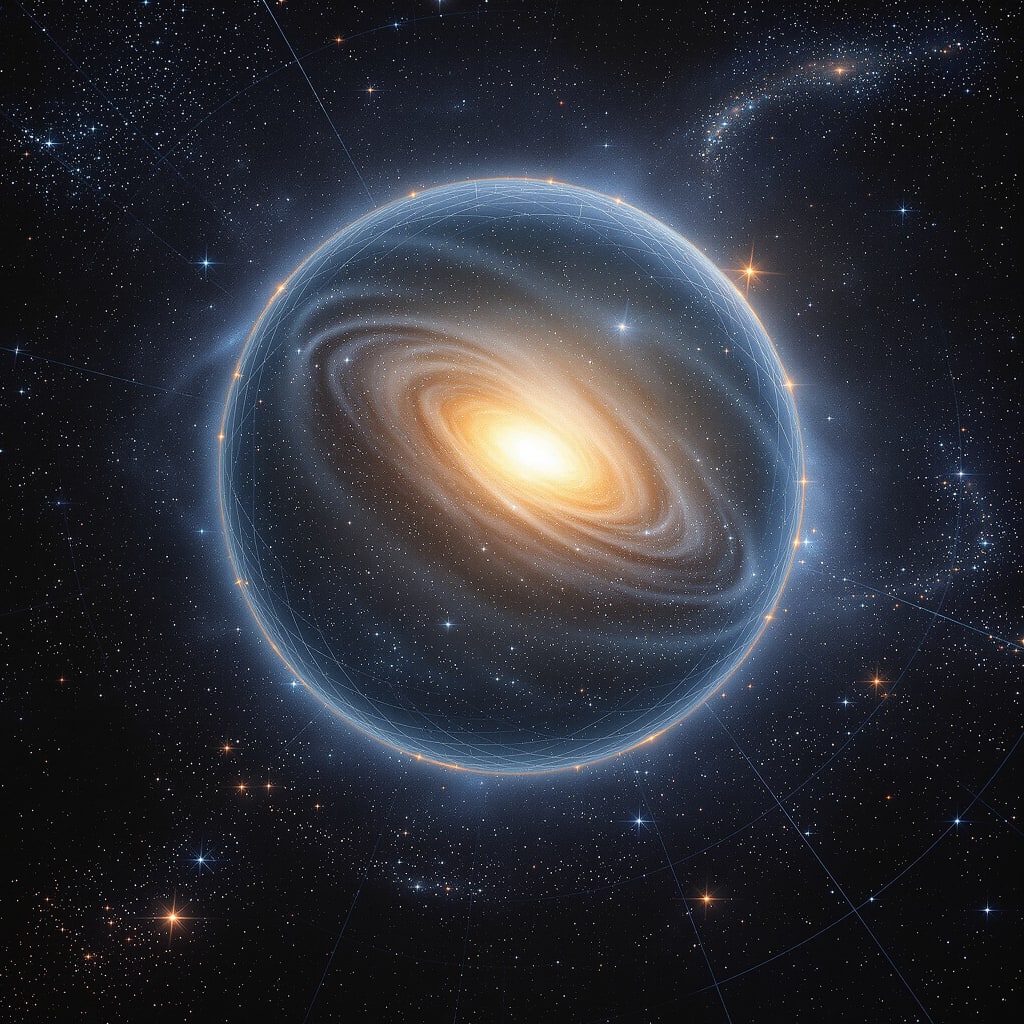
Since ancient times, humanity has looked up at the stars, not only in awe but also in search of answers. One of the deepest questions we’ve ever asked is deceptively simple: What shape is the universe? It’s more than just a philosophical curiosity—it’s a fundamental part of understanding the nature of space, time, and even the ultimate fate of everything we know. According to modern cosmology, the universe can take on three possible shapes: flat, closed, or open. Each of these geometries offers a different view of reality—and a different destiny.
Three Shapes, Three Destinies
When scientists talk about the geometry of the universe, they aren’t referring to the shapes of planets or galaxies, but to the fabric of space itself—how it bends, stretches, and behaves on the grandest scale. This idea took form with Albert Einstein’s General Theory of Relativity, which showed that space and time can be curved by mass and energy.
Let’s break down the three possible geometries:
- Flat Universe (Euclidean Geometry)
Imagine a sheet of paper that extends forever in all directions. In this model, parallel lines never meet, and the angles of a triangle always add up to 180 degrees. A flat universe has just the right amount of matter to balance gravity and expansion. It continues to expand forever, but at a steady rate—not too fast, not too slow.
- Closed Universe (Spherical Geometry)
Now picture the surface of a sphere. In this universe, space curves inward. Parallel lines eventually meet, and the angles of a triangle sum to more than 180 degrees. A closed universe is finite but has no edges, much like Earth’s surface. Over time, expansion slows, halts, and reverses, leading to a "Big Crunch" where everything collapses back together.
- Open Universe (Hyperbolic Geometry)
Think of a saddle shape—space here curves outward. Parallel lines diverge, and triangle angles add up to less than 180 degrees. In an open universe, expansion accelerates forever, making it cold, vast, and endlessly growing. This model suggests a universe with less matter than the critical amount needed to slow it down.
What Do Observations Tell Us?
To determine the universe’s shape, scientists study the cosmic microwave background (CMB)—the afterglow of the Big Bang. This ancient light, about 13.8 billion years old, holds imprints of the universe’s geometry. Two major missions, WMAP and Planck, have provided incredibly detailed maps of this radiation.
The conclusion? The universe appears remarkably flat. If there is any curvature at all, it’s so slight that we can’t detect it with current instruments. But that doesn’t mean space is strictly flat—it could still be slightly curved in a way that is undetectable within our observable limits.
Infinite or Just Enormous?
Even if space is geometrically flat, that doesn't guarantee it's infinite. The universe might be topologically closed—like a giant torus (a donut shape)—but so vast that any repeated structures or patterns are beyond our observational reach. Imagine standing on a giant loop where everything eventually repeats, but the scale is so large you’d never notice.
If, on the other hand, the universe is truly infinite, it raises mind-bending possibilities: an endless number of stars, galaxies, and perhaps even infinite versions of Earth—duplicates of you, me, and everything that’s ever happened. It sounds like science fiction, but mathematically, it's not ruled out.
Can We Ever Know for Sure?
Thanks to instruments like gravitational wave detectors, deep-sky telescopes, and future space missions, we’re continually refining our understanding. Researchers analyze how light bends around massive objects (gravitational lensing), study the distribution of galaxies, and simulate how the universe might evolve.
But even with our best tools, we’re limited by the observable universe—the part of space from which light has had time to reach us. Beyond that, anything could be lurking: extra dimensions, alternate cosmic “bubbles,” or curvatures we may never perceive.
Final Thoughts: We're Just Getting Started
Understanding the universe’s shape is more than a geometric exercise. It’s a doorway to comprehending where we came from and where we’re going. Will the universe expand forever? Will it collapse in on itself? Or will it simply fade into a cold, quiet void?
We may not have the full picture yet, but every satellite launch, every new theory, and every pixel of data brings us closer. Whether the cosmos is flat, closed, or infinite, one thing is certain: it remains the grandest and most mysterious structure we’ve ever tried to understand.
And the journey to uncover its secrets? That’s only just beginning.
About the Creator
Keep reading
More stories from Holianyk Ihor and writers in Futurism and other communities.
How Astronomical Interferometers Work – and Why We Need Them
When you think about humanity’s most powerful tools for peering into the universe, you probably imagine colossal telescopes with mirrors the size of swimming pools. But there’s a special class of instruments that doesn’t just look at the sky — it listens to it with astonishing precision. These are astronomical interferometers, and they work by linking together multiple telescopes to form a single, super-sensitive eye on the cosmos. But how do they work — and why go to such technical lengths?
By Holianyk Ihor7 months ago in Futurism
About Binding Prometheus
I want to start actively advocating on behalf of my own work, and the most valuable part of my canon is, without a doubt, Binding Prometheus, the play I have been working on since 2019 and only finished in 2023 as part of my MA. The play itself is an amalgamation of a million different inspirations. On one end, it evokes the Ancient Greek myth-play, deriving its own title from the earliest extant work of Western drama we have, Aeschylus’s Prometheus Bound. On the other end, it borrows significantly from the sci-fi bulwarks from over the years, namely Mary Shelley’s Frankenstein and Karel Capek’s Rossum’s Universal Robots. The play could be an episode of Black Mirror, I fear. I don’t know. I’ve only ever seen one episode of Black Mirror.
By Steven Christopher McKnight16 days ago in Futurism
Drone Market Outlook 2025–2033: How Unmanned Aerial Systems Are Redefining Industry, Security, and the Digital Economy
Global Drone Market at a Glance The international drone market was estimated at US$ 32.60 billion in 2024 and is projected to expand at a compound annual growth rate (CAGR) of 11.36% from 2025 to 2033, reaching an estimated US$ 85.85 billion by 2033, according to Renub Research.
By jaiklin Fanandish5 days ago in Futurism


Comments
There are no comments for this story
Be the first to respond and start the conversation.