
How Astronomical Interferometers Work – and Why We Need Them
Space

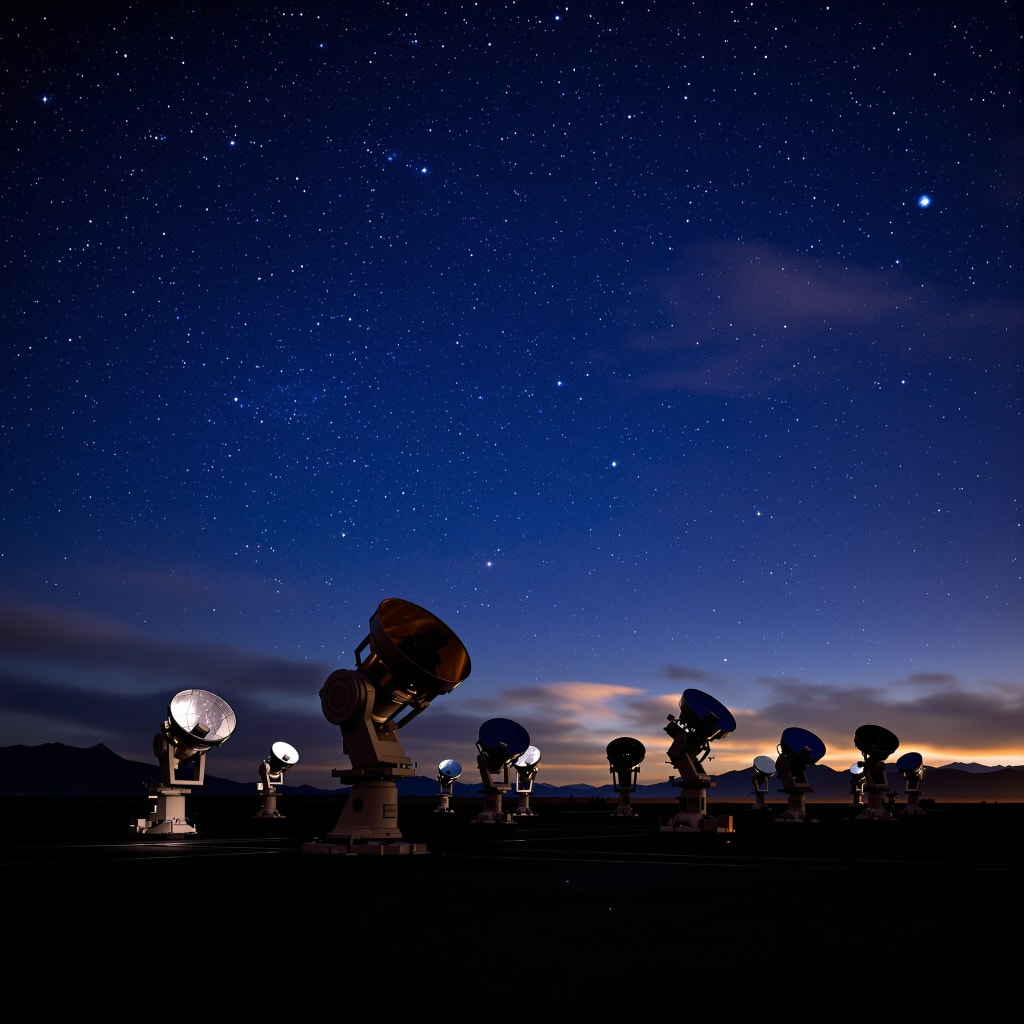
When you think about humanity’s most powerful tools for peering into the universe, you probably imagine colossal telescopes with mirrors the size of swimming pools. But there’s a special class of instruments that doesn’t just look at the sky — it listens to it with astonishing precision. These are astronomical interferometers, and they work by linking together multiple telescopes to form a single, super-sensitive eye on the cosmos. But how do they work — and why go to such technical lengths?
Why Not Just Build One Giant Telescope?
The clarity with which a telescope can distinguish fine details — its resolving power — depends largely on the diameter of its main mirror or dish. The bigger the mirror, the sharper the image. But there’s a limit. Building a perfectly smooth mirror hundreds of meters wide is not only an engineering nightmare, it’s incredibly expensive and impractical.
Enter the genius of interferometry: what if, instead of a single giant telescope, you used several smaller ones working together as if they were one?
The Principle Behind Interferometry: A Dance of Waves
The magic of interferometry lies in the wave nature of light. When light from a distant object reaches two or more telescopes, it doesn’t arrive at exactly the same moment — there are minute time differences, measured in billionths of a second. These delays depend on the relative position of the telescopes and the angle at which the light source appears in the sky.
Interferometers capture and analyze these tiny time differences — also known as phase shifts. By comparing them, scientists can reconstruct where the signal came from and what structure it has, with astonishing precision. It’s all based on interference: waves that align can amplify each other, while those slightly out of phase can cancel out. The resulting pattern reveals information that no single telescope could detect on its own.
Two Main Types: Radio and Optical Interferometers
Though the basic idea is the same, radio and optical interferometers operate differently due to the nature of the wavelengths they detect.
Radio Interferometers
Radio waves are long and easier to capture, store, and process. This makes radio interferometry especially powerful. One of the best-known techniques, Very Long Baseline Interferometry (VLBI), links radio telescopes across continents — even across the globe — to create a "virtual dish" as wide as the Earth.
A striking example is the Event Horizon Telescope, which in 2019 gave the world its first direct image of a black hole's shadow. Other radio interferometers study pulsars, galactic jets, and even measure the slow drift of Earth’s tectonic plates.
Optical Interferometers
Optical interferometers work with visible or infrared light, where wavelengths are much shorter. This requires incredibly precise synchronization and is far more susceptible to distortion from Earth’s atmosphere. Despite the challenges, systems like the Very Large Telescope Interferometer (VLTI) in Chile have achieved mind-blowing resolution — enough to detect features the size of a tennis ball on the Moon!
Why Do We Need Interferometers?
Interferometers unlock observational power that single telescopes can’t reach. Here’s what they bring to the table:
Unmatched Image Resolution: Interferometers can reveal the surfaces of stars, the dusty rings around newborn stars, and the glowing disks of matter spiraling into black holes.
Tracking Tiny Motions: They can detect the expansion of supernovae, the oscillations of stars, and even mergers of neutron stars — essentially, how celestial objects "breathe."
Precise Measurements: Interferometers can measure distances and sizes with extreme accuracy, down to a few microarcseconds — an angle so small, it’s like measuring a coin on the Moon from Earth.
Global and Space-Based Collaboration: By combining telescopes from different continents — or even different orbits — interferometers overcome the limitations of geography and Earth’s atmosphere.
The Future of Interferometry
What’s next? Enter space-based interferometers. Projects like LISA (Laser Interferometer Space Antenna) aim to detect gravitational waves using lasers between spacecraft separated by millions of kilometers. It’s a next-gen form of interferometry — not just a vision, but an actual "cosmic ear" capable of detecting the ripples of the universe itself.
Imagine listening to the sound of two black holes colliding, across billions of light-years, through the delicate echo of space-time itself.
A Collective Cosmic Eye
Astronomical interferometers aren’t just tools — they’re marvels of teamwork, technology, and scientific vision. By synchronizing instruments spread across vast distances, they offer us a window into parts of the universe that would otherwise remain invisible.
In a way, every new interferometer adds another "eye" to our collective vision of the cosmos. With each one, humanity gets a little closer to seeing — and truly understanding — the wonders of the universe.
Who knows what the next one will reveal?
About the Creator
Keep reading
More stories from Holianyk Ihor and writers in Futurism and other communities.
The First Spectra of Exoplanet Atmospheres: What Is Their Nature Breathing?
There was a time when simply spotting a planet around another star felt like a miracle. Today, we’ve gone far beyond mere observation — we've started to sniff the air of distant worlds. With the help of powerful space telescopes, scientists have captured the first atmospheric spectra of exoplanets, unlocking their chemical makeup and offering tantalizing clues about their environments. From searing gas giants to Earth-like candidates, each world has its own unique story hidden in its atmosphere.
By Holianyk Ihor7 months ago in Futurism
About Binding Prometheus
I want to start actively advocating on behalf of my own work, and the most valuable part of my canon is, without a doubt, Binding Prometheus, the play I have been working on since 2019 and only finished in 2023 as part of my MA. The play itself is an amalgamation of a million different inspirations. On one end, it evokes the Ancient Greek myth-play, deriving its own title from the earliest extant work of Western drama we have, Aeschylus’s Prometheus Bound. On the other end, it borrows significantly from the sci-fi bulwarks from over the years, namely Mary Shelley’s Frankenstein and Karel Capek’s Rossum’s Universal Robots. The play could be an episode of Black Mirror, I fear. I don’t know. I’ve only ever seen one episode of Black Mirror.
By Steven Christopher McKnight12 days ago in Futurism
Wi-Fi Chipset Market Size and Forecast 2025–2033
Introduction: Wi-Fi Chipsets at the Heart of the Connected World Wireless connectivity has become as essential as electricity in the modern digital economy. From smartphones and laptops to smart homes, industrial automation, and connected vehicles, seamless internet access underpins everyday life. At the core of this connectivity ecosystem lies the Wi-Fi chipset—a fundamental semiconductor component that enables devices to communicate over wireless networks.
By Aaina Oberoi7 days ago in Futurism



Comments
There are no comments for this story
Be the first to respond and start the conversation.