
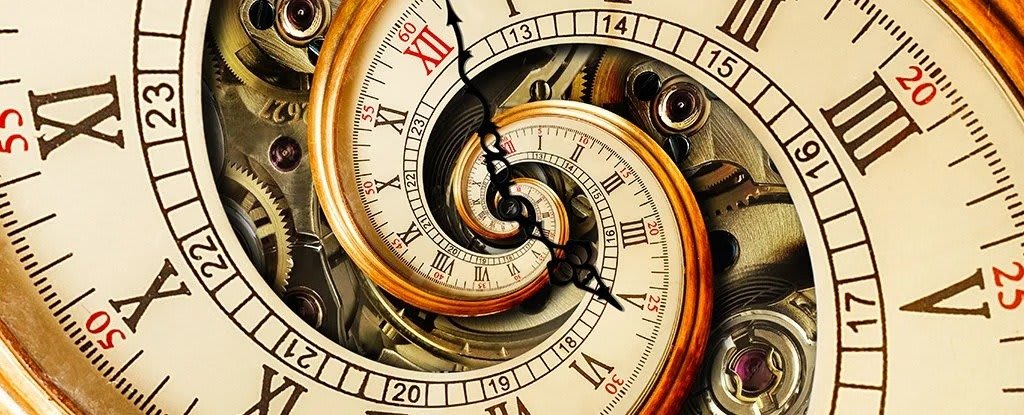
The concept of time is an ever-present force that shapes our understanding of events unfolding in a sequence from the past through the present into the future. This linear framework for time is deeply ingrained in our perception and the way we experience the world around us. However, what underlies the unidirectional flow of time? Why does time move forward and not backward? These questions have puzzled physicists for decades, leading to intriguing insights into the relationship between time and the fundamental laws of the universe.
Physics in the 19th and 20th centuries grappled with the puzzle of time's directionality and uncovered a remarkable truth: the clear arrow of time is not inherently embedded in the basic laws of physics. These laws are symmetric with respect to time, meaning that they do not favor a particular direction. In other words, the equations governing the behavior of particles and forces in the universe are equally valid whether time moves forward or backward. This leads us to a deeper exploration of the role of entropy and heat in shaping the direction of time.
Heat: The Unveiling Force of Time's Arrow
One of the captivating concepts that shed light on the direction of time is the role of heat. Heat is the transfer of energy between objects due to differences in temperature. When two objects with different temperatures come into contact, heat flows from the warmer object to the colder one. This phenomenon is so familiar that we hardly question it. Yet, its implications for the arrow of time are profound.
Imagine a cup of hot coffee placed in a room. Over time, the coffee cools down and eventually reaches the same temperature as the room. This cooling process is irreversible. Why? The answer lies in the increase of entropy. Entropy, often described as a measure of disorder, tends to increase over time. As the coffee cools, the particles within it slow down, and their motion becomes more disordered. This aligns with the principle of entropy increase, as particles move from an ordered state (hot coffee) to a more disordered state (room temperature).
Entropy and the Second Law of Thermodynamics
The concept of entropy aligns with the Second Law of Thermodynamics, which states that the total entropy of an isolated system will always increase over time or remain the same—it will never decrease. This law provides a basis for understanding why certain processes are irreversible, like the cooling of coffee or the mixing of cream into a cup of tea.
The increase of entropy in natural processes points towards the arrow of time. As entropy increases, the past becomes distinguishable from the future. This aligns with our everyday experience, where events in the past lead to events in the future. The relationship between entropy and the Second Law of Thermodynamics establishes a unique connection between the direction of time and the fundamental laws governing physical systems.
Beyond Physics: Philosophical and Existential Implications
The exploration of time's directionality goes beyond the realm of physics and delves into philosophical and existential inquiries. The connection between the arrow of time and the increase of entropy resonates with our understanding of causality—the idea that actions in the past lead to consequences in the future. This alignment between physical laws and our perception of time provides a profound insight into the nature of reality and the interconnectedness of events.
Conclusion: Time, Heat, and the Tapestry of Existence
The direction of time, often referred to as time's arrow, finds its foundation in the symphony of heat, entropy, and the Second Law of Thermodynamics. The intricate dance between particles, energy, and disorder shapes our experience of time as an irreversible journey from the past to the future. This fundamental connection between the macroscopic world we perceive and the microscopic processes that govern it underscores the elegance and complexity of the universe.
In the end, the exploration of time's directionality is not merely a scientific pursuit but a journey that intertwines the fabric of physics, philosophy, and the human experience. As we unravel the mysteries of time's arrow, we gain a deeper understanding of our place within the vast tapestry of existence and the profound interconnectedness that defines our reality.
About the Creator
Keep reading
More stories from writers in Futurism and other communities.
About Binding Prometheus
I want to start actively advocating on behalf of my own work, and the most valuable part of my canon is, without a doubt, Binding Prometheus, the play I have been working on since 2019 and only finished in 2023 as part of my MA. The play itself is an amalgamation of a million different inspirations. On one end, it evokes the Ancient Greek myth-play, deriving its own title from the earliest extant work of Western drama we have, Aeschylus’s Prometheus Bound. On the other end, it borrows significantly from the sci-fi bulwarks from over the years, namely Mary Shelley’s Frankenstein and Karel Capek’s Rossum’s Universal Robots. The play could be an episode of Black Mirror, I fear. I don’t know. I’ve only ever seen one episode of Black Mirror.
By Steven Christopher McKnight24 days ago in Futurism
Saudi Arabia Paper Cups Market: Sustainable Packaging, Rising Consumption & Market Expansion
According to IMARC Group's latest research publication, Saudi Arabia paper cups market size reached USD 64.4 Million in 2025. The market is projected to reach USD 79.4 Million by 2034, exhibiting a growth rate (CAGR) of 2.35% during 2026-2034.
By Jeffrey Wilson5 days ago in Futurism
🅼🅸🅳🅽🅸🅶🅷🆃 🆂🅽🅰🅲🅺🆂
"It's 10 in Tuscon! We all know what that means... It's Time for Midnight Snacks with your man, Gerald Gee! Ready to spend the night together? Me too! I'm full of snacks and can't wait to regurgitate them all back into your hungry ears. Crack a brew! Pop some corn! Anything to get ready for one hell of a show where the talk maybe cheap but the words cut deep...
By Lamar Wiggins2 days ago in Fiction
Thoughts on Vocal and the way the world is
"Death cannot stop true love, only delay it." – Wesley in The Princess Bride. I decided to come back to Vocal on a very cold and dark night at the end of December. I had been, and still am, convalescing from a horrible staph infection that had gone misdiagnosed for months. This, paired with the increasing challenges of being healthy, making the best choices for my co-parented child, being a wife, and being a director at a new job, was a lot to manage.
By Jazzy 6 days ago in Confessions


Comments
There are no comments for this story
Be the first to respond and start the conversation.