
The AI Paradox
Embracing Humanity in an Automated World

Once upon a time, a young girl named Lily existed in a world heavily reliant on artificial intelligence. She lived in a bustling city where automation had become integral to everyday life. Robots and intelligent machines handled mundane tasks, allowing humans more time to pursue their passions. Yet, amidst the convenience and efficiency, a profound paradox emerged—an existential struggle for preserving humanity.
Lily, a curious and empathetic soul, had always been fascinated by the advancements in AI. She understood the immense potential these technologies held for progress and innovation. However, she also recognized the pressing need to maintain a balance between automation and the core values that made humanity unique.
One day, while wandering through the city's gleaming streets, Lily stumbled upon an old bookstore. Inside, she found a dusty tome that caught her attention—the book chronicled the tale of an AI researcher who grappled with the very paradox that weighed heavily on her heart.
As she leafed through the pages, Lily discovered that the researcher had foreseen the potential pitfalls of an overly automated society. The narrative outlined how the excessive reliance on AI threatened to erode the essence of humanity. The machines had become so efficient that humans risked losing touch with their emotions, creativity, and the deep connections they formed with one another.
Motivated by her newfound knowledge, Lily embarked on a personal quest to challenge the status quo. She sought to awaken the city to the importance of embracing humanity in an automated world. With her infectious enthusiasm, she gathered a group of like-minded individuals who shared her concerns.
Together, they organized public gatherings, inviting renowned experts to speak about the AI paradox and the vital role of humanity within the ever-advancing technological landscape. These events fostered spirited discussions, encouraging people to reflect on the potential consequences of automation without a human touch.
Lily's group also initiated community projects aimed at fostering empathy and creativity. They organized art exhibitions, encouraging individuals to express their emotions through paintings, sculptures, and poetry. By emphasizing the power of the human spirit, they hoped to remind society that machines cannot replicate certain qualities.
Meanwhile, Lily continued her research, delving deeper into the ethical implications of AI development. She discovered that some innovators were already working on AI systems to emulate human emotions. While these advances appeared promising, they sparked heated debates about artificial emotions' authenticity and ethical implications.
As the movement gained traction, people began reevaluating their relationship with AI. They recognized that while automation had advantages, establishing boundaries was crucial. As a result, the community realized that a harmonious coexistence with technology required nurturing human values, compassion, and intuition.
Over time, Lily's efforts bore fruit. The city began implementing policies prioritizing human-centric design, ensuring that automation complemented rather than replaced human skills. As a result, the emphasis shifted from maximizing efficiency to enhancing the quality of life and preserving the human experience.
Lily's story captured the media's attention, and her ideas spread like wildfire, reaching far beyond the confines of the city. Governments and organizations worldwide took note, reevaluating their approaches to AI integration. They started investing in education, emphasizing emotional intelligence and critical thinking to prepare individuals for an automated future.
Lily became an advocate for the human cause in AI development. She travelled the world, delivering powerful speeches and inspiring countless others to join the movement. The message was clear—humanity and technology must coexist, but not at the expense of one another.
As the years passed, Lily's vision transformed into a reality. As a result, society learned to navigate the AI paradox, forging a path that celebrated the marvels of automation while cherishing the essence of what it meant.
About the Creator
Keep reading
More stories from Walter Nyashadzashe Bakare and writers in Futurism and other communities.
Affordable Home Security
Every 15 seconds, a home burglary takes place in the United States, equating to roughly 4,800 burglaries daily. Unfortunately, only 13% of reported cases are solved by the police. Thus, home security is of utmost importance. However, you don't need to convert your home into a fortress to feel safe. There are plenty of inexpensive ways to keep burglars out and your valuables secure.
By Walter Nyashadzashe Bakare3 years ago in Criminal
About Binding Prometheus
I want to start actively advocating on behalf of my own work, and the most valuable part of my canon is, without a doubt, Binding Prometheus, the play I have been working on since 2019 and only finished in 2023 as part of my MA. The play itself is an amalgamation of a million different inspirations. On one end, it evokes the Ancient Greek myth-play, deriving its own title from the earliest extant work of Western drama we have, Aeschylus’s Prometheus Bound. On the other end, it borrows significantly from the sci-fi bulwarks from over the years, namely Mary Shelley’s Frankenstein and Karel Capek’s Rossum’s Universal Robots. The play could be an episode of Black Mirror, I fear. I don’t know. I’ve only ever seen one episode of Black Mirror.
By Steven Christopher McKnight17 days ago in Futurism
Health Insurance Market: Preventive Care Focus, Value-Based Models & Industry Trends
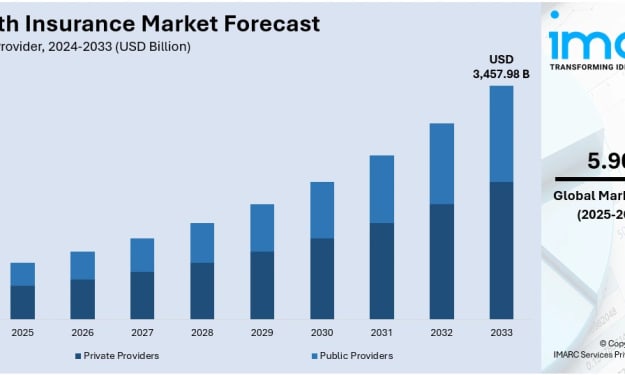
According to IMARC Group's latest research publication, global health insurance market size reached USD 1,949.84 Billion in 2024. Looking forward, IMARC Group expects the market to reach USD 3,457.98 Billion by 2033, exhibiting a growth rate (CAGR) of 5.90% during 2025-2033.
By Andrew Sullivan5 days ago in Futurism



Comments
There are no comments for this story
Be the first to respond and start the conversation.