future
Exploring the future of science today, while looking back on the achievements from yesterday. Science fiction is science future.
Time Travel: A Primer for the 4th Dimension, Part Two
Science fiction authors have been speculating about this for hundreds of years. Only recently has it become popular to compare and contrast different ideas to try and formulate a set of ideas that could plausibly work together with internal consistency and at the same time allow for interesting time travel stories of the sort we are familiar with.
By Jacob Holcomb8 years ago in Futurism
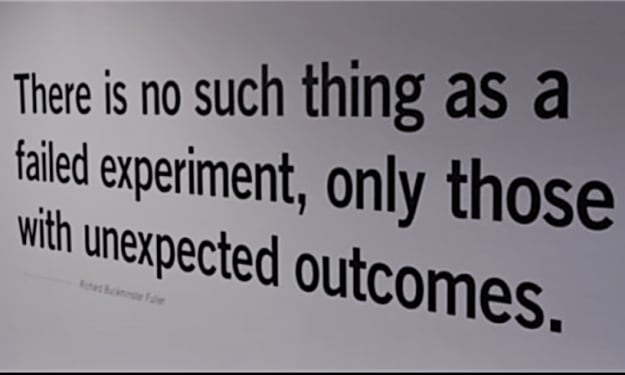
The Failed Experiment
Hayden had many thoughts cross her mind when the alarm clock woke her up. Would she be alive by the next morning? Who would she be sleeping next to if she were to wake up tomorrow? This was the last day she would have to be free. Free of a job, free of a husband, and free of life. But if the worst were to happen today, she would surely be free of any life and, of course, dead.
By Maddie Marcarelli8 years ago in Futurism
The Purpose of the U.L.C.
Overall most of our lives are based on the 9-5 work cycle, and we get up go to work, eat, sleep, and bathe, then do it all over again. The funny situation is that isn't normal. In most of our history, we got up at the crack of dawn, or perhaps whenever we wanted to, then we got whatever work needed to be done that done, done. There was no time constraints, or limiting factors to our daily lifestyle. On top of that there was much less stress on each individual person.
By Dustin Miller PolyInnovator8 years ago in Futurism
Life in 2050
2017 has given the planet its fair share of miseries and it's hard not to imagine oneself in the distant future, far away from the incessant click of phones and barrage of selfies (including my own, check my selfie it's my best yet). Technology and AI are making great leaps and bounds. The first female robot has been given citizenship of Saudi Arabia and you now have the option of consulting your doctor from your phone. For some reason the Conservative party still wants to remain in 1500 but that's ok, like climate change deniers it's likely they will catch up to the rest of the population in a century or so.
By Eve Tawfick8 years ago in Futurism
Relativistic Kill Vehicle
Warfare is constantly progressing, constantly changing. During World War II we pitted troops against each other on great fields of war in ways in which we haven’t seen since. Modern battles are fought with drones, smaller skirmishes and strike teams, surgical and careful. The concept of a Relativistic Kill Vehicle (or RKV), in some ways, it’s just the natural progression of warfare. Leaving the stone age, we developed weapons that took advantage of our newfound ability to manipulate metals. Later, we had a revolution as our understanding of chemistry grew and we realised we could use chemical reactions to propel projectiles. It’s foolish to think that the space age won’t do the same, despite our best efforts to keep space weapons free: The Outer Space Treaty bars placing weapons of mass destruction in orbit of Earth, installing them on the moon, or on or around any other celestial body, or stationing them in outer space in any capacity.
By Simon Mcbride8 years ago in Futurism
The Kardashev Scale. Top Story - October 2017.
Nikolai Kardashev is a little known Russian astrophysicist—certainly in regards to the current phenomena of science-related pop-culture icons, but despite this, some of his ideas have seeped in through the cracks. If the layman recognises his name at all, it won't be for the work that he put into examining the quasar CTA-102, but for the more theoretical exercise of developing what we now know as the Kardashev Scale. Even if you're not familiar with its name, there's a chance that you'll know a bit about its substance: Nikolai proposed the idea that some galactic civilisations would be possibly millions—even billions—of years ahead of us in regards to technology, and developed a scale in order to help with the categorisation of any civilisations that we may come across, or possibly fit into ourselves.
By Simon Mcbride8 years ago in Futurism
Time Prison
What is time, and why do we seem to never have enough? Time is very much a paradox in that it doesn't exist exactly. If no conscious being is there to keep track of events, then time is only an idea. Deers, trees, birds do not feel the constant anxiety like human beings because they do not keep track of time, only the cycles of night and day and the passing of seasons. So why is that? Why are only humans subject to constantly worrying about the waning hours of the day coming to a pass?
By Cortny Sellers8 years ago in Futurism
Adventures in the Infinite Library
I happen to be one of those people who thinks that there’s a Jorge Luis Borges story for everyone. I don’t believe in soulmates, or fate, or some mysterious ethereal force that wants you to find The One. But I do believe everyone can find something to like in the works of the great Argentinian writer.
By Ryan Frawley8 years ago in Futurism
The Human Experiment: Dark Origins, Dark Ends
Last week, I had a dream. A dream like no other dream could possibly be. It was, in fact, a nightmare. The most profoundly horrifying, fear to induce, soul chilling nightmare I have ever had in my life. And let me tell you, this is not easily achievable feat. I have had a long list of nightmares in my life. A list as long as the wars of humanity. But no nightmare was ever like this one. No night mare could ever be like this one. I shall never forget it. It will haunt me for the rest of my life. Even though I am risking a complete nervous breakdown in doing so, I am going to relate it to in its entirety. It concerns the true origins of man.
By Creative Hub8 years ago in Futurism
Speechless
It’s 2135 and we are stuck in what’s left of Pittsburgh. We aren’t allowed to speak. Or laugh, or cry, or scream. We aren’t allowed to write, and we have nothing to listen to. Every time I cough or sneeze I hold my breath because I fear one day they will outlaw that too. They have taken our books and our music and our screens. Seven years ago they took our lives.
By Emma Atwood8 years ago in Futurism