
Software Development Market Size and Forecast 2025–2033
Global Software Development Market to Reach US$ 1,458.20 Billion by 2033 Amid Rapid Digital Acceleration


The global software development market is entering a new era of innovation and scalability. According to Renub Research, the Software Development Market is expected to reach US$ 1,458.20 billion by 2033, growing from US$ 532.65 billion in 2024, with an impressive CAGR of 11.84% during 2025–2033. Fueled by digital transformation, rising demand for custom and scalable solutions, rapid cloud migration, and the integration of AI and automation across industries, software development has become the backbone of the modern digital economy.
Organizations across the world—whether small enterprises, large corporations, or government agencies—are aggressively adopting software-driven business models. From enterprise applications and mobile development to cloud-native platforms and embedded IoT systems, the software development industry continues to expand in scope, complexity, and economic impact.
Global Software Development Industry Overview
The global software development industry has emerged as one of the most influential pillars of economic growth. It continues to enable operational efficiency, scalability, innovation, and digital agility across nearly every sector. The industry is characterized by increasing adoption of agile methodologies, DevOps, automation, and AI-enabled development tools, all of which accelerate release cycles and improve productivity.
Cloud platforms such as AWS, Microsoft Azure, and Google Cloud have significantly reshaped development frameworks. Their scalable infrastructure, ready-to-use APIs, microservices capabilities, and global deployment services allow developers to build, test, and deliver applications at unprecedented speed. Similarly, the rise of open-source frameworks and low-code/no-code ecosystems has democratized development by reducing dependency on traditional coding expertise.
While North America remains the global leader in innovation, the Asia-Pacific region—particularly India and China—has become a major hub for software development due to its skilled talent pools, lower labor costs, and strong demand for digital solutions. Europe, meanwhile, continues to prioritize security-driven development as GDPR and regulatory compliance shape the way software is designed and deployed.
Despite challenges such as cybersecurity risks, rising system complexity, and talent shortages, the outlook for the global software development industry remains exceptionally strong. As companies pursue automation, data-driven decision-making, and connected digital ecosystems, software development will continue serving as the foundation for global digital transformation.
Key Factors Driving Software Development Market Growth
1. Industry-Wide Digital Transformation
Digital transformation is now a universal priority. Organizations across manufacturing, BFSI, retail, healthcare, IT, and government sectors require tailor-made software solutions to automate workflows, enhance customer experiences, optimize operations, and unlock real-time insights.
Businesses are rapidly adopting cloud-based platforms, AI-driven tools, mobile apps, and enterprise software to strengthen competitive advantage. Agile development and DevOps practices are enabling faster adaptation to market shifts by streamlining updates, ensuring continuous deployment, and reducing time-to-market.
As customer expectations heighten and industries shift toward digital-first models, demand for robust, user-centric, and scalable software is expected to grow exponentially through 2033.
2. Growing Use of SaaS and Cloud Computing
SaaS and cloud-based architectures have transformed software development by offering lower upfront costs, elastic scalability, remote access, and faster deployment. Platforms like AWS, Azure, and Google Cloud empower developers with powerful compute resources, integrated tools, development sandboxes, and global content delivery networks.
This shift allows companies to:
Accelerate their innovation cycle
Reduce infrastructure complexities
Enable remote and hybrid work environments
Deploy applications securely and globally
Cloud-native development—including microservices, containerization, serverless computing, and CI/CD pipelines—is gaining immense traction. As organizations continue migrating to cloud ecosystems, demand for cloud-driven software development is expected to multiply throughout the forecast period.
3. Integration of Artificial Intelligence and Automation
AI and automation are revolutionizing the way software is built, tested, and deployed. AI-assisted coding tools generate clean code, detect vulnerabilities, and accelerate debugging. Automated workflows streamline repetitive tasks like integration, testing, and deployment, paving the way for rapid CI/CD adoption.
AI-powered applications are also enabling advanced functionalities such as:
Predictive analytics
Real-time personalization
Speech and image recognition
Natural language processing
Intelligent decision-making
As enterprises shift toward intelligent, adaptive, and highly-responsive software ecosystems, the demand for AI-driven development tools and AI-powered applications will continue to rise significantly.
Challenges in the Software Development Market
Talent Shortage and Skill Gaps
A major challenge for the global software development landscape is the shortage of trained developers. Cutting-edge fields like AI/ML, cloud-native architectures, cybersecurity, blockchain, and IoT require specialized skillsets that many traditional developers lack. This mismatch increases hiring costs, delays projects, and presses organizations to invest more in upskilling initiatives.
Competition for talent is fierce across North America, Europe, and APAC, making employee retention equally challenging. Without significant investment in digital education and skill development, the talent gap may widen further.
Increasing Complexity and Security Risks
As software applications become more advanced and interconnected, development cycles face heightened complexity. Integrating multi-cloud systems, third-party components, APIs, and distributed architecture often increases risks, costs, and project timelines.
Further, cyber threats are growing more sophisticated. Developers must now incorporate zero-trust security, data privacy protocols, encryption, and compliance frameworks throughout the software lifecycle. Failure to do so exposes organizations to data breaches, regulatory penalties, and reputational harm.
Balancing innovation speed with security and reliability remains a delicate challenge for developers worldwide.
Software Development Market Overview by Regions
United States
The U.S. remains the global epicenter of software innovation, driven by world-class R&D, venture capital investments, and groundbreaking advancements in AI, enterprise software, cloud computing, and cybersecurity. Major technology hubs—Silicon Valley, Seattle, Austin, and Boston—continue to foster innovation across SaaS platforms, custom development, DevOps tools, and next-gen digital solutions.
The U.S. market is heavily influenced by:
Adoption of cloud-native architectures
Expansion of enterprise software
AI-driven automation
Startups scaling innovative digital products
Despite high operating and labor costs, the U.S. remains unmatched in its scale of innovation and technological leadership.
Germany
Germany is a powerhouse in Europe’s software development landscape, thanks to its industrial excellence and commitment to Industry 4.0. Manufacturing and automotive sectors rely heavily on custom software, automation tools, and embedded systems.
Growing adoption of AI, cloud platforms, cybersecurity solutions, and enterprise applications across logistics, finance, and healthcare is contributing to steady market expansion. Germany’s stringent regulatory environment (including GDPR) mandates secure and compliant software development, further shaping market growth.
Berlin, Munich, and Hamburg have evolved into thriving tech ecosystems, attracting startups, talent, and investments.
India
India is one of the fastest-growing software development markets in the world, powered by a vast talent pool, competitive pricing, IT outsourcing capabilities, and strong domestic digital adoption. The country is a global hub for:
Custom software development
IT services
Product engineering
SaaS platforms
Startup-driven innovation
Sectors including BFSI, e-commerce, telecom, and healthcare depend significantly on Indian IT companies for digital modernization. Government initiatives like Digital India, Startup India, and expansion of 5G networks further drive growth.
United Arab Emirates
The UAE is becoming one of the most technologically advanced nations in the Middle East. Smart city projects—such as Smart Dubai and Abu Dhabi’s digital transformation initiatives—are driving strong demand for software development across finance, retail, healthcare, logistics, and government services.
Growing startup ecosystems in Dubai Internet City and Abu Dhabi Hub71 provide fertile ground for innovation in AI, cloud services, cybersecurity, and enterprise solutions. The UAE’s strategic location and business-friendly regulations attract global tech companies, though the region continues to address its talent dependency on expatriates.
Recent Developments in the Software Development Industry
March 2025: Adobe partnered with AWS and Amazon Ads to release new joint products enabling large-scale customer personalization using Adobe Experience Platform.
February 2025: Google Cloud and Salesforce expanded their collaboration by integrating Gemini AI models into Salesforce Agentforce for advanced AI-driven service workflows.
January 2025: EPAM Systems announced the acquisition of NEORIS to enhance nearshore delivery capabilities for digital transformation projects in Latin America.
Market Segmentation
By Application Type
Enterprise Software
Mobile Application Development
Web Application Development
AI/ML and Data Analytics Software
Embedded Systems & IoT Software
By Organization Size
SMEs
Large Enterprises
By Deployment Mode
Cloud
On-Premise
By Industry Vertical
IT & Telecom
Retail
BFSI
Manufacturing
Healthcare
Government
Others
Regional Outlook
North America: U.S., Canada
Europe: France, Germany, Italy, Spain, U.K., Belgium, Netherlands, Turkey
Asia-Pacific: China, Japan, India, South Korea, Thailand, Malaysia, Indonesia, Australia, New Zealand
Latin America: Brazil, Mexico, Argentina
Middle East & Africa: Saudi Arabia, UAE, South Africa
Key Players Covered
Microsoft Corporation
Amazon.com Inc. (AWS)
Google LLC
IBM Corporation
Accenture plc
Apple Inc.
Oracle Corporation
Salesforce Inc.
Adobe Inc.
NVIDIA Corporation
Each company coverage includes:
Overview
Key Personnel
Recent Developments
SWOT Analysis
Revenue Analysis
Final Thoughts
The software development market is on a transformative growth path. From AI-assisted development to cloud-native architectures and industry-wide digital transformation, the sector is rapidly rewriting how businesses operate, scale, and innovate. As organizations seek agility, automation, and user-centric digital ecosystems, software development will remain one of the most strategic and high-growth industries through 2033.
With strong market fundamentals, expanding use cases, and continuous technological breakthroughs, the global software development market is set to shape the future of digital economies worldwide.
About the Creator
Renub Research
Renub Research is a Market Research and Consulting Company. We have more than 15 years of experience especially in international Business-to-Business Researches, Surveys and Consulting. Call Us : +1-478-202-3244
Keep reading
More stories from Renub Research and writers in Futurism and other communities.
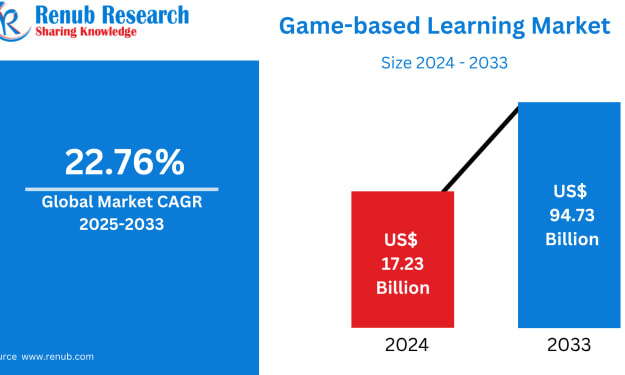
Global Game-Based Learning Market Size & Forecast 2025–2033
The global game-based learning market is entering a defining decade of explosive growth. According to Renub Research, the world game-based learning market is expected to surge from US$ 17.23 billion in 2024 to a remarkable US$ 94.73 billion by 2033, growing at a CAGR of 20.85% during 2025–2033. This acceleration is powered by rapid classroom digitalization, increasing smartphone penetration, and the rising acceptance of immersive pedagogical methods that make learning more interactive, enjoyable, and effective.
By Renub Research2 months ago in Futurism
About Binding Prometheus
I want to start actively advocating on behalf of my own work, and the most valuable part of my canon is, without a doubt, Binding Prometheus, the play I have been working on since 2019 and only finished in 2023 as part of my MA. The play itself is an amalgamation of a million different inspirations. On one end, it evokes the Ancient Greek myth-play, deriving its own title from the earliest extant work of Western drama we have, Aeschylus’s Prometheus Bound. On the other end, it borrows significantly from the sci-fi bulwarks from over the years, namely Mary Shelley’s Frankenstein and Karel Capek’s Rossum’s Universal Robots. The play could be an episode of Black Mirror, I fear. I don’t know. I’ve only ever seen one episode of Black Mirror.
By Steven Christopher McKnight14 days ago in Futurism
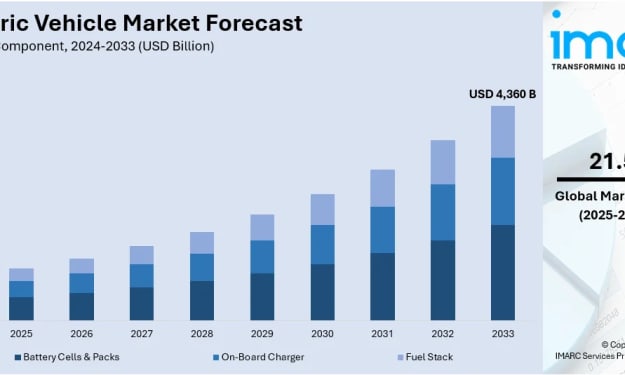
Electric Vehicle Market Size to Hit USD 4,360 Billion by 2033 Driven by Battery Innovation & Cost Declines
Rising environmental concerns, supportive government policies, falling battery costs, and expanding charging infrastructure are accelerating electric vehicle adoption, supported by technological innovation, fuel cost savings, and increasing consumer acceptance worldwide. According to IMARC Group's latest research publication, global electric vehicle market size reached USD 755 Billion in 2024. Looking forward, IMARC Group expects the market to reach USD 4,360 Billion by 2033, exhibiting a growth rate (CAGR) of 21.5% during 2025-2033.
By Abhay Rajputa day ago in Futurism


Comments
There are no comments for this story
Be the first to respond and start the conversation.