
Global Game-Based Learning Market Size & Forecast 2025–2033
How Gamified Education Is Shaping the Future of Learning Across Classrooms, Corporations, and Countries

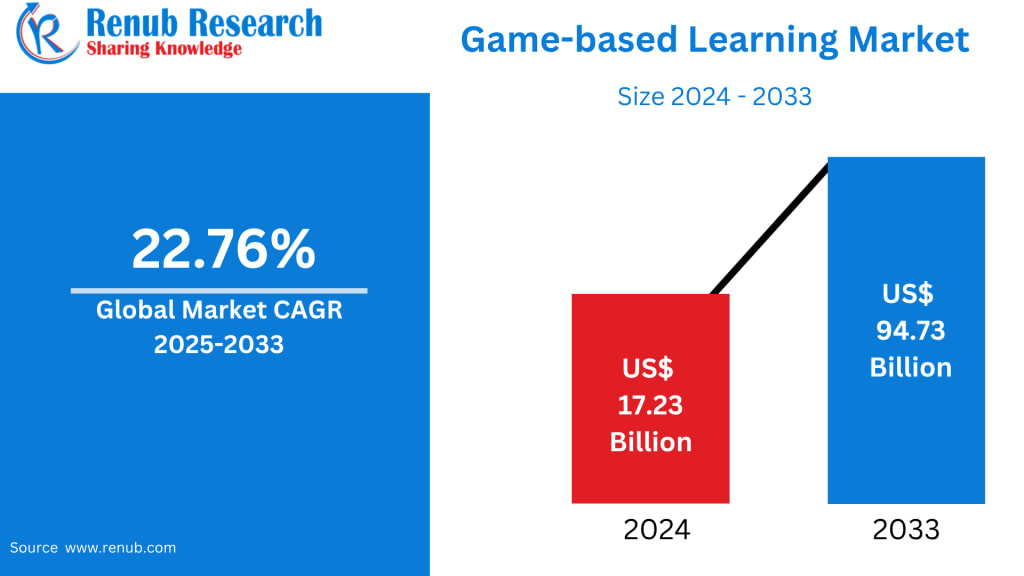
The global game-based learning market is entering a defining decade of explosive growth. According to Renub Research, the world game-based learning market is expected to surge from US$ 17.23 billion in 2024 to a remarkable US$ 94.73 billion by 2033, growing at a CAGR of 20.85% during 2025–2033. This acceleration is powered by rapid classroom digitalization, increasing smartphone penetration, and the rising acceptance of immersive pedagogical methods that make learning more interactive, enjoyable, and effective.
From K–12 classrooms to military simulators, and from soft-skill development in corporate environments to AR-powered museum tours, game-based learning (GBL) is becoming one of the most influential educational technologies of our time.
A Global Shift Toward Engaging, Immersive, and Effective Learning
Game-based learning (GBL) integrates game mechanics—such as achievements, levels, rewards, storytelling, and competitive challenges—into educational content. Unlike traditional rote learning, GBL thrives on active participation, experiential learning, and instant feedback, triggering better cognitive engagement and long-term retention.
Today, game-based learning is no longer confined to young learners. It serves all age groups, from early childhood education to professional training. Complex subjects such as mathematics, engineering, medicine, science, and languages are increasingly delivered using educational games, simulations, quizzes, and problem-solving scenarios.
At the corporate level, GBL is transforming employee onboarding, compliance training, sales enablement, cybersecurity training, and leadership development. Military institutions too rely on game-based simulations to build decision-making skills under pressure. This versatility—combined with its proven track record—is driving widespread adoption across educational, enterprise, and government sectors.
Why Game-Based Learning Is Taking Over: Key Market Growth Drivers
1. Growing Adoption of Digital Education Tools
Schools and universities continue to accelerate their digital transformation journeys. As hybrid and online learning become mainstream, educators are actively seeking tools that increase student engagement and help overcome the learning-fatigue associated with screen time.
Game-based learning platforms deliver interactive lessons and immersive experiences, improving attention, retention, and overall learning satisfaction.
The COVID-19 pandemic served as a turning point, proving that gamified digital platforms can successfully support remote and hybrid learning models. Investments in EdTech surged across Asia, Europe, and North America.
A notable example came in June 2025, when Google Cloud launched Digital Campus 3.0 in India, an AI-driven learning ecosystem designed to support AI-first campuses with generative AI-driven courses, automated assessments, and intelligent learning dashboards.
2. Rising Demand for Skill Development and Workforce Training
Game-based learning excels in developing:
problem-solving
critical thinking
collaboration
communication
decision-making skills
Enterprises increasingly use game-based modules to train employees in soft skills, product knowledge, sales training, and customer service—all areas where simulations outperform traditional PowerPoint-style instruction.
In May 2024, Bengaluru-based Kairos, a learning technology firm, entered the Indian market with game-based learning solutions specifically aimed at enhancing soft skills among corporate employees—an area of significant demand in the digital-first economy.
3. Advances in AR, VR, and AI Are Redefining Learning
From virtual chemistry labs to AR-based museum tours, immersive technologies are reshaping the GBL landscape.
AR brings learning into the real world.
VR enables high-stakes simulations in safe environments.
AI personalizes learning by adapting content in real time.
These technologies allow learners to practice, experiment, and fail safely. Costs of AR/VR headsets are declining and software is becoming more accessible, enabling faster adoption.
In January 2024, Minecraft Education and ISTE launched Level Up Learning, a global virtual event series to advance game-based pedagogy and address evolving education challenges. This demonstrated how established platforms continue to push innovation in the sector.
Challenges Holding Back Wider Adoption
1. High Development and Implementation Costs
High-quality game development requires expertise in:
software engineering
design & animation
curriculum mapping
testing
instructional design
For budget-constrained institutions, investing in the required infrastructure and technical support becomes difficult. This financial hurdle remains one of the biggest barriers to scaling GBL globally.
2. Resistance to Change & Low Awareness
Despite the benefits, traditional education systems often resist innovation. Lack of teacher training, comfort with legacy systems, and concerns about screen addiction hinder adoption.
Awareness initiatives, professional development, and success case studies are essential to bridging this gap.
Market Breakdown: Key Segments Driving Growth
Game-Based Learning Solutions
These include digital applications, software platforms, subject-specific modules, and customized content integrated with analytics dashboards and performance trackers. They dominate the market due to scalability and adaptability.
Online Game-Based Learning
Delivered via web or app platforms, online GBL supports:
virtual classrooms
global training programs
distance learning
self-paced learning
Its low cost, accessibility, and scalability make it the fastest-growing mode.
On-Premise Game-Based Learning
Preferred by organizations requiring:
enhanced data security
compliance controls
local performance management
This is especially common in healthcare, defense, aerospace, and regulated industries.
AI-Based Game-Based Learning
AI enhances GBL by enabling:
real-time feedback
adaptive learning
intelligent tutoring
personalized difficulty levels
As AI matures, this segment will see exponential growth.
Location-Based Game-Based Learning
Using AR, GPS, and real-world environments, this format enables experiential learning through museum tours, environmental studies, urban exploration games, and language learning. Its adoption is rising in both formal and informal learning settings.
Educational Game-Based Learning
The largest end-user segment, it includes K-12, higher education, and vocational training. Content is often aligned with curriculum standards, making integration seamless for teachers.
Regional Market Insights
1. United States
The U.S. leads the global GBL market, supported by:
advanced digital infrastructure
federal investments in EdTech
widespread adoption in K-12 and higher education
heavy enterprise spending on training
Innovation hubs like Silicon Valley are constantly developing cutting-edge educational tools, boosting the country’s dominance.
2. Germany
Germany shows strong adoption particularly in:
vocational training
engineering education
technical skill development
corporate learning
Despite concerns surrounding data privacy and screen time, digital reforms support continued growth.
3. India
India is one of the fastest-growing GBL markets due to:
a massive student population
EdTech boom
curriculum-aligned educational games
low-cost smartphone and internet access
government support through Digital India & NEP 2020
GBL adoption is rising across both urban and rural ecosystems.
4. Brazil
Brazil’s education sector faces engagement challenges, making GBL a perfect fit. Government reforms, private school investments, and mobile-first learning initiatives strengthen adoption, especially in languages and STEM.
5. Saudi Arabia
Backed by Saudi Vision 2030, the country is transforming its learning environment. Investments in AI, EdTech, and digital classrooms are accelerating the use of GBL in:
schools
universities
government training
corporate L&D
Partnerships with global EdTech providers are fueling this rapid transition.
Market Segmentation Overview
Component
Solutions
Services
Platform Type
Online
Offline
Deployment Mode
Cloud
On-Premise
Game Type
AR/VR Games
AI-Based Games
Location-Based Games
Knowledge/Skill-Based Games
Language-Learning Games
Others
End User
Education
Enterprises
Government
Consumer
Others
Countries Covered
North America: United States, Canada
Europe: France, Germany, Italy, Spain, UK, Belgium, Netherlands, Turkey
Asia-Pacific: China, Japan, India, South Korea, Thailand, Malaysia, Indonesia, Australia, New Zealand
Latin America: Brazil, Mexico, Argentina
Middle East & Africa: Saudi Arabia, UAE, South Africa
Key Companies in the Global Game-Based Learning Market
All companies include five viewpoints: Overview, Key Person, Recent Developments, SWOT Analysis, and Revenue Analysis.
Badgeville (CallidusCloud)
Bunchball (BI WORLDWIDE)
Classcraft Studios Inc.
Six Waves Inc.
Recurrence, Inc.
Gametize Pte. Ltd.
Kuato Studios
BreakAway Ltd., Inc.
Filament Games
LearningWare, Inc.
Final Thoughts
The next decade will belong to interactive, immersive, and learner-centered digital education. As the global game-based learning market races toward US$ 94.73 billion by 2033, it is clear that gamification is no longer a trend—it is a transformational force reshaping how the world learns.
Whether it’s a child mastering fractions through a math adventure game, a medical student practicing surgeries in VR, or a corporate employee improving leadership skills through simulation, GBL empowers learners to explore, experiment, and excel.
About the Creator
Renub Research
Renub Research is a Market Research and Consulting Company. We have more than 15 years of experience especially in international Business-to-Business Researches, Surveys and Consulting. Call Us : +1-478-202-3244
Keep reading
More stories from Renub Research and writers in Futurism and other communities.
Virtual Reality Market Companies Analysis: A New Era of Immersive Innovation
The global Virtual Reality (VR) market is entering its most transformative decade yet, supported by technological leaps, new device launches, and shifting consumer behaviors. According to Renub Research, the VR industry is projected to surge to US$ 382.87 billion by 2033, up dramatically from US$ 43.58 billion in 2024, reflecting a remarkable CAGR of 27.31% between 2025 and 2033. This growth is propelled by widespread VR adoption in gaming, healthcare, education, defense, retail, and entertainment, with next-generation headsets enabling more immersive, realistic, and accessible digital worlds.
By Renub Research2 months ago in Futurism
About Binding Prometheus
I want to start actively advocating on behalf of my own work, and the most valuable part of my canon is, without a doubt, Binding Prometheus, the play I have been working on since 2019 and only finished in 2023 as part of my MA. The play itself is an amalgamation of a million different inspirations. On one end, it evokes the Ancient Greek myth-play, deriving its own title from the earliest extant work of Western drama we have, Aeschylus’s Prometheus Bound. On the other end, it borrows significantly from the sci-fi bulwarks from over the years, namely Mary Shelley’s Frankenstein and Karel Capek’s Rossum’s Universal Robots. The play could be an episode of Black Mirror, I fear. I don’t know. I’ve only ever seen one episode of Black Mirror.
By Steven Christopher McKnight14 days ago in Futurism




Comments (1)
Brilliant. Now I’m just waiting to buy a VR headset and switch on “learning mode”!