
Electric Vehicle Market Size to Hit USD 4,360 Billion by 2033 Driven by Battery Innovation & Cost Declines
How rapid battery innovation, falling production costs, and improving driving range are accelerating adoption and reshaping competition in the global electric vehicle market

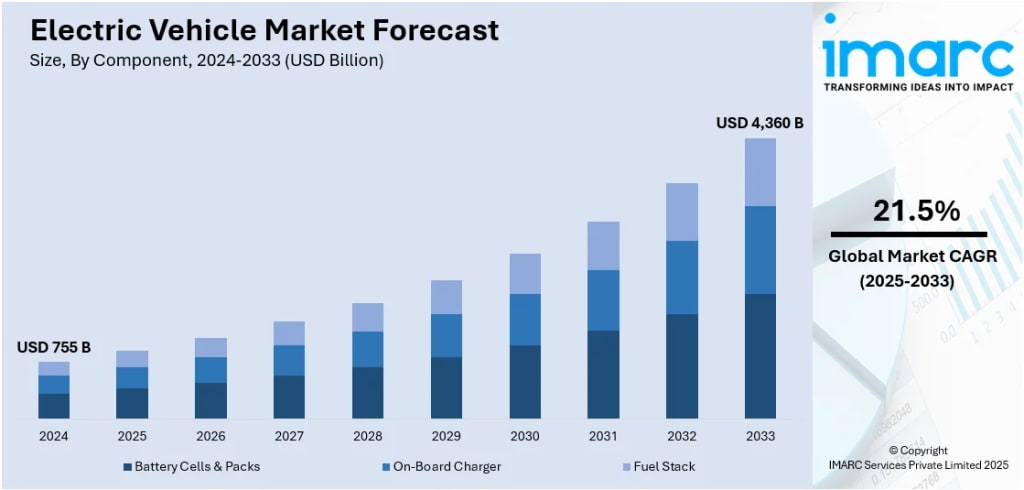
Rising environmental concerns, supportive government policies, falling battery costs, and expanding charging infrastructure are accelerating electric vehicle adoption, supported by technological innovation, fuel cost savings, and increasing consumer acceptance worldwide. According to IMARC Group's latest research publication, global electric vehicle market size reached USD 755 Billion in 2024. Looking forward, IMARC Group expects the market to reach USD 4,360 Billion by 2033, exhibiting a growth rate (CAGR) of 21.5% during 2025-2033.
How AI is Reshaping the Future of Electric Vehicle Market
- Autonomous Driving and Advanced Driver-Assistance Systems: AI-powered autonomous technologies enable self-driving capabilities through real-time processing of sensor data from cameras, LiDAR, and radar systems. Machine learning algorithms predict traffic patterns, optimize route planning, and enhance safety features, reducing accidents by up to 40% while improving passenger comfort and transportation efficiency.
- Energy Management and Range Optimization: AI algorithms continuously analyze driving conditions, terrain, weather, and traffic patterns to optimize energy consumption in real-time. Intelligent systems maximize driving range by adjusting power distribution, regenerative braking, and climate control, achieving up to 25% efficiency improvements over conventional energy management approaches.

Electric Vehicle Industry Overview:
Charging infrastructure expansion accelerates globally with public charging stations projected reaching 25 million by 2035 compared to 4 million currently, driven by massive government investments and private sector commitments. Asia Pacific dominates with 46.5% market share, powered by China's aggressive EV production, extensive subsidies, and target for EVs accounting 40% of vehicle sales by 2030. Major automakers including Tesla, BYD, Volkswagen, BMW, Toyota, and Hyundai command significant positions through continuous innovation in battery technology, autonomous capabilities, and model diversification across passenger and commercial segments. United States infrastructure investments totaling USD 7.5 billion through Bipartisan Infrastructure Law support nationwide charging network development, while battery technology advances exceed 750 GWh global demand marking 40% year-over-year growth.
Request a Sample Report with the Latest Data & Forecasts
Electric Vehicle Market Trends & Drivers
Environmental sustainability and emission reduction imperatives drive unprecedented EV adoption as transportation sectors confront climate change responsibilities. Atmospheric carbon dioxide concentrations increased 11.4% over two decades according to World Meteorological Organization, intensifying regulatory pressures and consumer awareness about fossil fuel pollution impacts. Zero tailpipe emissions positioning electric vehicles as critical solutions for air quality improvements in urban centers experiencing severe pollution challenges. Governments worldwide implement stringent emission standards and phase-out timelines for internal combustion engines, with multiple nations targeting complete bans by 2030-2040. Electric vehicles eliminate harmful pollutants including nitrogen oxides and particulate matter, directly improving public health outcomes in densely populated areas.
Battery technology breakthroughs transform market dynamics through enhanced energy density, extended driving range, and reduced costs enabling mass-market adoption. Global battery demand exceeded 750 GWh marking 40% year-over-year growth, with United States and Europe achieving over 40% increases while China contributed 415 GWh maintaining market dominance. Modern lithium-ion batteries combined with advanced management systems extend driving ranges beyond 400 miles on single charges, eliminating range anxiety barriers that previously hindered adoption. Solid-state battery development promises revolutionary improvements in safety, charging speeds, and energy capacity, with several manufacturers targeting commercial deployment within 3-5 years. Manufacturing scale economies and raw material innovations drive battery costs down 85% over past decade, projecting continued 50% reductions by 2030 making EVs price-competitive with conventional vehicles.
Government policies and incentives create favorable adoption environments through comprehensive support frameworks addressing financial, infrastructure, and regulatory barriers simultaneously. United States suspended 12% federal excise tax for zero-emission trucks while providing substantial tax credits reducing EV ownership costs significantly. Infrastructure Investment and Jobs Act allocated USD 5 billion for highway charging networks along alternative fuel corridors, plus USD 2.5 billion competitive grants supporting expanded infrastructure development. India witnessed 16% EV registration increases with 16,344 public charging stations and 10,756 fast charging points demonstrating infrastructure commitment. European Union emissions regulations and ambitious EV penetration targets compel automakers toward electric production, while 22.7% of new car registrations representing electric vehicles showcase policy effectiveness.
Leading Companies Operating in the Global Electric Vehicle Industry:
- BYD Company Limited
- BMW Group
- Chevrolet (General Motor Company)
- Ford Motor Company
- Hyundai Motor Group
- Mercedes-Benz Group AG
- Mitsubishi Motors Corporation
- Nissan Motor Corporation
- Tesla, Inc.
- Toyota Motor Corporation
- Volkswagen Group
Electric Vehicle Market Report Segmentation:
By Component:
- Battery Cells & Packs
- On-Board Charger
- Fuel Stack
Battery cells & packs dominate through critical importance in determining vehicle range, performance, and cost, with ongoing innovations in energy density and charging capabilities driving continuous improvements and market expansion.
By Charging Type:
- Slow Charging
- Fast Charging
Slow charging leads with 71.2% market share owing to cost-effectiveness, easier installation, lower electrical grid impact, preservation of battery lifespan, and suitability for overnight home charging and workplace applications.
By Propulsion Type:
- Battery Electric Vehicle (BEV)
- Fuel Cell Electric Vehicle (FCEV)
- Plug-In Hybrid Electric Vehicle (PHEV)
- Hybrid Electric Vehicle (HEV)
Hybrid electric vehicle (HEV) commands 61.3% market share through bridging conventional and fully electric powertrains, offering lower emissions, improved fuel efficiency, and addressing range concerns while requiring no charging infrastructure investments.
By Vehicle Type:
- Passenger Vehicles
- Commercial Vehicles
- Others
Passenger vehicles account for 73.5% market share, driven by evolving consumer preferences, urbanization, rising disposable incomes, autonomous driving features, sustainability concerns, and favorable financing options making personal electric mobility increasingly accessible.
Regional Insights:
- Asia Pacific (China, Japan, India, South Korea, Australia, Indonesia, Others)
- Europe (Norway, Netherlands, Sweden, United Kingdom, France, Germany, Others)
- North America (United States, Canada)
- Middle East and Africa (Turkey, Saudi Arabia, Iran, United Arab Emirates, Others)
- Latin America (Brazil, Mexico, Argentina, Colombia, Others)
Asia Pacific dominates with 46.5% market share, propelled by China's manufacturing capabilities, aggressive government policies, extensive charging infrastructure development, rapid urbanization, and strong consumer adoption across passenger and commercial segments.
Recent News and Developments in Electric Vehicle Market
- November 2024: Switch Mobility Automotive Ltd. partnered with Vertelo to deploy 1,000 electric commercial vehicles across India over 3-5 years. Vertelo will lease and fund Switch's electric buses and light commercial vehicles, addressing financial barriers and promoting sustainable mobility solutions for businesses and municipalities.
- October 2024: TDK partnered with McLaren Racing to enhance presence in electric vehicle sector, integrating TDK's technology into McLaren's Formula E cars. The collaboration focuses on advancing EV components including inverters and sensors, leveraging TDK's expertise in passive components while demonstrating commitment to innovation and sustainable mobility.
- September 2024: BMW unveiled the i Vision Circular concept vehicle designed for 2040, prioritizing sustainability through circular economy principles. The fully electric compact four-seater emphasizes recyclability and renewable materials, showcasing BMW's innovative approach to reducing carbon footprints while offering premium performance aligned with environmental stewardship.
- August 2024: General Motors and EVgo celebrated launching their 1,000th DC fast-charging stall under metropolitan charging partnership, strengthening United States charging infrastructure. The milestone enhances EV accessibility and convenience in urban areas, supporting GM's growing electric vehicle lineup while demonstrating joint commitment to broader adoption.
- May 2024: Honda introduced the e:Ny1, its second fully electric vehicle, during European Media Event in Germany. The compact SUV designed for European markets emphasizes performance and environmental sustainability through sleek design and advanced battery technology, reflecting Honda's commitment to electrifying entire European lineup.
Note: If you require specific details, data, or insights that are not currently included in the scope of this report, we are happy to accommodate your request. As part of our customization service, we will gather and provide the additional information you need, tailored to your specific requirements. Please let us know your exact needs, and we will ensure the report is updated accordingly to meet your expectations.
About the Creator
Abhay Rajput
I am working in market research company that provides market and business research intelligence across the globe.
Keep reading
More stories from Abhay Rajput and writers in Futurism and other communities.
Egypt Meat Market: Urban Consumption Growth, Price Volatility & Industry Outlook
According to IMARC Group's latest research publication, Egypt meat market size reached USD 5.00 Billion in 2024. The market is projected to reach USD 5.90 Billion by 2033, exhibiting a growth rate of 1.91% during 2025-2033.
By Abhay Rajput6 days ago in Futurism
About Binding Prometheus
I want to start actively advocating on behalf of my own work, and the most valuable part of my canon is, without a doubt, Binding Prometheus, the play I have been working on since 2019 and only finished in 2023 as part of my MA. The play itself is an amalgamation of a million different inspirations. On one end, it evokes the Ancient Greek myth-play, deriving its own title from the earliest extant work of Western drama we have, Aeschylus’s Prometheus Bound. On the other end, it borrows significantly from the sci-fi bulwarks from over the years, namely Mary Shelley’s Frankenstein and Karel Capek’s Rossum’s Universal Robots. The play could be an episode of Black Mirror, I fear. I don’t know. I’ve only ever seen one episode of Black Mirror.
By Steven Christopher McKnight18 days ago in Futurism
Top 10 Medical Device Software Development Companies in the USA 2026
The rapid evolution of healthcare technology continues to fuel unprecedented innovation in medical devices and the software that powers them. Today, software-driven intelligence, such as real-time analytics, edge computing, AI for diagnostics, and connected medical systems, is central to improving patient outcomes and clinical workflows. As we move through 2026, the landscape of medical device software development in the United States is led by both specialized digital health developers and major technology giants expanding into healthcare. The following article dives into the top 10 companies shaping this space, blending deep healthcare expertise with cutting-edge software prowess.
By Steve Waugh3 days ago in Futurism



Comments
There are no comments for this story
Be the first to respond and start the conversation.