
Scientists Witness a New Planet Forming in Real Time — A First in Human History
Space

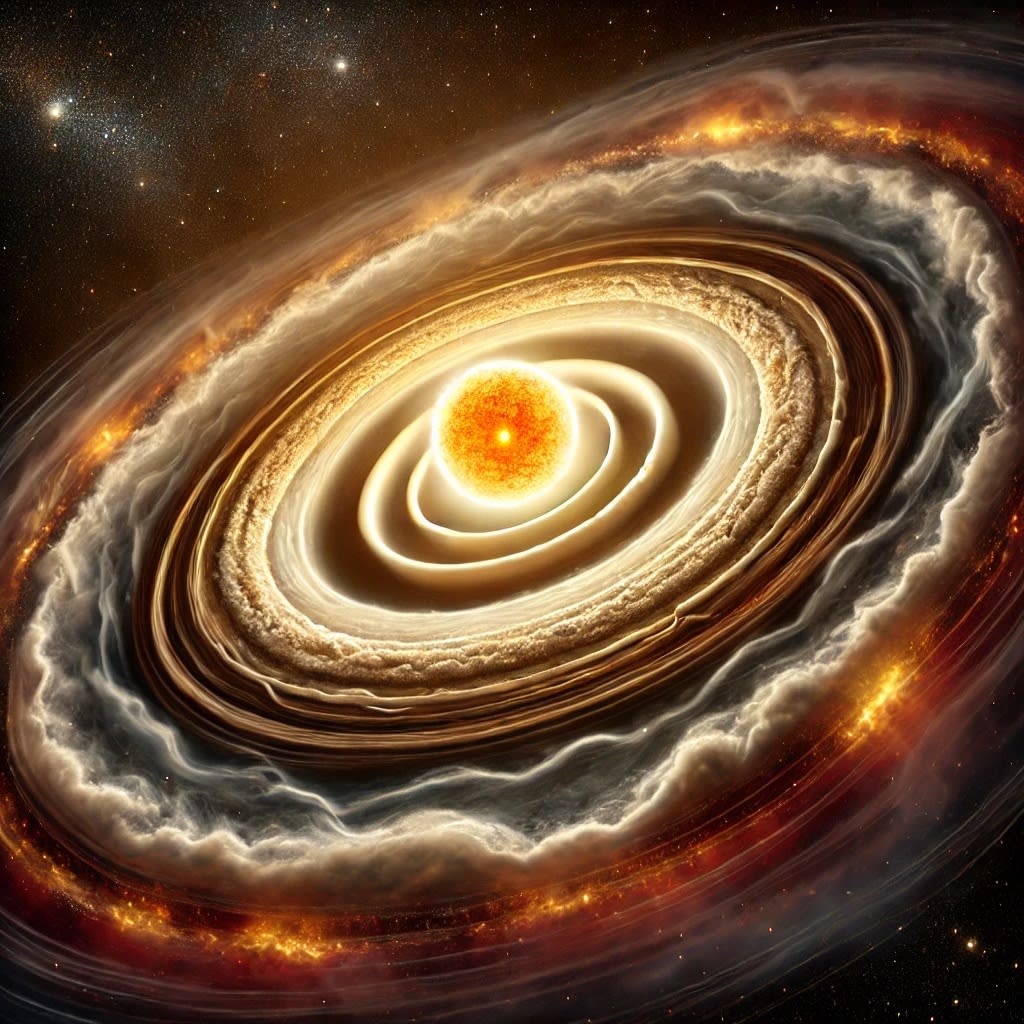
Astronomy has always dealt in enormous timescales. Stars take millions of years to ignite, galaxies evolve over billions, and planets emerge so slowly that their formation has long been considered impossible to observe directly. Scientists usually reconstruct these events like cosmic detectives, working with faint hints and fragmented data.
But for the first time in history, researchers have watched a brand-new planet take shape as it happens — not as a theoretical model, not as a reconstructed event, but as a live cosmic process unfolding before our eyes.
This breakthrough was made possible by a rare combination of cutting-edge technology and extraordinary luck: a young star system positioned just right relative to Earth, allowing astronomers to peer directly into its protoplanetary workshop.
A Planet in the Making
Young stars are surrounded by massive disks of dust and gas known as protoplanetary disks. These disks function like planetary factories. Within them, microscopic particles collide, stick together, grow into pebbles, then boulders, then enormous planetary embryos. Over millions of years, these embryos sweep up surrounding material and carve out their orbits.
Until now, astronomers could only infer a planet’s birth from indirect signs—gaps in the disk, ripples, or oddly shaped dust rings. These were the footprints of planets, not the planets themselves.
The newly observed system, however, provided something unprecedented: an embryonic world caught in the act of growing.
The young system, located about 450 light-years away in the constellation Taurus and known as LkCa 15, has been a subject of debate for more than a decade. Its disk showed suspiciously shaped voids and asymmetries, but no one could say with certainty whether these were caused by forming planets or by something else.
Now, new data has delivered the answer.
What the Researchers Actually Saw
Using a combination of high-resolution radio observations from ALMA (the Atacama Large Millimeter/submillimeter Array) and advanced optical instruments equipped with adaptive optics, astronomers spotted a brilliant, compact source of energy buried deep inside the disk.
This glow matches the signature of accretion — the process in which gas spirals down onto a growing planetary core. It is the cosmic equivalent of watching a snowball roll downhill, gathering layers and becoming larger with every turn.
The forming planet, designated LkCa 15 b, appears to be a young gas giant roughly the size of Jupiter, still surrounded by a heated envelope of dust. What makes this discovery extraordinary is that:
- Scientists detected thermal radiation emitted by infalling material, providing direct evidence of growth.
- They observed clear structural disturbances within the disk that match a planet’s gravitational influence.
- Over several years, they recorded dynamic changes, confirming they were witnessing a process in motion, not a static image.
It is the closest thing to watching a time-lapse of a planet’s birth.
Why This Discovery Matters
This is not merely a scientific curiosity. It is a milestone that transforms how we study planet formation.
For decades, astrophysicists have relied on computational models to estimate how quickly planets grow, how their atmospheres develop, and how their orbits evolve. Those models were informed by leftover evidence from mature planetary systems — like trying to understand human childhood by examining only adults.
Now, for the first time, scientists have a direct observational window into a planet’s earliest years.
This discovery allows researchers to:
- Measure how fast planets accumulate mass.
For example, by tracking the brightness and temperature of the accretion flow, astronomers can calculate growth rates with unprecedented precision.
- Analyze the chemical composition of forming atmospheres.
Early atmospheres can reveal whether a planet forms rich in water vapor, methane, ammonia, or carbon dioxide — clues that help us understand its long-term evolution.
- Study the interactions between young planets and their disks.
If LkCa 15 b shifts position over time, it will provide direct proof of planetary migration, a process suspected to have shaped our own Solar System.
- Refine theories on how common gas giants truly are.
Seeing one form in real time suggests such births may not be as rare as previously assumed.
A Glimpse Into the Future
The team plans to continue observing LkCa 15 for years — perhaps decades. With improving instruments, scientists hope to monitor how the planet shapes its orbit, how quickly it clears a path in the disk, and whether additional worlds are forming alongside it.
Future telescopes, such as the upcoming Extremely Large Telescope (ELT), may eventually capture even sharper images, revealing the evolving atmosphere, potential ring structures, or changes in accretion patterns.
This is just the beginning.
A Living Universe
We often imagine the universe as a static place — a gallery of frozen stars and worlds. But discoveries like LkCa 15 b remind us that cosmic evolution is happening right now. Stars are being born, galaxies are colliding, and new planets are taking shape in quiet, glowing disks light-years away.
For the first time, humanity is not merely discovering planets.
We are watching them arrive.
This marks a new era in astronomy — one where the universe is not just a record of ancient history, but a dynamic, unfolding story we can observe in real time.
About the Creator
Keep reading
More stories from Holianyk Ihor and writers in Futurism and other communities.
Astronomers Detect a Strange Object That “Blinks” Every 20 Minutes — and No One Knows What It Is
Astronomy has a way of humbling everyone who dares to believe we finally understand the Universe. Just when scientists start to think the cosmic inventory is complete, something unexpected appears and shatters the sense of certainty. This time, the surprise comes in the form of a mysterious radio object that behaves unlike anything seen before: it blinks with perfect regularity once every 20 minutes.
By Holianyk Ihorabout a month ago in Futurism
About Binding Prometheus
I want to start actively advocating on behalf of my own work, and the most valuable part of my canon is, without a doubt, Binding Prometheus, the play I have been working on since 2019 and only finished in 2023 as part of my MA. The play itself is an amalgamation of a million different inspirations. On one end, it evokes the Ancient Greek myth-play, deriving its own title from the earliest extant work of Western drama we have, Aeschylus’s Prometheus Bound. On the other end, it borrows significantly from the sci-fi bulwarks from over the years, namely Mary Shelley’s Frankenstein and Karel Capek’s Rossum’s Universal Robots. The play could be an episode of Black Mirror, I fear. I don’t know. I’ve only ever seen one episode of Black Mirror.
By Steven Christopher McKnight18 days ago in Futurism
Egypt ICT Market: Cloud Adoption, 5G Rollout & Technology Investment Trends
According to IMARC Group's latest research publication, The Egypt ICT market size reached USD 27,685.0 Million in 2024. Looking forward, IMARC Group expects the market to reach USD 39,712.3 Million by 2033, exhibiting a growth rate (CAGR) of 4.09% during 2025-2033.
By Abhay Rajput3 days ago in Futurism



Comments
There are no comments for this story
Be the first to respond and start the conversation.