
Runaway Stars: The Cosmic Sprinters Racing Out of the Milky Way at 2,000 km/s
Space

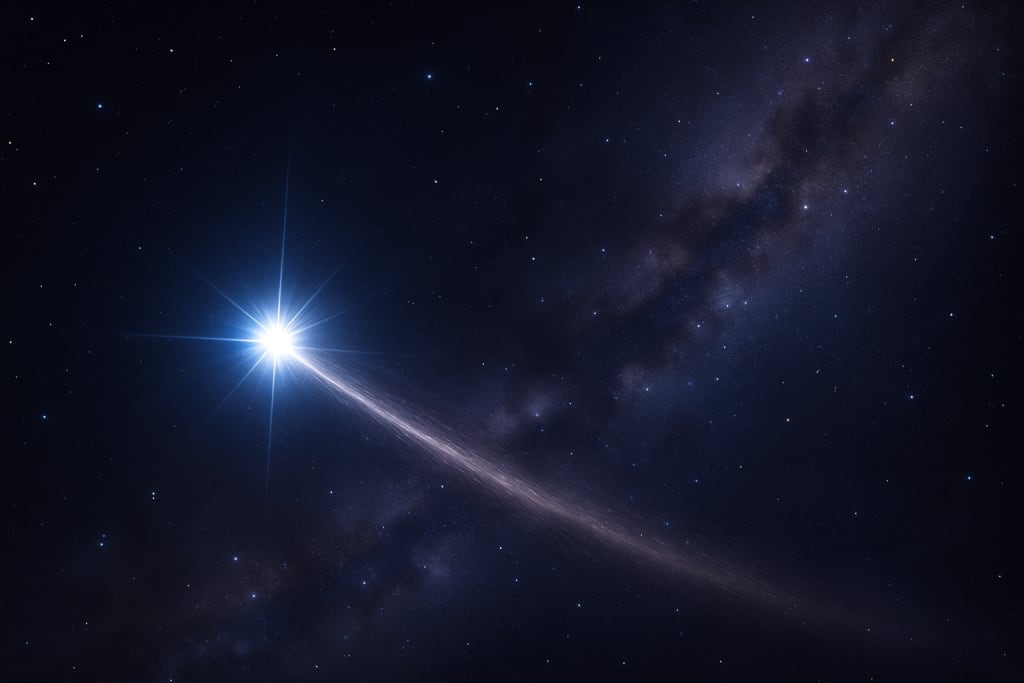
When we look up at the night sky, the stars seem eternal and unmoving. We imagine them as quiet beacons, frozen in place. But in reality, every one of them is hurtling through space at incredible speeds. Most stars drift along at a calm and predictable pace—maybe a few dozen or a few hundred kilometers per second. Fast by human standards, but nothing extraordinary by galactic ones.
And then there are the outliers.
A rare class of stars is moving so fast that they practically sprint through our Galaxy. Some of them reach astonishing velocities of 2,000 kilometers per second—fast enough to break free from the Milky Way entirely. These extreme objects are called hypervelocity stars, and they are among the most dramatic travelers the cosmos has ever produced.
How Can a Star Move So Fast?
Stars are massive—millions to billions of times heavier than planets. Accelerating something that enormous to 2,000 km/s seems almost impossible. Yet the Milky Way contains natural “engines” powerful enough to do it.
The most important of these is the supermassive black hole at the Galactic Center, known as Sagittarius A*.
The Hills Mechanism: A Galactic Slingshot
Imagine two stars orbiting each other, forming what astronomers call a binary system. Now picture this pair wandering too close to the monstrous gravity of Sagittarius A*. What happens next is one of the most dramatic gravitational interactions in the universe.
The black hole tears the binary apart:
- One star is captured, possibly ending up in a tight orbit near the black hole.
- The other is flung outward like a stone from a cosmic slingshot, gaining a massive boost in speed.
This process, known as the Hills mechanism, can accelerate stars to thousands of kilometers per second—far beyond the typical speeds found elsewhere in the Galaxy.
That’s how a star becomes a runaway.
Real Hypervelocity Stars: Examples From the Milky Way
Astronomers have already cataloged dozens of these cosmic speedsters, and each one has a story to tell.
HVS 2 — One of the Fastest Known
HVS 2 is a star blazing through the Galaxy at more than 1,000 km/s. That’s fast enough to cross the distance between Earth and the Moon in about six minutes. It’s currently on track to escape the Milky Way completely and wander alone into intergalactic darkness.
HVS 3 — A Star From Another Galaxy?
This star is even stranger. Observations suggest it may have originated not from the Milky Way, but from the Large Magellanic Cloud, a nearby dwarf galaxy. Something—perhaps a massive black hole—hurled it into space at an extraordinary speed.
If true, HVS 3 would be a visitor from beyond our own galaxy—an intergalactic traveler passing through our cosmic neighborhood.
The "S5-HVS1" Discovery (2019)
In 2019, astronomers spotted S5-HVS1, a star moving at nearly 1,700 km/s, one of the fastest ever observed. Its trajectory pointed straight back toward Sagittarius A*, serving as near-direct evidence of the Hills mechanism in action.
Why Hypervelocity Stars Matter
They aren’t just fascinating anomalies—these runaway stars are incredibly useful scientific tools.
1. They Reveal Secrets About the Galactic Center
By tracing their paths backward, astronomers can map the chaotic region around the Milky Way’s supermassive black hole. Hypervelocity stars act like “test particles” that help scientists understand the black hole’s environment and the dense cluster of stars orbiting it.
2. They Help Us Measure the Mass of the Milky Way
A star trying to escape the Galaxy must overcome its gravitational pull. If we know the star’s speed, we can estimate how much mass the Galaxy contains—most of which is dark matter. Hypervelocity stars therefore help refine our understanding of the vast, invisible halo surrounding the Milky Way.
3. They Teach Us About Extreme Stellar Interactions
Hypervelocity stars are living evidence of violent, high-energy events—binary disruptions, black-hole passes, and cluster interactions. Studying them tells us how common such dramatic processes are.
Lonely Wanderers of Deep Space
Imagine a single star racing into the void at 2,000 km/s. Millions of years from now, it will be far beyond the spiral arms of the Milky Way. It will drift into the nearly perfect emptiness between galaxies, where the nearest light is millions of light-years away. No planets, no neighbors—just a solitary star illuminating the darkness.
It began as part of our Galaxy, maybe even as part of a peaceful binary pair. But one close encounter with a black hole changed its fate forever.
It became a cosmic exile—a lone traveler on an endless journey.
About the Creator
Keep reading
More stories from Holianyk Ihor and writers in Futurism and other communities.
Are There “Cosmic Spheres” of Antimatter?
Possible Relics of Ancient Universal Processes Antimatter is one of the most fascinating substances in the universe. It flashes into existence in violent cosmic events, vanishes the moment it touches ordinary matter, and leaves behind nothing but pure energy. Scientists chase its traces using the world’s most sensitive instruments. But a bold idea has been circulating in astrophysics: what if the universe still hides large objects made of antimatter—stable structures formed in the earliest moments after the Big Bang?
By Holianyk Ihor2 months ago in Futurism
About Binding Prometheus
I want to start actively advocating on behalf of my own work, and the most valuable part of my canon is, without a doubt, Binding Prometheus, the play I have been working on since 2019 and only finished in 2023 as part of my MA. The play itself is an amalgamation of a million different inspirations. On one end, it evokes the Ancient Greek myth-play, deriving its own title from the earliest extant work of Western drama we have, Aeschylus’s Prometheus Bound. On the other end, it borrows significantly from the sci-fi bulwarks from over the years, namely Mary Shelley’s Frankenstein and Karel Capek’s Rossum’s Universal Robots. The play could be an episode of Black Mirror, I fear. I don’t know. I’ve only ever seen one episode of Black Mirror.
By Steven Christopher McKnight19 days ago in Futurism
Recycled Plastics Market in Saudi Arabia: Waste Reduction, Green Innovation & Demand Expansion
Saudi Arabia's recycled plastics market advances through SASO bans on oxo-degradable materials, promoting compostable alternatives and rPET for packaging, backed by Vision 2030's circular economy push to cut waste. Saudi Arabia recycled plastics market size reached USD 431.5 Million in 2025. Looking forward, IMARC Group expects the market to reach USD 728.4 Million by 2034, exhibiting a growth rate (CAGR) of 5.99% during 2026-2034.
By Jeffrey Wilson5 days ago in Futurism


Comments
There are no comments for this story
Be the first to respond and start the conversation.