

Possible Relics of Ancient Universal Processes
Antimatter is one of the most fascinating substances in the universe. It flashes into existence in violent cosmic events, vanishes the moment it touches ordinary matter, and leaves behind nothing but pure energy. Scientists chase its traces using the world’s most sensitive instruments. But a bold idea has been circulating in astrophysics: what if the universe still hides large objects made of antimatter—stable structures formed in the earliest moments after the Big Bang?
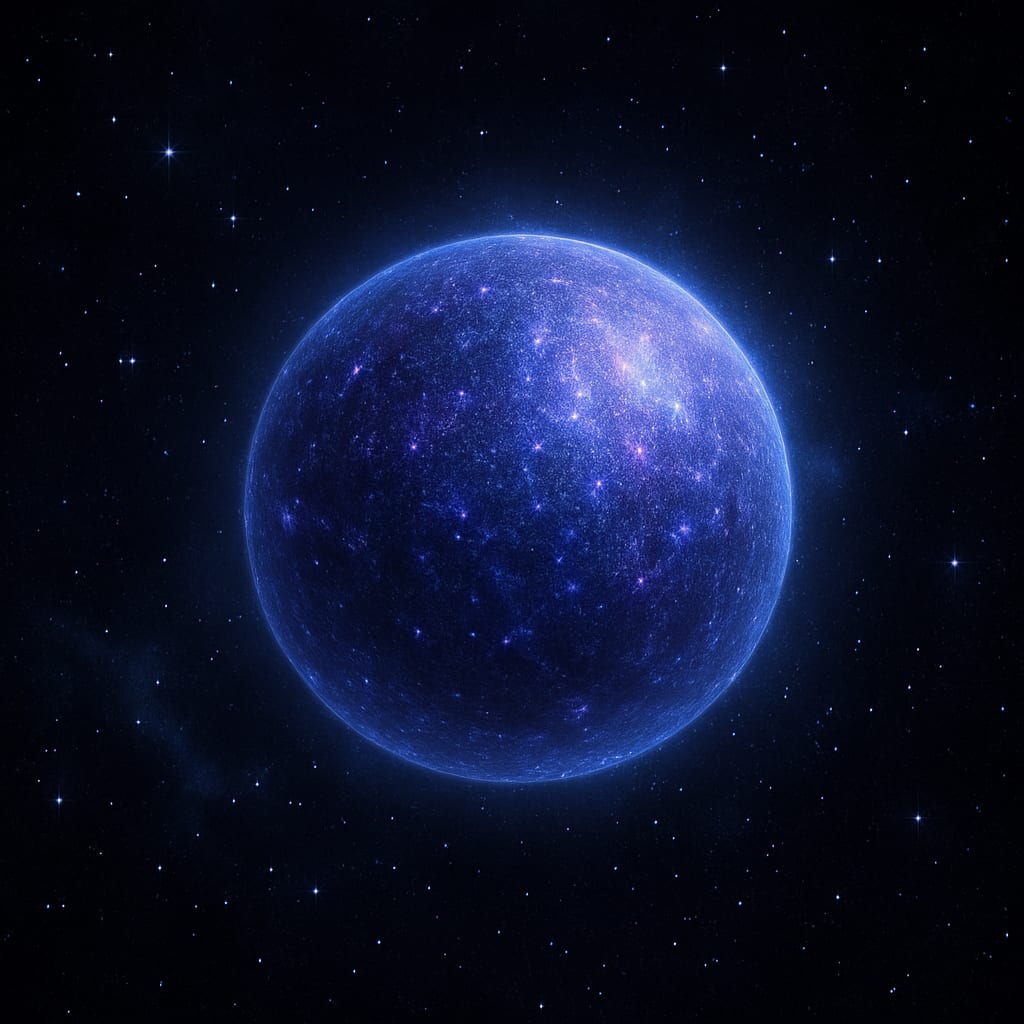
These hypothetical bodies—sometimes called antimatter nuggets or “cosmic spheres”—could be the last surviving witnesses of a strange, ancient era. And if they exist, they might rewrite our understanding of how the universe was born.
Why Is Antimatter So Rare Today?
According to the Big Bang model, the newborn universe should have created matter and antimatter in equal amounts. These two forms are identical twins with opposite charges. When they meet, they annihilate each other in a burst of gamma radiation.
Yet everywhere we look—from galaxies to the atoms in our bodies—there is almost no antimatter. The cosmos is overwhelmingly made of ordinary matter. This imbalance, called baryon asymmetry, is one of the biggest mysteries in physics.
Something—some unknown process—allowed matter to win the cosmic battle for survival. Antimatter all but disappeared.
Or did it?
The Wild Hypothesis: Islands of Ancient Antimatter
Some astrophysicists suggest that in the first microseconds after the Big Bang, the universe was anything but uniform. Conditions may have differed from region to region—temperature fluctuations, quantum anomalies, or early symmetry violations might have allowed small pockets of antimatter to survive while the rest annihilated.
If these pockets were large or dense enough, they might have:
- avoided total destruction,
- formed stable structures,
- persisted for billions of years, floating like isolated islands in space.
These potential structures are not stars or planets in the usual sense. Instead, they are something far stranger.
What Could These “Cosmic Spheres” Be?
One popular idea describes them as antimatter nuggets, tiny to massive objects composed of incredibly dense anti-quark matter. Imagine a sphere no larger than a golf ball but with a mass comparable to a mountain. Or a chunk the size of a meteorite with a density millions of times greater than steel.
These strange objects might have formed during early quark–gluon phase transitions, moments when the universe cooled enough for quarks to clump together.
How Could They Survive?
Under normal conditions, antimatter touching regular matter should instantly annihilate. Yet antimatter nuggets are theorized to have:
- extreme density, which gives them a protective “shell,”
- unusual surface properties, slowing down interactions with surrounding matter,
- a stable quark structure that resists dissolution.
- In other words, they might be antimatter that refuses to die.
What Signs Should We Look For?
If antimatter spheres exist, they would interact with the cosmic environment in subtle but detectable ways. Scientists search for their fingerprints using gamma detectors, cosmic-ray instruments, and microwave background maps.
1. Unusual Gamma-Ray Bursts
When even a tiny bit of ordinary matter touches an antimatter nugget, it should produce gamma radiation with a distinct signature—sharp, short flashes with specific energies. Satellite observatories like Fermi and Integral constantly watch the sky for exactly this kind of anomaly.
Some mysterious gamma events already observed remain unexplained. Could they be antimatter encounters? It's possible—but far from confirmed.
2. Exotic Cosmic Rays
Detectors on the International Space Station, including the famous AMS-02 experiment, sometimes find antihelium nuclei—objects that shouldn’t be produced in meaningful quantities by normal astrophysical processes.
If antihelium truly exists in cosmic rays, it could mean one thing:
there is a source of bulk antimatter somewhere out there.
3. Subtle Patterns in the Cosmic Microwave Background
If the early universe contained patches of antimatter, these regions might have interacted differently with surrounding matter fields. This could leave faint temperature or polarization anomalies in the cosmic microwave background—the universe’s “baby picture.”
Scientists have noticed several odd features in the data, such as the Cold Spot or certain asymmetries. None prove the existence of antimatter islands, but they keep the question alive.
Why This Matters
The existence of antimatter spheres would change more than one chapter of modern physics.
A New Explanation for Dark Matter
Some researchers propose that antimatter nuggets might account for part of the mass we call dark matter. They would be massive, compact, and extremely hard to detect—exactly what dark matter seems to be.
A Time Capsule from the Beginning of the Cosmos
These objects would be relics of processes that happened a fraction of a second after the Big Bang. Studying them could reveal:
- new physics of the early universe,
- details of symmetry breaking,
- the behavior of exotic quark phases,
- clues about why matter dominates today.
- A Breakthrough in Fundamental Physics
If antimatter nuggets are real, they prove the universe can store antimatter in stable, long-lived forms—contrary to our current expectations.
Are We Close to Finding Them?
Not yet. The search is difficult:
- Antimatter spheres would be incredibly rare.
- They might drift through interstellar space without interacting much.
- Signals are faint and often indistinguishable from more ordinary astrophysical phenomena.
Still, interest is growing. Each new anomaly in gamma-ray maps or cosmic-ray data fuels the discussion.
The possibility remains tantalizing:
somewhere in the vast darkness, ancient specks of anti-universe may still be floating, untouched since the dawn of time.
About the Creator
Keep reading
More stories from Holianyk Ihor and writers in Futurism and other communities.
The Space Garden on the ISS: How Astronauts Grow Lettuce and Microgreens in Orbit
When most people imagine life aboard the International Space Station (ISS), they picture floating astronauts, futuristic experiments, and breathtaking views of Earth rising over the curve of the planet. What they don’t usually picture is a garden. Yet hundreds of miles above us, orbiting at nearly 28,000 kilometers per hour, astronauts tend to a small but remarkable “space greenhouse” where they grow fresh lettuce and nutrient-packed microgreens.
By Holianyk Ihor2 months ago in Futurism
About Binding Prometheus
I want to start actively advocating on behalf of my own work, and the most valuable part of my canon is, without a doubt, Binding Prometheus, the play I have been working on since 2019 and only finished in 2023 as part of my MA. The play itself is an amalgamation of a million different inspirations. On one end, it evokes the Ancient Greek myth-play, deriving its own title from the earliest extant work of Western drama we have, Aeschylus’s Prometheus Bound. On the other end, it borrows significantly from the sci-fi bulwarks from over the years, namely Mary Shelley’s Frankenstein and Karel Capek’s Rossum’s Universal Robots. The play could be an episode of Black Mirror, I fear. I don’t know. I’ve only ever seen one episode of Black Mirror.
By Steven Christopher McKnight15 days ago in Futurism
UAE Mental Health Market: Rising Awareness, Service Expansion & Growth Outlook
According to IMARC Group's latest research publication, UAE Mental Health Market size reached USD 13.10 Billion in 2024. Looking forward, IMARC Group expects the market to reach USD 28.26 Billion by 2033, exhibiting a growth rate (CAGR) of 8.92% during 2025-2033.
By Abhay Rajput3 days ago in Futurism


Comments
There are no comments for this story
Be the first to respond and start the conversation.