
Dear Early 21st Century,
I’m only writing this because I’ve got nothing better to do as I sit here on my stack of belongings. I know nothing I say here will change what’s happened, but Dad always said writing made him feel better, so here it goes.
It started with the plague of gophers.
Once, back when I was a little girl living in Salt Lake City, I remember going to the store with my mom and begging her for this snack or that toy, just like most of you probably did. I went to school. I even had a few friends—difficult to believe, I know.
That was before the gopher population got out of control. My biology teacher said it had something to do with pollution and climate change. I never got to finish biology, so I never found out the end of the story.
Instead, I am sitting on a mound of clothes and stale food holding a sharpened stick waiting for any of my neighbors to make a move to take what’s mine.
I will never forget a single detail about that day, my last day of school. I was walking from ninth-grade biology to English when the ground started shaking. Several people in the crowded hallways shouted, “EARTHQUAKE!” like that wasn’t obvious at that point.
You know those duck and cover earthquake drills they teach you in school? Well, let me tell you, they don’t really work. Nobody tried to find cover under a desk or doorframe. Instead, we all charged for the nearest exit. I ran with the stampede, my school uniform skirt flying up and making me grateful—for once—that I wore tights.
Outside was chaos. Students rushed in every direction, trying to find their teachers. I tried to do the same, but the ground where my foot was crumpled to dust. I stumbled and fell to my hands and knees. Pockets of earth were disappearing all around me. Some as small as a shoe, others as large as a building.
As I scrambled to my feet there was a loud boom behind me. I spun. A section of the school had imploded. I stood there, stunned, watching a cloud of dust mushroom out of the crater. The only sound I heard was my own heart thumping in my ears. Buildings all around me were trembling, crumbling, then falling. It was rare that whole cities succumbed at once, but I had seen it on TV. The last big city to fall to Plague-G was Las Vegas. The destruction had been catastrophic. Only about 15,000 survivors.
Panicked, I searched frantically for my English teacher. He was standing in a circle of students near the flagpole. On the way I passed a deep pit. I happened to glance down. Two of my school mates had fallen in. Neither of them was moving. Horrified, I edged away from the pit, my pulse thudding. The breath hitched in my lungs. I couldn’t seem to look away from those sprawled bodies surrounded by steep dirt walls.
My English teacher shouted my name. My eyes snapped to him. He gestured to me frantically, and I sprinted to his side. We huddled around the flagpole as a class, praying we wouldn’t be next to get sucked into the void.
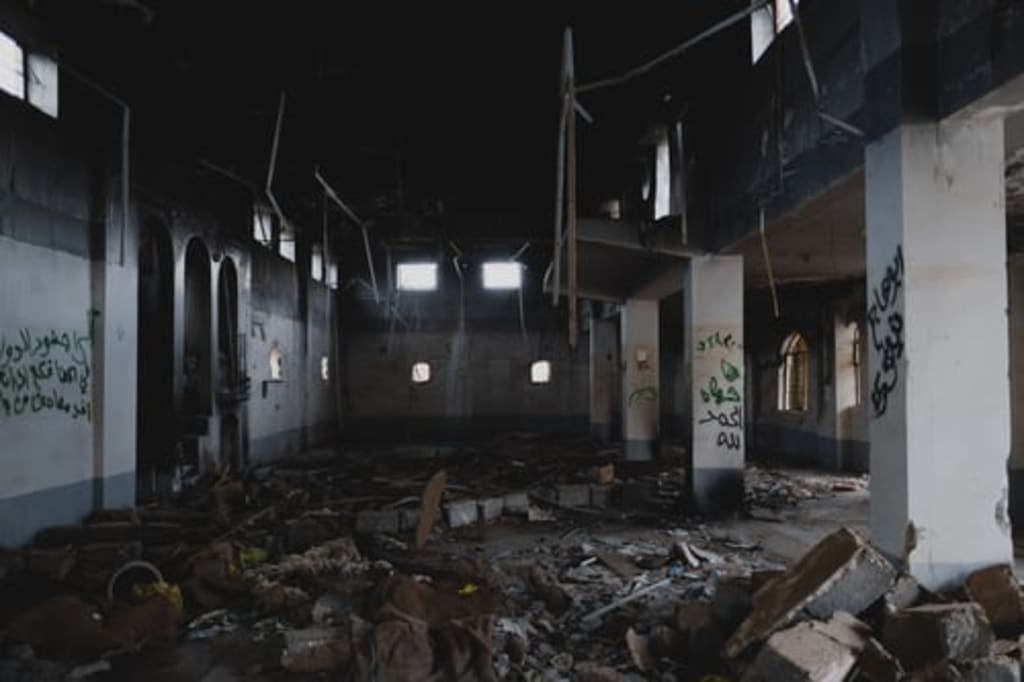
Eventually the ground stopped shaking, the clamor hushed, and dust started to clear. My English class huddled on the pavement, which was safer than the grass, though not by much. The schoolyard now looked like the surface of the moon. Chunks of earth, cement, and rubble had sunk into the deep tunnels created by an army of digging rodents.
The rest of the day seemed to drag on. The school counted the survivors and barricaded us in the gym. I don’t know why that particular room was safer than anywhere else on campus, but that’s what happened. They wouldn’t let us leave until our parents came for us. They did bring in some snacks once, which was a nice thought, especially considering how sparse food was about to be, but at the time, I was too nervous to eat.
Several questions ate at my attention. Where were Mom and Dad? Were they okay? Had the house been hit? Maybe they were just trying to find my younger brother first. That made sense. He would be much more scared than I was—though I was pretty scared. Of course they would pick him up first. Or maybe the car had fallen into a gopher hole, and they had to walk to the school to pick me up.
They never came.
I heard a couple staff members talking and learned that something like 258 kids survived and that the current count for fatalities city-wide was already at 10,000 and climbing. My worry about my family increased. I stayed at the school for about three days. By that point I was one of six other kids who still hadn’t been picked up and it had been hours since someone had come for their child. Anxiety gnawed at me, and I couldn’t stand the wait a second longer.
I asked to go to the bathroom. A teacher unlocked the door and watched me walk to the women’s restroom. I crossed to the other side of the long room where another entrance led into a second hallway. I left the bathroom, then made my way to the front of the school. It was a difficult journey as there were large sections of floor missing, or sometimes fallen columns or bits of ceiling that I had to climb over.
Eventually I made it out the front doors and ran for it. I had walked home from school every afternoon with a group of friends, and I could have traveled it in my sleep. In some ways it was now faster because many traffic lights were broken, and there were few cars on the road. I took shortcuts and jaywalked like a maniac.
When I finally got to our house, my feet slowed and my heart sank. The roof had collapsed. Eerie country music drifted from the wreckage like my mom was still doing dishes at the kitchen sink. Tears formed in my eyes and I tried to hold them back as I stepped forward. The door hung on one hinge. I ducked under it.
“Mom? Dad?” I called, voice trembling.
No response.
I picked through the house, moving toward the source of the music. It was coming from the kitchen, or what was left of it. Water sprayed into the air from the broken pipes. The back wall of the kitchen had fallen, crushing everything in its way. My gut tightened as I crawled, trying to see beneath the rubble.
There was my mother. A large hunk of sheetrock pressed her into the ground. She was perfectly still, and blood soaked into her strawberry blonde hair. With some effort, I shifted the debris and scooted beside her. Just by looking at her I knew she was dead. There was so much blood, and she was horribly pale.
Then I heard a sound that was worse than the crumbling of buildings and shouts of terrified children. It was a scream. Shrill and anguished and lost. And I realized I was making that sound as I clutched my mother’s corpse, repeatedly asking her to come back.
After hours, I woke up with a shiver. It was dark now. Nothing else had changed. The broken room was growing steadily wetter, my uniform was now stained with blood, and Mom was still gone. I sniffled and brushed a lock of hair out of her face. Something glinted in the moonlight that filtered through the broken ceiling. I reached down and fingered the locket around my mom’s neck. I recognized it as an heirloom that used to belong to her grandmother.
Gently, I undid the clasp and opened the heart. Inside was a picture of my great grandma when she was young. She was beautiful and wore a fancy gown. There was a corsage on her wrist, and her hair was immaculate. The woman in the photo looked so happy and carefree. Mom had loved her grandma almost more than her own mother. My hand curled around the necklace, and I tucked it close to my heart, silently promising to keep the treasure safe.
Then I stood and left the house. I didn’t know what else to do. Mom was dead. Dad would have been working when Plague-G struck. My brother Josh was at school. There was no point waiting around in a ruined house with a body.
The teachers at Josh’s school told me they never found him. They considered him dead. I like to think that he’s out there doing what I’m doing: surviving.
Dad I found in one of the many triage tents set up around the city. He’d been taken to the one nearest his office building with a serious puncture wound caused by debris. I was able to hold his hand and tell him about Mom and Josh before he too left me.
So here I am, alone, homeless, and writing on a napkin with a pen that only sometimes works. Plague-G has swept the country. Salt Lake wasn’t the first, nor was it the last. Now the majority of U.S. citizens are living in cardboard boxes, and raiding abandoned and half buried grocery stores for food that might still be edible. We’ve turned to scavenging and stealing to live. Everyone hides in their den’s, viciously protecting their own. As a people, we’ve gone underground. Just like the gophers.
Oh, I’m sure the government is trying to do something. That’s the problem with government though, isn’t it? They’re always trying to do stuff, instead of just actually doing it. A lot of government buildings were destroyed too, so no one’s really heard much from the White House. Probably there’s not enough of those politicians left to keep the states united anymore.
Anyhow, I’ve got to depend on myself. But don’t worry, I’ve got my stick and my food, and someday I’ll find my brother and then we can depend on each other.
So…yeah. Thanks for reading or whatever.
-Kate
About the Creator
Cambri Morris
I am an Art and Design major at Utah Valley University, and I have wanted to be an author since I was 12 years old. I am trying to get out of working at jobs that I just do for money, and start writing full time.
Keep reading
More stories from writers in Futurism and other communities.
About Binding Prometheus
I want to start actively advocating on behalf of my own work, and the most valuable part of my canon is, without a doubt, Binding Prometheus, the play I have been working on since 2019 and only finished in 2023 as part of my MA. The play itself is an amalgamation of a million different inspirations. On one end, it evokes the Ancient Greek myth-play, deriving its own title from the earliest extant work of Western drama we have, Aeschylus’s Prometheus Bound. On the other end, it borrows significantly from the sci-fi bulwarks from over the years, namely Mary Shelley’s Frankenstein and Karel Capek’s Rossum’s Universal Robots. The play could be an episode of Black Mirror, I fear. I don’t know. I’ve only ever seen one episode of Black Mirror.
By Steven Christopher McKnight17 days ago in Futurism
UAE Mental Health Market: Rising Awareness, Service Expansion & Growth Outlook
According to IMARC Group's latest research publication, UAE Mental Health Market size reached USD 13.10 Billion in 2024. Looking forward, IMARC Group expects the market to reach USD 28.26 Billion by 2033, exhibiting a growth rate (CAGR) of 8.92% during 2025-2033.
By Abhay Rajput5 days ago in Futurism
Silver Screen Magic with Mae West
American actress and singer Mae West became a popular film actress during the Great Depression. She started entertaining in vaudeville, then performed on Broadway, and finally went to Hollywood. She signed up with Paramount Pictures and made her debut in the 1932 film “Night After Night.” She also starred in musicals, comedies, and crime dramas. The American Film Institute named her one of the best classic Hollywood actresses.
By Rasma Raisters5 days ago in Geeks


Comments
There are no comments for this story
Be the first to respond and start the conversation.