
Pandora Mission: Opening a Cosmic Box of Secrets
Space

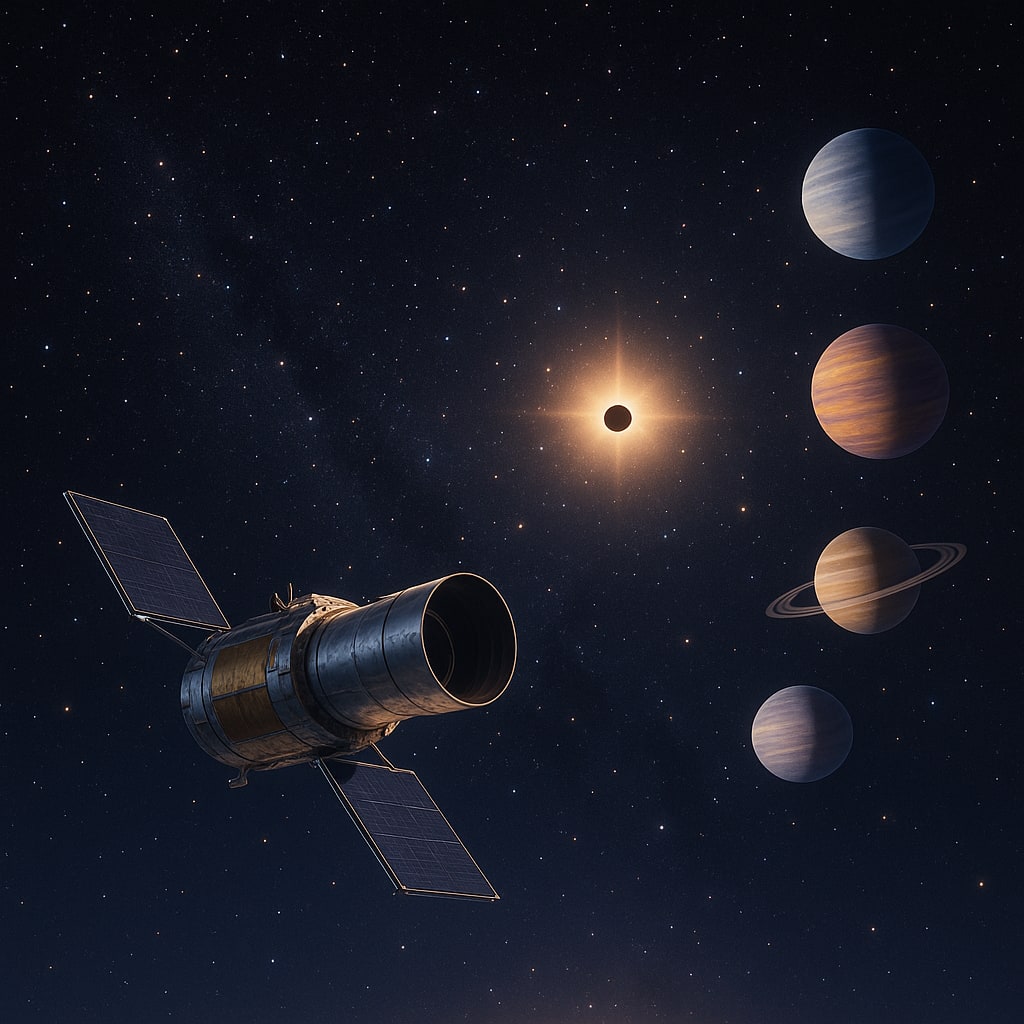
For centuries, humanity has looked to the night sky in wonder — to predict the seasons, to navigate oceans, or to seek meaning among the stars. Today, our gaze has a new purpose: to find out whether we’re alone in the universe. And leading this quest is NASA’s Pandora mission, a small but mighty space telescope designed to study the atmospheres of 39 distant exoplanets — all while watching their host stars and planets simultaneously.
It’s not just another telescope. It’s a window into other worlds.
Why the Name “Pandora”?
The name Pandora comes from ancient Greek mythology. When Pandora opened her legendary box, she released all the troubles of the world — but hope remained inside. The scientists behind NASA’s Pandora chose the name intentionally: this mission also opens a mysterious box, but what it releases is knowledge, and perhaps hope — hope that Earth may not be the only world capable of supporting life.
A Small Telescope with a Big Vision
Pandora is part of NASA’s Astrophysics Pioneers program, which funds small, innovative missions that can do groundbreaking science without billion-dollar budgets. Unlike colossal observatories such as the James Webb Space Telescope (JWST), Pandora is compact, affordable, and highly specialized.
But make no mistake — this little explorer is aiming high. Its primary mission is to decode the chemical fingerprints of alien atmospheres by analyzing starlight as planets pass in front of their stars, a process known as the transit method.
Here’s how it works: when an exoplanet transits its star, a tiny fraction of the star’s light filters through the planet’s atmosphere before reaching us. Different gases absorb specific wavelengths of light, leaving behind telltale “spectral lines.” By studying these lines, Pandora can identify the presence of water vapor, methane, carbon dioxide, and other molecules — the very ingredients that hint at habitability.
Why Observe the Star and Planet at the Same Time?
You might think studying a planet’s atmosphere is as simple as analyzing its spectrum. But stars are messy. They pulse, flicker, and flare — all of which can distort measurements and create false signals. Imagine trying to listen to a whisper during a thunderstorm; without filtering out the thunder, the message is lost.
That’s where Pandora shines. Its key innovation is simultaneous observation: it watches both the star and its planet together. This dual-view approach allows scientists to subtract the star’s variability and isolate the planet’s true atmospheric signature. The result? Far cleaner, more reliable data — essential for studying small, faint worlds hundreds of light-years away.
39 Worlds to Explore
Over its mission, Pandora will focus on 39 exoplanets, many of them gas giants and “sub-Neptunes” — planets larger than Earth but smaller than Neptune. These worlds orbit stars scattered across our galactic neighborhood, each offering a unique laboratory for atmospheric science.
Some lie in the so-called habitable zone, where conditions might allow liquid water to exist. If Pandora detects molecules like water vapor or methane in those atmospheres, it could point to the tantalizing possibility of life-friendly environments beyond our solar system.
Working Hand in Hand with Other Telescopes
Pandora isn’t a lone wanderer. It’s designed to complement major observatories like JWST and Hubble. While those telescopes can capture detailed, high-resolution spectra, Pandora provides consistent, long-term observations that help correct for stellar variability. Together, they’ll create a richer, more accurate portrait of distant planetary atmospheres.
Think of Pandora as the steady heartbeat in a symphony of instruments — its rhythm keeping the data in tune, while larger telescopes add the dramatic crescendos.
From Data to Discovery
By the end of its mission, Pandora will have collected terabytes of information about how exoplanet atmospheres form, evolve, and interact with their stars. Scientists hope to answer big questions:
- What makes some planets shrouded in thick clouds while others are crystal clear?
- Why do some have hydrogen-rich atmospheres while others lose theirs to space?
- Could any of these alien skies shelter the chemistry of life?
These answers won’t come overnight. But every spectrum Pandora captures brings us one step closer to understanding not only other worlds — but our own.
The Bigger Picture: Searching for Life
The study of exoplanet atmospheres is humanity’s next great frontier. We’ve already discovered over 5,000 exoplanets, from blazing-hot Jupiters to icy mini-Neptunes. But finding planets is only the beginning; learning what their air is made of is the next challenge.
Pandora will help identify which worlds deserve a closer look by future missions — especially those that might show biosignatures, the chemical fingerprints of life. If we ever detect oxygen, methane, and water vapor together in the right balance, it could be the first whisper from another living world.
Hope Among the Stars
In the end, the Pandora mission isn’t just about data or discovery. It’s about perspective. Every time we look into the cosmos, we learn a little more about what makes our own planet special — and what connects us to the universe beyond.
Just like in the ancient myth, Pandora’s box may unleash many questions — but at its heart, it carries hope. Hope that the vast, star-speckled darkness is not empty… but alive with possibilities.
About the Creator
Keep reading
More stories from Holianyk Ihor and writers in Futurism and other communities.
SPHEREx: The Space Telescope That Will Redraw Our Map of the Universe
When we gaze up at the night sky, we see a silent ocean of stars — calm, timeless, and still. But behind that peaceful illusion lies a dynamic history: galaxies forming, stars igniting, and cosmic structures evolving over billions of years. To truly understand where we came from, astronomers must look back — far back — into the cosmic dawn. And soon, a new explorer will help them do just that.
By Holianyk Ihor3 months ago in Futurism
About Binding Prometheus
I want to start actively advocating on behalf of my own work, and the most valuable part of my canon is, without a doubt, Binding Prometheus, the play I have been working on since 2019 and only finished in 2023 as part of my MA. The play itself is an amalgamation of a million different inspirations. On one end, it evokes the Ancient Greek myth-play, deriving its own title from the earliest extant work of Western drama we have, Aeschylus’s Prometheus Bound. On the other end, it borrows significantly from the sci-fi bulwarks from over the years, namely Mary Shelley’s Frankenstein and Karel Capek’s Rossum’s Universal Robots. The play could be an episode of Black Mirror, I fear. I don’t know. I’ve only ever seen one episode of Black Mirror.
By Steven Christopher McKnight16 days ago in Futurism
Massage Equipment Market: Ergonomic Innovation, Wellness Demand & Market Momentum
According to IMARC Group's latest research publication, The global massage equipment market size reached USD 8.1 Billion in 2024. Looking forward, IMARC Group expects the market to reach USD 16.3 Billion by 2033, exhibiting a growth rate (CAGR) of 8.08% during 2025-2033.
By James Whitman4 days ago in Futurism


Comments
There are no comments for this story
Be the first to respond and start the conversation.