
SPHEREx: The Space Telescope That Will Redraw Our Map of the Universe
Space

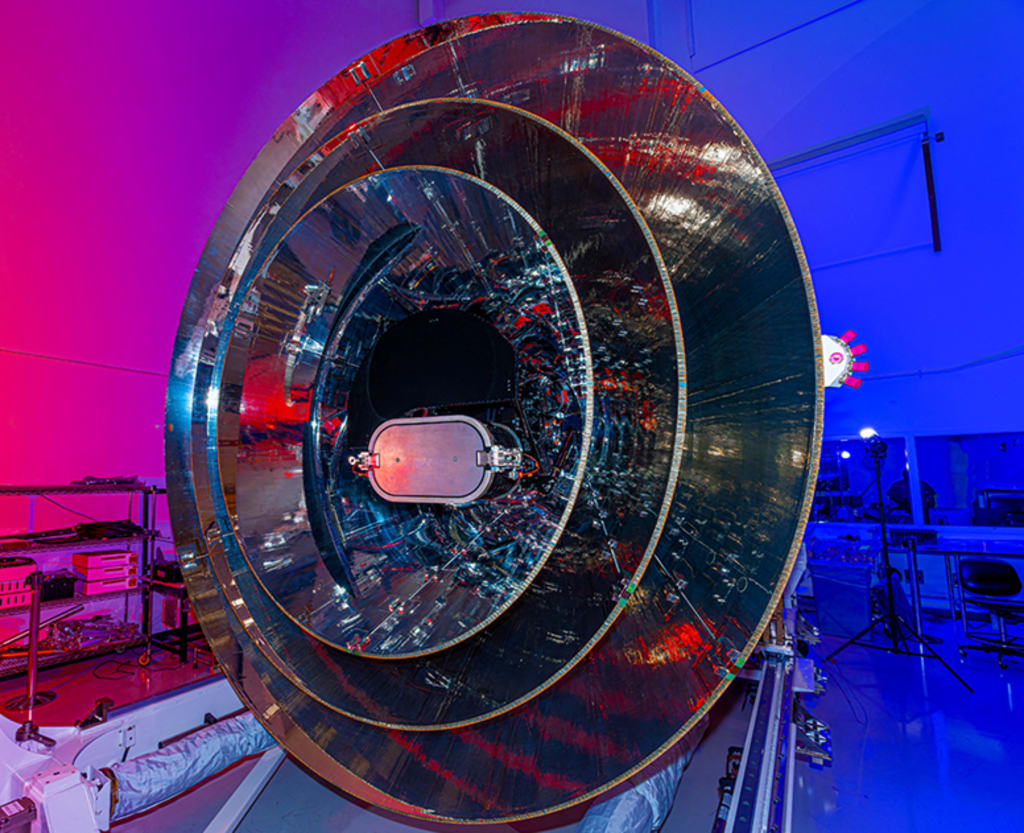
When we gaze up at the night sky, we see a silent ocean of stars — calm, timeless, and still. But behind that peaceful illusion lies a dynamic history: galaxies forming, stars igniting, and cosmic structures evolving over billions of years. To truly understand where we came from, astronomers must look back — far back — into the cosmic dawn. And soon, a new explorer will help them do just that.
Meet SPHEREx, short for Spectro-Photometer for the History of the Universe, Epoch of Reionization, and Ices Explorer. It’s NASA’s upcoming space telescope with a bold mission: to map the entire sky in unprecedented detail and reveal secrets about the first galaxies, the chemistry of interstellar space, and even the mysterious force driving the universe’s expansion.
A 3D Map of the Cosmos
Unlike telescopes that focus on small patches of the sky, SPHEREx is an all-sky surveyor. Every six months, it will scan the entire celestial sphere, collecting light across the near-infrared spectrum — wavelengths invisible to the human eye but essential for peering through cosmic dust and seeing the farthest reaches of the universe.
But SPHEREx won’t just take pictures; it will take spectra — measurements of how light spreads across different wavelengths. Imagine not just photographing the stars, but listening to their unique “color signatures.” By analyzing these spectral fingerprints, scientists can determine what distant galaxies are made of and how far away they are.
Over the course of its mission, SPHEREx is expected to collect data on more than 400 million galaxies and around 100 million stars. That means it will create one of the most comprehensive 3D maps of the cosmos ever made. Each data point will help astronomers trace how galaxies cluster together, forming the vast cosmic web that stretches across billions of light-years.
Chasing the First Light: The Epoch of Reionization
One of SPHEREx’s most exciting goals is to explore one of the least understood chapters of cosmic history — the Epoch of Reionization. This was the time, roughly 13 billion years ago, when the first stars and galaxies began to shine, flooding the universe with light and transforming the fog of neutral hydrogen into the transparent cosmos we see today.
Understanding when and how this transition happened is crucial to understanding cosmic evolution. By analyzing the faint infrared glow of ancient galaxies, SPHEREx will help scientists determine how quickly the universe went from dark and opaque to bright and transparent, and how early cosmic structures — the seeds of today’s galaxies — came to be.
In other words, SPHEREx is like a time machine. Its sensors will pick up ancient light that has traveled across the universe for billions of years, carrying clues about the universe’s youth — a time before the Milky Way even existed.
Probing the Mystery of Dark Energy
Beyond mapping galaxies, SPHEREx will tackle one of modern science’s biggest mysteries: dark energy. This invisible phenomenon is thought to make up about 68% of the universe, pushing galaxies apart and accelerating cosmic expansion.
By measuring how galaxies are distributed across vast cosmic scales, SPHEREx will allow astronomers to test theories of how dark energy behaves. If the expansion of the universe is speeding up differently in various regions or epochs, that could hint at new physics beyond the standard cosmological model.
The mission won’t solve the dark energy puzzle alone, but it will provide a treasure trove of data — the kind that future observatories like the Nancy Grace Roman Space Telescope and the James Webb Space Telescope (JWST) can build upon.
The Chemistry of Life Among the Stars
SPHEREx isn’t just looking outward in space — it’s also looking inward, into the chemical heart of our own galaxy. Its infrared vision can penetrate dusty clouds where new stars and planets are born, revealing the molecular building blocks that make life possible.
In these cold regions, simple molecules like water, carbon dioxide, and methane freeze onto grains of dust, forming icy mantles that may later become part of planets. By studying how these ices are distributed across different environments in the Milky Way, SPHEREx will shed light on how organic molecules form and survive before they end up on planets like Earth.
Imagine being able to trace the story of life’s ingredients — from interstellar clouds to planetary systems. That’s part of SPHEREx’s scientific magic.
A Foundation for the Future
The data SPHEREx collects will guide the next generation of telescopes. For instance, its all-sky spectral maps will help JWST and Roman zero in on the most intriguing galaxies and star-forming regions for deeper study.
Think of SPHEREx as the cosmic cartographer — it sketches the outlines of the unknown so that other telescopes can zoom in and explore. This synergy between missions is what makes 21st-century astronomy so powerful: each observatory contributes a unique piece to the grand puzzle of the universe.
The Next Great Sky Survey
Scheduled for launch aboard a SpaceX Falcon 9 rocket, SPHEREx represents the next step in humanity’s quest to understand the cosmos not just visually, but chemically and chronologically. It’s a mission that bridges disciplines — cosmology, astrophysics, and astrochemistry — to create a more complete picture of how our universe came to be.
In the end, SPHEREx is more than a telescope. It’s a storyteller — one that reads the faint light of distant galaxies and ancient ice to narrate the epic history of everything we see in the sky. Every photon it collects will help us piece together our cosmic origins, from the first galaxies to the icy seeds of life itself.
When SPHEREx finally opens its eyes to the universe, it won’t just map the stars. It will map our place in time, showing us how far we’ve come — and how much there still is to discover.
About the Creator
Keep reading
More stories from Holianyk Ihor and writers in Futurism and other communities.
The “Planet Y” Hypothesis: A Hidden World at the Edge of Our Solar System
For decades, astronomers have known that the Solar System doesn’t end with Neptune. Beyond it stretches the Kuiper Belt — a vast, icy frontier filled with dwarf planets, comets, and frozen remnants from the early days of planetary formation. Yet, recent discoveries suggest that something strange is happening out there.
By Holianyk Ihor3 months ago in Futurism
About Binding Prometheus
I want to start actively advocating on behalf of my own work, and the most valuable part of my canon is, without a doubt, Binding Prometheus, the play I have been working on since 2019 and only finished in 2023 as part of my MA. The play itself is an amalgamation of a million different inspirations. On one end, it evokes the Ancient Greek myth-play, deriving its own title from the earliest extant work of Western drama we have, Aeschylus’s Prometheus Bound. On the other end, it borrows significantly from the sci-fi bulwarks from over the years, namely Mary Shelley’s Frankenstein and Karel Capek’s Rossum’s Universal Robots. The play could be an episode of Black Mirror, I fear. I don’t know. I’ve only ever seen one episode of Black Mirror.
By Steven Christopher McKnight17 days ago in Futurism
Macarons Market: Premium Dessert Demand, Flavor Innovation & Gourmet Bakery Trends
According to IMARC Group's latest research publication, global macarons market size reached USD 1,077.8 Million in 2024. Looking forward, IMARC Group expects the market to reach USD 1,715.4 Million by 2033, exhibiting a growth rate (CAGR) of 5.03% during 2025-2033.
By sujeet. imarcgroup2 days ago in Futurism


Comments
There are no comments for this story
Be the first to respond and start the conversation.