
Orbiting the Fire
How satellites circling the Sun became humanity’s newest storytellers of light, gravity, and cosmic memory

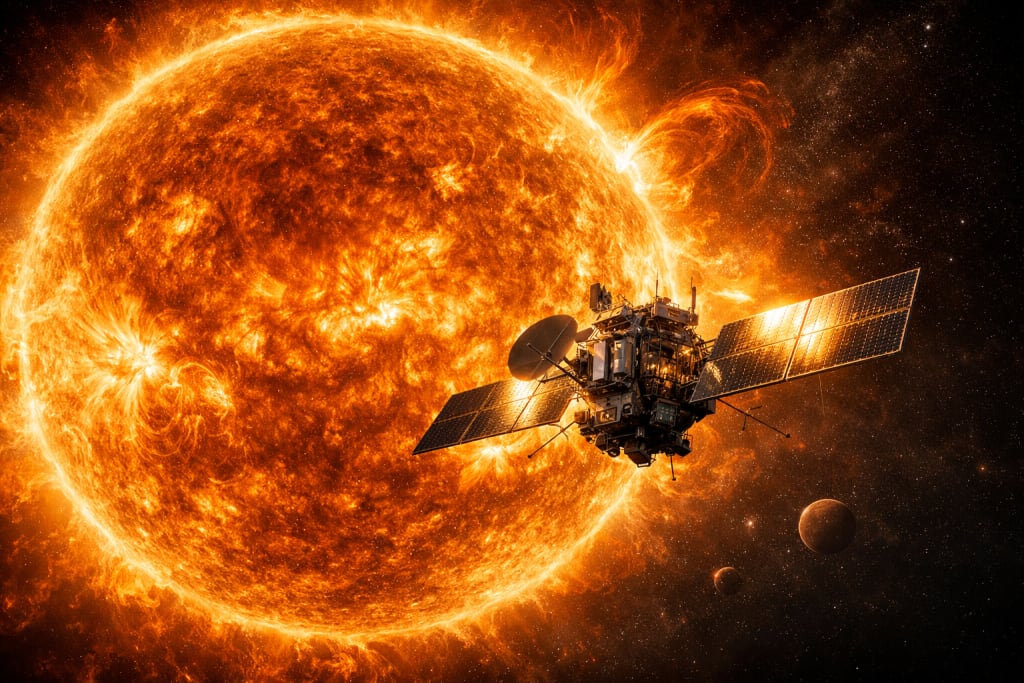
The Keepers of the Sun
Long before metal gleamed in the vacuum of space, before engines hummed and signals pulsed through the dark, there were only stories.
They were not written in ink but carried in firelight—whispers of gods steering chariots across the sky, of flaming wheels pulled by divine horses, of a great golden eye watching over Earth. The Sun was not a star then. It was a deity, a guardian, a force with intention.
But time moved, and so did human imagination.
Where once poets memorized epics beneath constellations, scientists began to measure them. Where once elders spoke of celestial chariots, engineers envisioned vessels of steel. The old myths did not disappear—they transformed. And in that transformation, a new kind of storyteller was born: the satellite.
These silent machines now move around the Sun, not in reverence, but in rhythm—bound by gravity instead of prayer.
They are the modern rhapsodes of the cosmos.
Far beyond Earth’s protective embrace, satellites trace long elliptical paths around the Sun. Some are observatories, unfolding delicate mirrors like metallic petals to study solar flares and ancient light. Others are probes, flung outward on daring trajectories, carrying instruments instead of lyres. They listen to the hum of radiation, measure invisible winds of charged particles, and map the silent currents of interplanetary space.
They do not sing in verses, yet they speak.
Each transmission sent back to Earth is a stanza of data. Each image of a coronal eruption or a distant planet is a line added to humanity’s ongoing epic. In laboratories and control rooms, scientists gather like ancient listeners around a new kind of fire—the glow of monitors—decoding the language carried across millions of miles.
The Sun, once imagined as a chariot of flame, is now understood as a roiling sphere of fusion, where hydrogen becomes helium and light is born in violence. Yet the sense of wonder remains unchanged. Satellites orbit it with careful precision, balancing between its pull and their own forward motion. Too slow, and they would fall inward. Too fast, and they would drift away. In that delicate dance lies survival.
The laws of physics have replaced mythic reins, but the choreography is no less poetic.
Some satellites move in paths that align with Earth, watching the Sun from a constant vantage point, guardians against solar storms that could silence power grids and darken cities. Others sweep above and below the plane of the planets, mapping the star’s poles and revealing mysteries once hidden from view. They are our envoys, enduring radiation and isolation to protect the fragile world that launched them.
If ancient bards were the memory-keepers of kings, these machines are the memory-keepers of stars.
They preserve records of solar cycles—the waxing and waning of magnetic tempests that follow an eleven-year rhythm. They observe eruptions that hurl plasma across space like cosmic folklore repeating itself in bursts of flame. They teach us that the Sun is not static but alive in motion, a dynamic force shaping every orbiting body.
And like the storytellers of old, satellites pass wisdom forward.
The data they gather guides astronauts, shields spacecraft, and informs the design of future missions. It deepens our understanding of climate, of planetary atmospheres, of the invisible threads connecting Earth to its star. Knowledge travels from instrument to antenna, from antenna to Earth, from Earth to textbooks and minds.
The lineage is unbroken.
There is something profoundly human about sending satellites around the Sun. We are creatures who once feared eclipses as omens. Now we calculate them centuries in advance. We once imagined the heavens as unreachable realms. Now we navigate them with mathematics as our compass.
Yet despite this progress, the impulse is the same as it was beside ancient fires: to understand our place in the vastness.
Satellites orbiting the Sun are not merely tools of science. They are extensions of curiosity. They are mechanical pilgrims circling the source of our warmth and light. Their paths carve invisible threads through space, stitching together planets, gravity, and time.
In their motion, one can glimpse an echo of older rhythms—the repetition that once made poetry memorable. Orbit itself is a kind of rhyme: a returning, a circling back, a pattern that holds meaning through consistency. Each revolution is both repetition and renewal.
And so the story continues.
Humanity has moved from chanting myths to launching instruments, from imagining solar gods to studying solar winds. But the desire to look upward and ask why has never faded. Satellites around the Sun embody that question. They move in silence, yet their presence speaks of ambition, ingenuity, and awe.
Perhaps one day, centuries from now, people will look back on these early solar missions as we now look upon ancient epics—foundational chapters in a much larger narrative. They will see them as the first verses in a grander cosmic poem, written not with ink, but with trajectories and light.
The Sun still burns as it did before stories were spoken. Around it, planets turn, and now, so do our creations. Steel and silicon have joined stone and song in humanity’s long tradition of remembrance.
For whether whispered by a bard or transmitted by a satellite, the purpose remains unchanged:
To carry knowledge forward. To hold memory against time. To orbit wonder without ever letting it go.
About the Creator
Jhon smith
Welcome to my little corner of the internet, where words come alive
Keep reading
More stories from Jhon smith and writers in Futurism and other communities.
Australia Industrial Robotics for Assembly Lines Market: Automation Adoption, Operational Efficiency & Technology Innovation
According to IMARC Group, the Australia industrial robotics for assembly lines market was valued at USD 369.85 Million in 2025 and is projected to reach USD 1,049.60 Million by 2034, exhibiting a strong compound annual growth rate (CAGR) of 12.29% during 2026–2034. The accelerating shift toward advanced manufacturing and smart factory integration across Australia is significantly driving market expansion. Industrial robots deployed in assembly lines are increasingly becoming essential tools for improving productivity, precision and safety. As industries aim to enhance operational efficiency while managing labor shortages and cost pressures, robotics adoption is emerging as a strategic priority.
By Kevin Cooper6 days ago in Futurism
Tatt~Master
— Assembly Line Tatt Machine ~ Impressions to Impress — As I begin to understand more about the Tattoo Phenomenon. I've written silly, yet verbatim, dating site anecdotes in 'Frazzled.' So let me ask you: Would you be More attracted to someone slathered with tattoos, or Less?
By Jay Kantor3 days ago in Humor




Comments
There are no comments for this story
Be the first to respond and start the conversation.