
Online Education Market Size & Forecast 2025–2033
Digital Learning Redefines Global Education, Workforces, and Lifelong Skill Development


Introduction: A Digital Transformation of Education
The education sector is undergoing one of the most significant transformations in modern history. Driven by advances in digital infrastructure, changing learner expectations, and the growing demand for flexible skill development, online education has evolved from a supplemental learning method into a global education ecosystem. From professional certifications and virtual classrooms to full-scale online universities and enterprise training platforms, digital learning now touches millions of learners across borders and socioeconomic backgrounds.
According to Renub Research, the global online education market is projected to grow at a compound annual growth rate (CAGR) of 11.68% from 2025 to 2033, reaching an estimated USD 880.17 billion by 2033, up from USD 325.74 billion in 2024. This remarkable expansion is driven by increased internet penetration, mobile device adoption, workforce reskilling needs, and the rising acceptance of remote and hybrid learning models worldwide.
Understanding Online Education
Online education refers to learning delivered through internet-enabled platforms, allowing students to access content, participate in live or recorded classes, complete assessments, and earn certifications or degrees from anywhere in the world. Unlike traditional classroom-based instruction, online education emphasizes flexibility, scalability, and personalization.
One of its most compelling advantages is accessibility. Working professionals, parents, and learners in remote regions can pursue education without relocating or disrupting personal responsibilities. Moreover, the breadth of programs—from micro-credentials and coding bootcamps to postgraduate degrees—enables continuous learning across industries.
The COVID-19 pandemic accelerated digital adoption across schools, universities, and corporations, demonstrating that online platforms can deliver effective education at scale. What began as a crisis response has now become a permanent structural shift in global education systems.
Renub Research Market Outlook
Renub Research estimates that the online education market will grow from USD 325.74 billion in 2024 to USD 880.17 billion by 2033, registering a CAGR of 11.68% during the forecast period. This rapid expansion reflects not only increasing enrollment but also higher monetization through premium certifications, enterprise subscriptions, AI-based learning tools, and platform partnerships.
Key growth drivers include:
Rising global internet penetration and smartphone usage
Corporate demand for reskilling and digital transformation
Expansion of government-backed digital education initiatives
Technological innovations such as AI tutoring, adaptive learning, and immersive classrooms
Market Drivers: What Is Fueling Growth?
1. Demand for Flexible Learning
Modern learners increasingly prioritize convenience. Online platforms allow students to learn at their own pace, making education compatible with work schedules, caregiving responsibilities, and geographic limitations.
2. Workforce Reskilling and Upskilling
Automation, AI, and digital transformation are reshaping job markets. Employers are turning to online education providers for continuous employee training, leadership development, and technical skill acquisition.
3. Expansion of Global Connectivity
Affordable smartphones, improved broadband, and cloud infrastructure are extending digital learning access across emerging economies, particularly in Asia-Pacific, Africa, and Latin America.
4. Cost-Effectiveness
Compared to traditional education, online programs reduce infrastructure, travel, and accommodation costs, making higher education more affordable for students and institutions alike.
Top Manufacturers and Platform Leaders
Coursera Inc. (Founded 2012, USA)
Coursera collaborates with leading universities and enterprises to offer professional certificates, degrees, and industry-aligned training. Its combination of academic rigor, flexible formats, and global partnerships makes it a cornerstone of digital education.
Instructure Holding Inc. (Founded 2008, USA)
Through its Canvas Learning Management System (LMS), Instructure supports K–12, higher education, and corporate training environments, providing robust digital infrastructure for learning delivery.
Adobe Inc. (Founded 1982, USA)
Adobe enables content creation, digital publishing, and learning content management through creative and enterprise software solutions used extensively in education.
Alphabet Inc. (Founded 2015, USA)
Alphabet’s education ecosystem spans Google Classroom, YouTube Learning, and Google Cloud, integrating AI, analytics, and global connectivity to support scalable digital education.
Udemy (Founded 2010, USA)
Udemy’s marketplace model empowers instructors to offer diverse skill-based courses across business, technology, and creative domains, serving individuals and corporate clients worldwide.
Recent Product Launches and Industry Initiatives
Pearson (June 2023): Expanded Connections Academy’s K–12 online offerings through partnerships with Coursera, Acadeum, e-Dynamic Learning, and Credly to enhance career readiness.
Stride Inc. (January 2023): Launched Stride Tutoring, providing one-on-one academic support from certified teachers to address learning gaps in U.S. schools.
These initiatives reflect how providers are aligning digital education with employability, accreditation, and personalized learning.
SWOT Analysis: Industry Leaders
Pluralsight Inc.
Strengths: Specialization in technology-driven professional training, strong corporate partnerships, data-driven Skill IQ assessments, and subscription-based revenue stability.
Pluralsight’s focus on high-demand tech skills and enterprise analytics positions it as a trusted workforce development partner.
edX (2U, Inc.)
Strengths: Academic credibility, global university partnerships, diverse offerings from MOOCs to degrees, and strong brand equity.
edX’s heritage from MIT and Harvard reinforces trust and learning outcomes, making it a leader in accredited online education.
Sustainability Goals: Responsible Digital Growth
Duolingo Inc.
Duolingo integrates sustainability through digital-first operations, renewable-powered data systems, and inclusive learning access. Its free language education model promotes social equity while minimizing physical resource consumption.
BYJU’S (India)
BYJU’S emphasizes educational inclusion and eco-conscious operations. Its digital learning ecosystem reduces paper use, supports e-waste management, and provides free resources to underserved communities through Education for All initiatives.
Sustainability is becoming a competitive differentiator as learners and institutions increasingly favor platforms aligned with environmental and social responsibility.
Recent Developments
Simplilearn (December 2024): Recognized among the Top IT and Technical Training Companies for its innovation in enterprise digital upskilling.
Teachable (October 2025): Announced a major rebrand and product evolution, emphasizing practical, results-driven learning for creators and entrepreneurs.
These developments highlight industry-wide shifts toward personalized, outcomes-focused education.
Market Segmentation
By Learning Type
Academic (K–12, Higher Education)
Professional & Corporate Training
Vocational & Skill-Based Learning
By Delivery Mode
Self-paced courses
Instructor-led virtual classrooms
Hybrid learning models
By End User
Individuals
Enterprises
Educational institutions
Government & non-profit organizations
Market Share Analysis: Competitive Landscape
Leading platforms such as Coursera, Udemy, LinkedIn Learning (Microsoft), Pluralsight, edX, Skillshare, BYJU’S, Duolingo, Khan Academy, Blackboard, Simplilearn, Teachable, Thinkific, and Udacity compete on content quality, technological innovation, partnerships, and user experience.
Coursera and edX dominate in accredited higher education, while Udemy and Skillshare thrive in the consumer learning space. Enterprise-focused providers such as LinkedIn Learning and Pluralsight are capturing the growing corporate training market.
Company Profile Snapshot: Coursera Inc.
Overview:
Coursera’s mission is to provide universal access to world-class education. It partners with universities and companies to deliver degrees, certificates, and job-ready programs.
Business Model:
Subscription-based courses, enterprise solutions, and institutional partnerships drive scalable global growth.
Sustainability Approach:
Coursera emphasizes digital delivery, energy-efficient infrastructure, and inclusive access to learning across regions.
Strategic Outlook:
Through mergers, partnerships, and AI-driven personalization, Coursera continues to expand its global learner base while enhancing content relevance.
Opportunities and Challenges
Opportunities
Integration of AI tutors and adaptive learning platforms
Growth in micro-credentials and competency-based education
Expansion into emerging markets with government-backed digital learning initiatives
Challenges
Digital divide in low-connectivity regions
Maintaining academic integrity and assessment standards
Increasing competition and content commoditization
Forecast Analysis: 2025–2033
With a projected CAGR of 11.68%, the online education market will nearly triple in value, reaching USD 880.17 billion by 2033. Growth will be most pronounced in Asia-Pacific and emerging economies, driven by government digitization programs, youth demographics, and enterprise training demand.
Technological innovations—AI-driven personalization, virtual reality classrooms, and blockchain-based credentialing—will redefine how education is delivered, verified, and monetized.
Final Thoughts: The Future of Learning Is Digital
Online education is no longer a niche alternative—it is a core pillar of global education systems. As Renub Research’s forecast demonstrates, the industry’s growth reflects deeper shifts in how individuals learn, how companies train, and how societies expand access to knowledge.
The next decade will see digital education become more immersive, personalized, and outcome-driven. Providers that combine technological innovation with academic credibility, sustainability, and inclusivity will define the future of learning.
For educators, policymakers, businesses, and learners alike, the message is clear: online education is not just transforming classrooms—it is reshaping the global knowledge economy.
About the Creator
Renub Research
Renub Research is a Market Research and Consulting Company. We have more than 15 years of experience especially in international Business-to-Business Researches, Surveys and Consulting. Call Us : +1-478-202-3244
Keep reading
More stories from Renub Research and writers in Futurism and other communities.
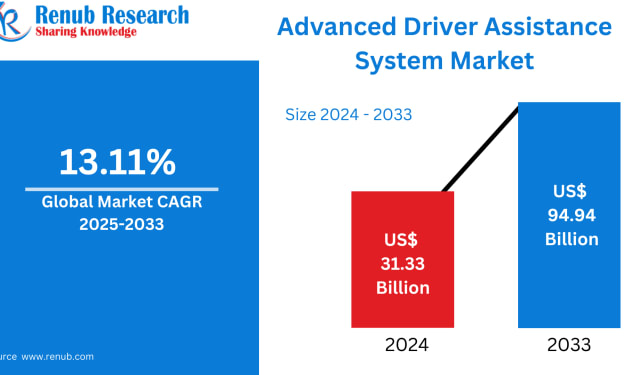
Advanced Driver Assistance System Market Size and Forecast 2025–2033
Advanced Driver Assistance System Market Advanced Driver Assistance System Industry Overview The Advanced Driver Assistance System (ADAS) industry represents one of the most transformative segments of modern automotive technology. Designed to enhance vehicle safety, minimize human error, and improve driving comfort, ADAS technologies are increasingly becoming essential rather than optional. From adaptive cruise control and lane departure warning to collision avoidance and automatic emergency braking, these systems are redefining how vehicles interact with drivers, roads, and surrounding traffic environments.
By Renub Research4 days ago in Futurism
About Binding Prometheus
I want to start actively advocating on behalf of my own work, and the most valuable part of my canon is, without a doubt, Binding Prometheus, the play I have been working on since 2019 and only finished in 2023 as part of my MA. The play itself is an amalgamation of a million different inspirations. On one end, it evokes the Ancient Greek myth-play, deriving its own title from the earliest extant work of Western drama we have, Aeschylus’s Prometheus Bound. On the other end, it borrows significantly from the sci-fi bulwarks from over the years, namely Mary Shelley’s Frankenstein and Karel Capek’s Rossum’s Universal Robots. The play could be an episode of Black Mirror, I fear. I don’t know. I’ve only ever seen one episode of Black Mirror.
By Steven Christopher McKnight16 days ago in Futurism
Top Generative AI Use Cases for UK Enterprises in 2026
Generative AI is moving decisively beyond experimentation and into the core operational fabric of UK enterprises. What began as content generation and chatbot experimentation is now evolving into mission-critical systems that influence decision-making, automation, customer engagement, compliance, and innovation velocity.
By NextGen Narratives2 days ago in Futurism


Comments
There are no comments for this story
Be the first to respond and start the conversation.