
New Frontiers in Space: How Microsatellites and CubeSats Are Revolutionizing Space Technology
Space

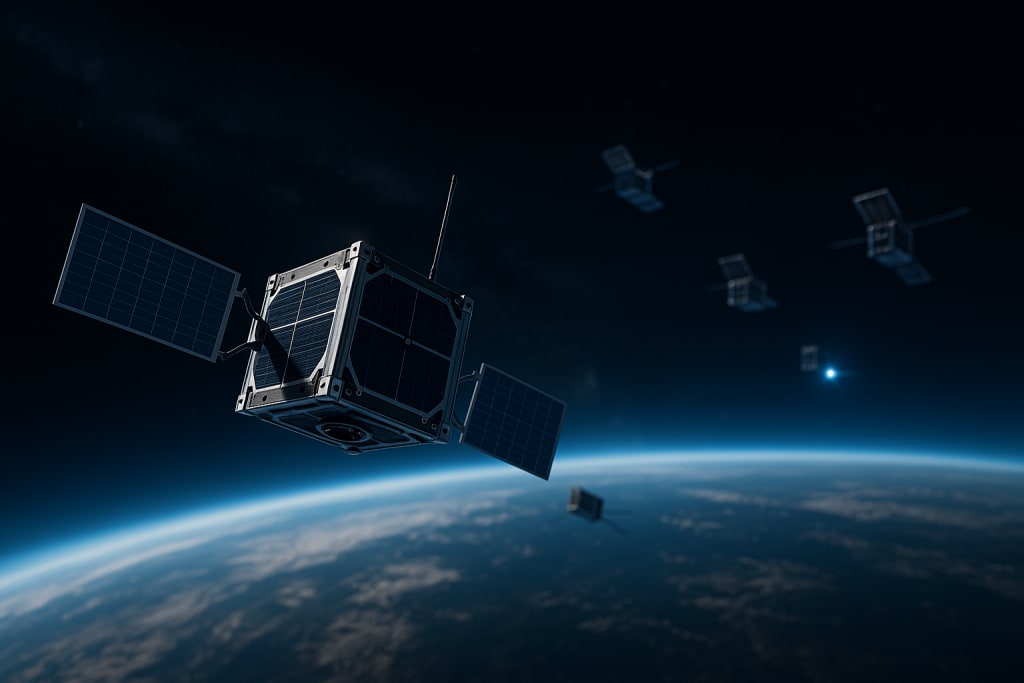
In the past, sending something into space was a privilege reserved for national space agencies and billion-dollar aerospace companies. But in the last decade, a quiet revolution has been unfolding — one driven by tiny, affordable, and surprisingly powerful satellites known as microsatellites and CubeSats. These small wonders are reshaping everything we know about space exploration, communication, and even climate research.
What Exactly Are Microsatellites and CubeSats?
Microsatellites are typically satellites weighing between 10 and 100 kilograms, while CubeSats are an even smaller class of standardized mini-satellites, built in cubic units of just 10 x 10 x 10 centimeters. A CubeSat can weigh as little as 1.3 kilograms — about the weight of a loaf of bread — yet carry instruments capable of performing serious scientific missions.
What makes CubeSats special is their modularity. They can be combined into larger units — 2U, 3U, or even 12U configurations — depending on the mission’s complexity. This flexibility, combined with low cost and accessibility, has opened the door to a new generation of space innovation.
From Costly to Compact: The New Space Economy
Traditionally, launching a satellite could cost hundreds of millions of dollars. Now, thanks to advancements in miniaturization, 3D printing, and standardized components, the cost of building and launching a CubeSat can range from $100,000 to $1 million — a fraction of what large satellites used to cost. This has made space more accessible not just to governments, but also to startups, universities, and even high school teams.
For example, Planet Labs, a U.S. company, operates the world’s largest fleet of Earth-observing microsatellites called Doves. These small spacecraft capture high-resolution images of the Earth’s surface daily, providing data for environmental monitoring, agriculture, and disaster response. This level of global observation was once impossible for small companies — now it’s routine.
Technological Breakthroughs Powering the Change
Several cutting-edge technologies have fueled this small-satellite boom:
- Miniaturized electronics: The same trend that made your smartphone powerful enough to replace a computer has enabled satellites the size of a shoebox to carry cameras, sensors, and processors that rival those on much larger spacecraft.
- Advanced propulsion systems: New electric propulsion units, such as ion thrusters or cold-gas engines, allow CubeSats to maneuver in orbit or even travel to the Moon and beyond.
- Inter-satellite networking: CubeSats can now communicate with one another, forming constellations that share data in real time — creating what’s often called a “mesh network” in space.
- AI and edge computing: Artificial intelligence enables these small satellites to process data on board, deciding what’s important to send back to Earth. This saves bandwidth and allows for faster decision-making in applications like disaster monitoring or defense.
CubeSats in Action: Real Missions Making an Impact
One striking example of CubeSat innovation is NASA’s MarCO mission — two briefcase-sized satellites, nicknamed EVE and WALL-E, that accompanied the InSight lander to Mars in 2018. These CubeSats relayed signals back to Earth during InSight’s descent, proving that even small spacecraft can perform critical functions in deep space.
Another example is Swarm Technologies, which operates a network of tiny CubeSats to provide low-cost global Internet of Things (IoT) connectivity. Their satellites allow remote sensors — in agriculture, shipping, or energy — to transmit data from anywhere on Earth, even in places with no cell coverage.
New Challenges: The Other Side of Miniaturization
Despite their success, CubeSats and microsatellites face challenges. Space debris is a growing concern; as the number of small satellites skyrockets, so does the risk of collisions in orbit. Efforts are underway to develop self-deorbiting systems, where satellites burn up safely in the atmosphere at the end of their missions.
Another issue is limited lifespan and power. Small satellites can only carry tiny solar panels and fuel reserves, which means they typically operate for one to three years. However, ongoing research into energy-efficient electronics and deployable solar arrays is helping extend their longevity.
The Future: Swarms, AI, and Beyond Earth Orbit
Looking ahead, the potential of these small satellites seems limitless. Imagine swarms of CubeSats working together to create real-time 3D maps of Earth’s atmosphere, or a fleet orbiting the Moon, providing continuous communications for future lunar bases.
Companies like Rocket Lab and SpaceX are developing dedicated small-satellite launch systems, making it even easier and cheaper to deploy constellations of CubeSats. Meanwhile, space agencies and private innovators are already planning interplanetary CubeSat missions — not just to Mars, but to asteroids and Jupiter’s moons.
In the next decade, experts predict that over 50,000 small satellites will be launched. The result will be a new, data-rich understanding of our planet — and the ability to explore deeper into the cosmos with smaller, smarter, and more sustainable technology.
Conclusion: Small Satellites, Big Revolution
Microsatellites and CubeSats represent more than a technological innovation — they symbolize a cultural shift in space exploration. Space is no longer the exclusive domain of superpowers; it’s a shared frontier, open to scientists, students, and entrepreneurs worldwide.
From monitoring wildfires and mapping coral reefs to exploring distant planets, these tiny spacecraft are proving that bigger isn’t always better. In fact, the future of space may well depend on going small — and thinking big.
About the Creator
Keep reading
More stories from Holianyk Ihor and writers in Futurism and other communities.
The End of an Era: Gaia’s Mission Comes to a Close — and Its Legacy Is Just Beginning
In early 2025, the European Space Agency’s Gaia spacecraft officially ended its operational life after more than a decade of mapping the Milky Way with breathtaking precision. It’s a bittersweet milestone for astronomers worldwide: while Gaia has stopped collecting new data, the treasure trove it leaves behind will keep fueling discoveries for decades.
By Holianyk Ihor3 months ago in Futurism
About Binding Prometheus
I want to start actively advocating on behalf of my own work, and the most valuable part of my canon is, without a doubt, Binding Prometheus, the play I have been working on since 2019 and only finished in 2023 as part of my MA. The play itself is an amalgamation of a million different inspirations. On one end, it evokes the Ancient Greek myth-play, deriving its own title from the earliest extant work of Western drama we have, Aeschylus’s Prometheus Bound. On the other end, it borrows significantly from the sci-fi bulwarks from over the years, namely Mary Shelley’s Frankenstein and Karel Capek’s Rossum’s Universal Robots. The play could be an episode of Black Mirror, I fear. I don’t know. I’ve only ever seen one episode of Black Mirror.
By Steven Christopher McKnight15 days ago in Futurism
Syngas Market: Synthetic Fuel Innovation, Energy Security & Market Momentum
According to IMARC Group's latest research publication, The global syngas market size reached 260.7 MM Nm3/h in 2024. Looking forward, IMARC Group expects the market to reach 554.8 MM Nm3/h by 2033, exhibiting a growth rate (CAGR) of 8.32% during 2025-2033.
By James Whitman7 days ago in Futurism
Center Stage with Paul Stewart
*** I'm keen to republish the interviews I did for my series with Vocal creators. It's been a few years and I thought it might be nice to revisit these wonderful conversations. I'll be releasing them one at a time for a few weeks/months.
By Heather Hublera day ago in Interview



Comments
There are no comments for this story
Be the first to respond and start the conversation.