
Neutrino Observatories in Deep Space: Eyes That See Through the Stars
Space

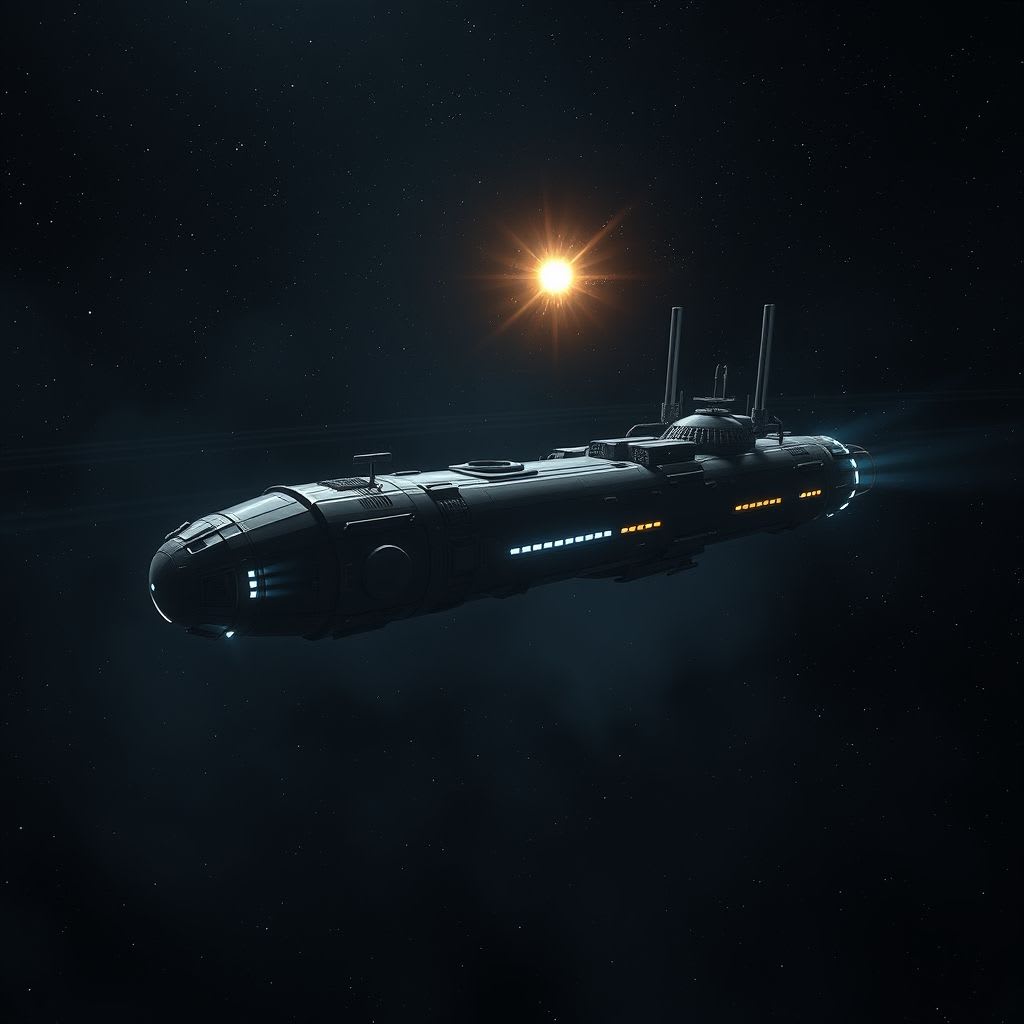
Far across the cosmos, billions of light-years away, events of unimaginable power unfold supernova explosions, neutron star collisions, and energy bursts from supermassive black holes. Most of these cosmic cataclysms remain hidden from traditional telescopes, their signals swallowed by gas, dust, and distance.
But there is one type of messenger that can carry unaltered information across the Universe: the neutrino.
These tiny, ghost-like particles barely interact with matter at all. Trillions of them stream through your body every second without leaving a trace. They pass through planets, stars, and galaxies as if they were made of smoke. And precisely because of this elusiveness, neutrinos are one of the most valuable tools for unlocking the Universe’s deepest secrets.
Why Neutrinos Are the Key to Cosmic Mysteries
Light, even in its most energetic forms like gamma rays, can be absorbed or scattered by interstellar dust and gas. Gravitational waves tell us about the violent motion of massive objects, but they don’t reveal their composition. Neutrinos, on the other hand, carry pristine information from the heart of the event that produced them whether it’s the nuclear core of a collapsing star or the particle jets of a quasar.
The problem? Detecting neutrinos is incredibly hard. They are so reluctant to interact with matter that even the enormous stream passing through Earth barely leaves a trace in our detectors. This is why scientists build vast and sensitive observatories to capture the rare moments when a neutrino collides with an atom.
Why Take the Hunt for Neutrinos into Deep Space?
Here on Earth, massive facilities like IceCube in Antarctica monitor huge volumes of ice for tiny flashes of Cherenkov light caused by neutrino collisions. While powerful, these ground-based detectors face challenges:
- Background noise from cosmic rays and the atmosphere.
- Limited viewing angles, as the planet itself blocks parts of the sky.
- Environmental interference that can mask the faintest neutrino signals.
Placing neutrino observatories in deep space could solve these problems.
Advantages include:
- Pristine signal detection – far from Earth’s background radiation.
- Full 360° field of view – no planetary “shadow” to limit observations.
- Closer proximity to cosmic events – potentially catching higher fluxes of neutrinos.
What Would a Space-Based Neutrino Observatory Look Like?
Imagine a vast structure outfitted with thousands of ultra-sensitive photodetectors, suspended in a medium such as pure ice or water. In space, this could mean using the icy oceans beneath the crust of moons like Europa or Enceladus as natural detectors.
When a neutrino finally interacts with matter, it can produce a faint burst of Cherenkov radiation a bluish light detected by the observatory’s sensors.
Other proposed designs include:
- Liquid xenon or liquid argon chambers, which are dense and increase the chance of detection.
- Inflatable light traps packed with layered sensor arrays.
- Constellations of small detectors spread across the Solar System, networked into a single “mega-observatory.”
Potential Locations in Deep Space
- Jupiter’s orbit – far from Earth’s interference, with a great vantage point for detecting neutrinos from the galactic core and beyond.
- Europa or Enceladus – their thick ice layers and subsurface oceans could double as detection mediums.
- Interplanetary space near Lagrange points – stable gravitational “parking spots” for long-term missions.
- Near-interstellar space – as part of future missions beyond the Solar System.
What Could We Learn?
With deep-space neutrino observatories, humanity could:
- Predict supernovae hours or even days before their light reaches Earth.
- Unveil the secrets of black holes and quasars, observing processes hidden from traditional telescopes.
- Trace the origin of ultra-high-energy cosmic rays, one of astrophysics’ biggest mysteries.
- Test the fundamental laws of physics under extreme conditions impossible to reproduce in laboratories.
The Race for the Invisible Light
International space agencies are already exploring these concepts. NASA, ESA, and Japan’s JAXA are considering small-scale neutrino detectors that could be deployed on deep-space missions. In the future, such observatories may link up with gravitational wave detectors and electromagnetic telescopes, forming a global, multi-messenger observation network the ultimate system for studying the Universe.
Neutrinos are like the Universe’s whisper too faint for ordinary ears, yet carrying the most ancient and unaltered truths. In the stillness of deep space, free from interference, we may finally hear that whisper clearly. And when we do, it will tell us stories of the birth and death of stars, the hunger of black holes, and perhaps even the dawn of the cosmos itself.
About the Creator
Keep reading
More stories from Holianyk Ihor and writers in Futurism and other communities.
Cosmic Relics — The Remnants of Stars and Planets
Scattered across the vast darkness of the Universe lie ancient artifacts cosmic relics that have survived the births and deaths of stars, the violent creation of planets, and catastrophic collisions between celestial giants. These silent travelers have been drifting through space for billions of years, each one carrying a fragment of the Universe’s history like a page torn from an ancient, unending book. Today, astronomers are learning to “read” those pages, unlocking secrets from the dawn of time.
By Holianyk Ihor5 months ago in Futurism
About Binding Prometheus
I want to start actively advocating on behalf of my own work, and the most valuable part of my canon is, without a doubt, Binding Prometheus, the play I have been working on since 2019 and only finished in 2023 as part of my MA. The play itself is an amalgamation of a million different inspirations. On one end, it evokes the Ancient Greek myth-play, deriving its own title from the earliest extant work of Western drama we have, Aeschylus’s Prometheus Bound. On the other end, it borrows significantly from the sci-fi bulwarks from over the years, namely Mary Shelley’s Frankenstein and Karel Capek’s Rossum’s Universal Robots. The play could be an episode of Black Mirror, I fear. I don’t know. I’ve only ever seen one episode of Black Mirror.
By Steven Christopher McKnight16 days ago in Futurism
Saudi Arabia Used Car Market: Rising Demand, Digital Platforms & Pricing Trends
According to IMARC Group's latest research publication, The Saudi Arabia used car market size was valued at USD 10.2 Billion in 2025. Looking forward, IMARC Group estimates the market to reach USD 17.4 Billion by 2034, exhibiting a CAGR of 6.11% from 2026-2034.
By Abhay Rajputa day ago in Futurism


Comments
There are no comments for this story
Be the first to respond and start the conversation.